Vashi Deemed Conveyance: A Complete Guide for Homebuyers & Housing Societies
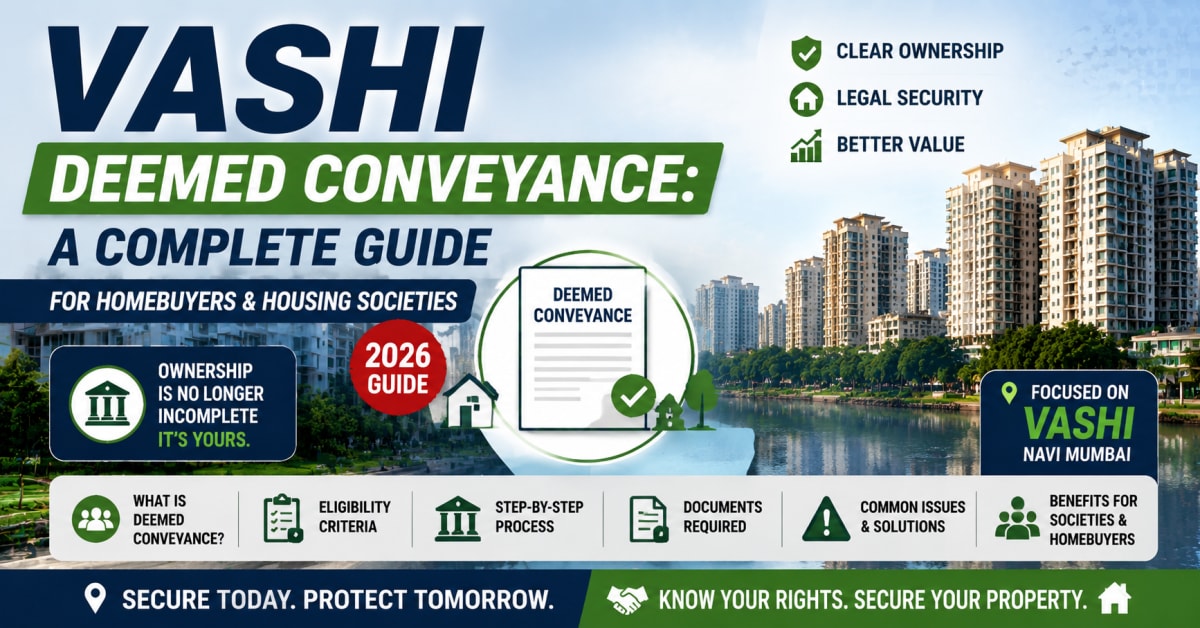
Imagine you've found the perfect resale flat in Vashi. The location is great. The price fits your budget. The society looks well maintained. Then someone asks... "Does the society have Deemed Conveyance?" If you're buying your first home, chances are you've never heard this term before. Many buyers simply ignore it because it sounds like a complicated legal process. But understanding deemed conveyance can help you make a more informed property decision—especially when buying a resale flat in one of Vashi's older housing societies. The good news? You don't need to be a lawyer to understand it. This guide explains everything in simple English, including what deemed conveyance means, why it matters, how to verify it, and what questions you should ask before buying a property in Vashi.
Quick Answer
Deemed Conveyance is a legal mechanism available under the Maharashtra Ownership Flats Act (MOFA) that allows an eligible housing society to obtain ownership rights over the land and building when the builder or promoter has not executed the conveyance deed despite being legally required to do so. For buyers, it is one of several important documents to understand when purchasing a resale flat. However, the absence of deemed conveyance does not automatically mean a property is illegal or unsafe to buy. It simply means you should verify the property's legal documents carefully and understand the society's current status before making a decision.
Why This Matters for Vashi Homebuyers

Vashi is one of the oldest and most established residential nodes in Navi Mumbai. Many housing societies here were formed decades ago. Over the years, some builders completed the conveyance process properly. Others did not. As a result, many housing societies across Maharashtra have applied for deemed conveyance to secure legal ownership of the land and building. If you're buying a resale flat in an older Vashi society, understanding whether the society has completed conveyance—or is in the process of obtaining deemed conveyance—can give you a clearer picture of its legal documentation.
What is Conveyance?
Let's start with the basics. When a builder develops a housing project, they are generally required under applicable law to transfer the ownership of the land and building to the Co-operative Housing Society or other legal body formed by the flat purchasers. This transfer is called Conveyance. Think of it as officially handing over the property to the society. Without this transfer, ownership records may not fully reflect the society's rights over the property.
What is Deemed Conveyance?
Sometimes, a builder does not execute the conveyance deed even after the society is formed. To address this, the Maharashtra Ownership Flats Act (MOFA) allows eligible societies to apply for Deemed Conveyance. In simple words, the Competent Authority can, after following the legal process, grant unilateral conveyance to the society if the promoter has failed to execute it. This process helps eligible societies secure legal ownership rights without depending on the builder's cooperation.
Why Is Deemed Conveyance Important?
For housing societies, deemed conveyance can provide clearer ownership over the land and building. It may also make future activities such as redevelopment and property management more straightforward, depending on the facts of each case. For buyers, it offers better clarity regarding the society's legal documentation. Remember, it is one important factor—not the only factor—to evaluate before buying a property.
Why Is This Relevant in Vashi?
Vashi was among the first planned residential nodes developed in Navi Mumbai. Many housing societies are now decades old. Because of this, you'll often hear terms such as:
- Conveyance
- Deemed Conveyance
- Redevelopment
- CIDCO Lease
- Society Title
These issues are more common in older societies than in newly constructed projects. However, every society is different. Never assume the legal status of one society applies to another.
Who Issues or Maintains These Records?
| Document | Authority / Holder |
| Conveyance Deed | Registered through Maharashtra IGR |
| Deemed Conveyance Order | Competent Authority under Maharashtra Co-operation framework |
| Society Registration | Co-operative Department |
| Share Certificate | Housing Society |
| Sale Deed | Maharashtra IGR |
| Property Registration | Maharashtra IGR |
| CIDCO Lease Documents (where applicable) | CIDCO |
| RERA Registration (if applicable) | MahaRERA |
How to Verify Deemed Conveyance Before Buying
You don't have to guess. Follow these steps.
Step 1: Ask the Society
Begin by asking the housing society whether:
- Conveyance has been completed.
- Deemed conveyance has been obtained.
- An application is pending.
Request documentary proof rather than relying on verbal statements.
Step 2: Verify the Seller's Documents
Check:
- Sale Deed
- Share Certificate
- Previous ownership documents
- Property tax receipts
- Maintenance records
Step 3: Understand the Land Status
Many older Vashi properties are on land originally allotted by CIDCO. Where applicable, understand whether the property is on leasehold land and ask for relevant lease-related documents.
Step 4: Review Society Records
If possible, ask for:
- Society Registration Certificate
- Conveyance documents
- Deemed Conveyance order (if available)
- Society resolutions (where relevant)
Step 5: Consult a Property Lawyer
If any document appears incomplete, unclear, or inconsistent, seek professional legal advice before signing any agreement.
Documents Buyers Should Check
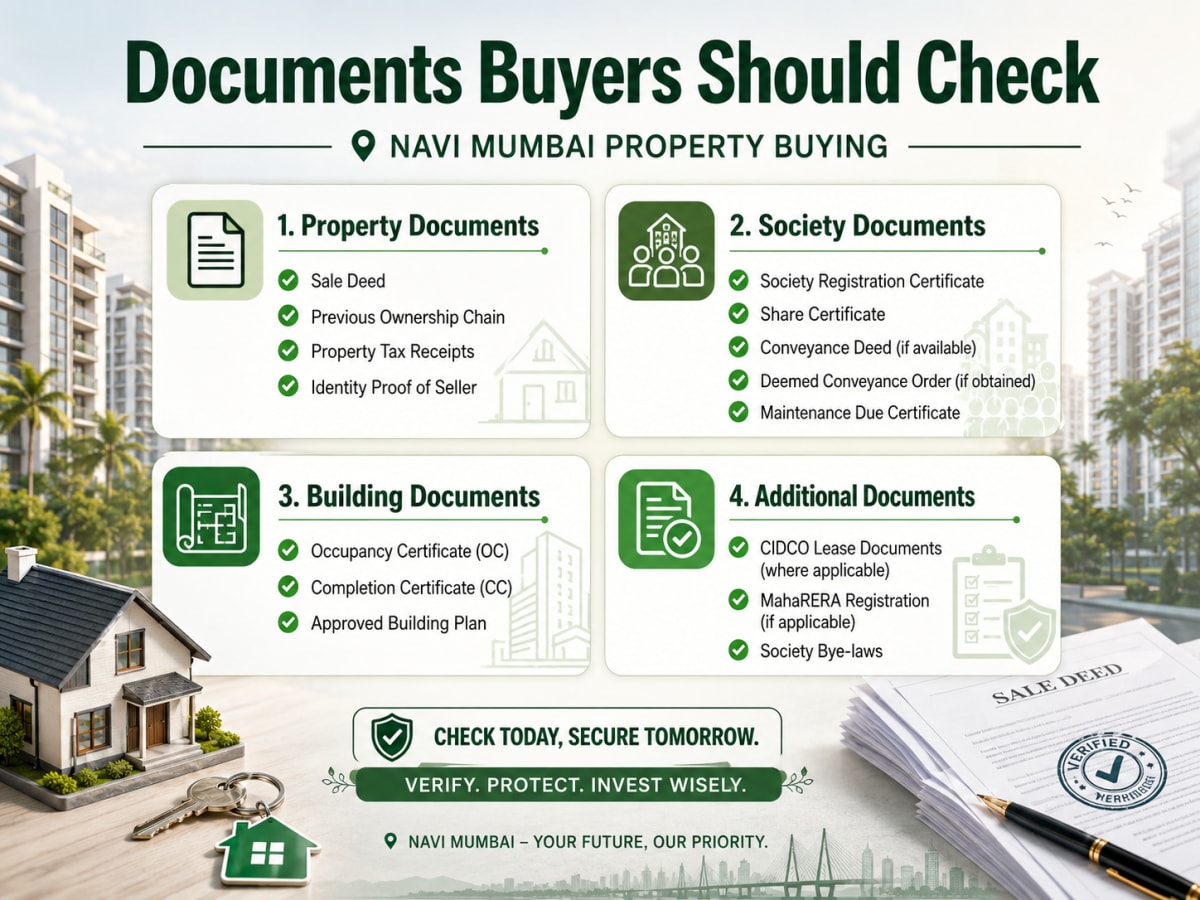
Property Documents
✔ Sale Deed ✔ Previous Ownership Chain ✔ Property Tax Receipts ✔ Identity Proof of Seller
Society Documents
✔ Society Registration Certificate ✔ Share Certificate ✔ Conveyance Deed (if available) ✔ Deemed Conveyance Order (if obtained) ✔ Maintenance Due Certificate
Building Documents
✔ Occupancy Certificate (OC) ✔ Completion Certificate (CC) ✔ Approved Building Plan
Additional Documents
✔ CIDCO Lease Documents (where applicable) ✔ MahaRERA Registration (if applicable) ✔ Society Bye-laws
New Flat vs Resale Flat
| New Flat | Resale Flat |
| Usually purchased directly from the developer | Purchased from an existing owner |
| Focus on RERA registration and construction approvals | Focus on ownership history and society records |
| Builder documentation is important | Society documentation becomes equally important |
| Conveyance may not yet be completed in some projects | Conveyance status should be understood before purchase |
Does Deemed Conveyance Affect Redevelopment?
This is a common question. In many cases, societies discuss deemed conveyance while planning redevelopment because clearer ownership documentation can help with future redevelopment processes. However, every redevelopment project has its own legal requirements. Do not assume that:
- every society with deemed conveyance will undergo redevelopment, or
- redevelopment cannot happen without deemed conveyance.
The position depends on the facts, applicable regulations, and professional advice.
Red Flags Buyers Should Watch For
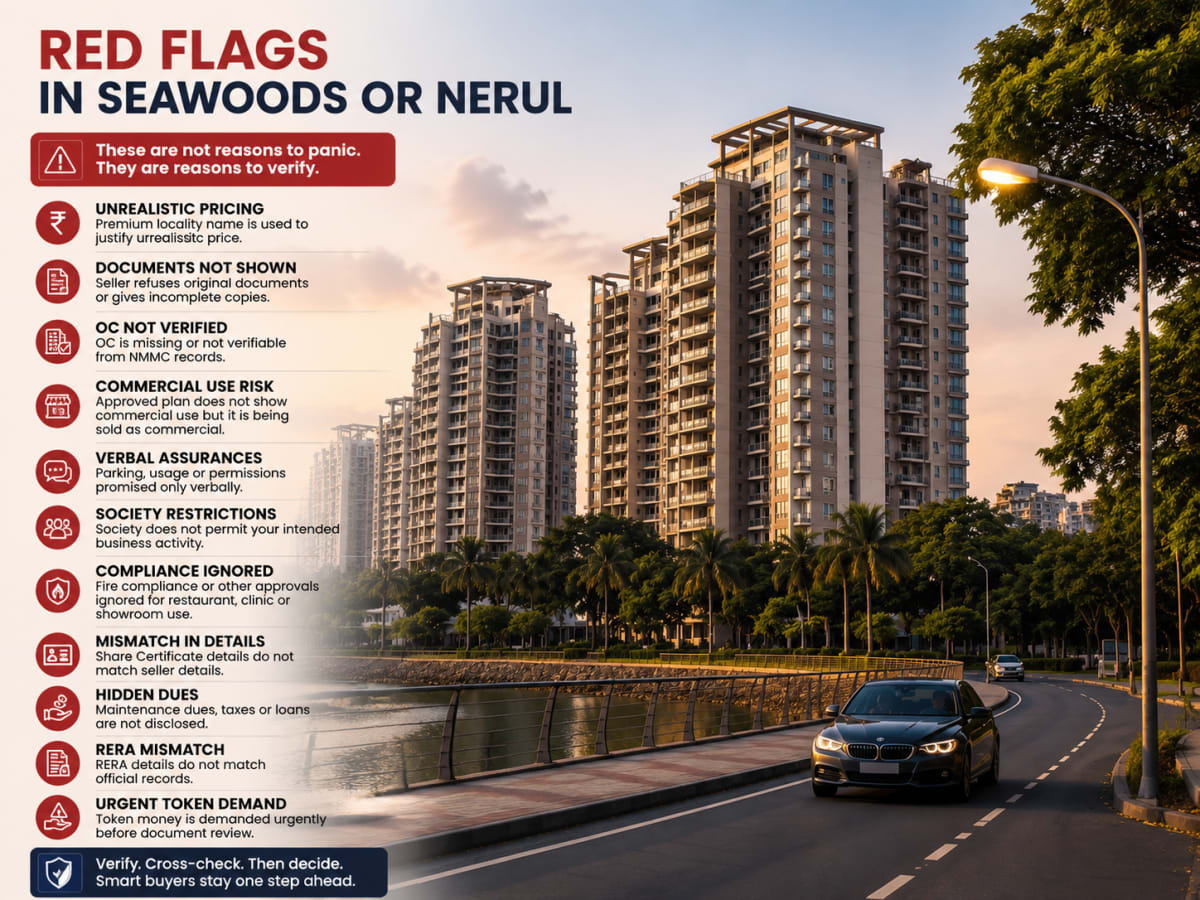
Stay cautious if someone says:
- "Conveyance isn't important."
- "Nobody checks these documents."
- "Builder documents are missing but that's normal."
- "Everything will be sorted after registration."
Instead, verify the paperwork. Other warning signs include:
- Seller cannot explain ownership.
- Society has no records.
- Missing share certificate.
- Incomplete ownership chain.
- No documentary proof of deemed conveyance despite claims.
These issues don't always mean you should walk away—but they do deserve careful investigation.
How to Choose the Right Real Estate Agent in Vashi
The right real estate agent should make the buying process easier—not riskier. Here are a few practical tips.
Choose Someone Who Knows Vashi Well
A local agent should understand:
- Older sectors
- Redevelopment-prone societies
- CIDCO leasehold properties
- Market pricing
Ask Whether They Encourage Document Verification
A trustworthy agent should never discourage you from checking documents. If someone says,
"Don't worry about paperwork." treat that as a warning sign.
Look for Transparency
A professional agent should clearly explain:
- Ownership status
- Society documentation
- Building approvals
- Any known redevelopment plans
without making unrealistic promises.
Avoid Guaranteed Investment Claims
No one can guarantee future appreciation or redevelopment. Property prices depend on multiple factors including market conditions, approvals, infrastructure, and demand.
Common Mistakes Buyers Make
Many buyers:
- Focus only on location.
- Ignore society records.
- Don't ask about conveyance.
- Skip ownership verification.
- Believe verbal assurances.
- Never check building approvals.
- Depend entirely on brokers.
These mistakes are avoidable with a little research and document verification.
Final Buyer Checklist
Before paying a booking amount, make sure you've verified: ✔ Sale Deed ✔ Share Certificate ✔ Conveyance status ✔ Property ownership ✔ Society records ✔ Occupancy Certificate ✔ Completion Certificate ✔ Approved building plans ✔ Maintenance dues ✔ Applicable RERA details ✔ CIDCO-related documents (where relevant) If any important document is unavailable, ask questions before proceeding.
Need Help Understanding Property Documents?
Buying a home is one of the biggest financial decisions you'll ever make. At Navi Mumbai Property Deals, our goal is simple: Help homebuyers make confident decisions through easy-to-understand guides, document checklists, and practical property verification tips—not confusing legal language. Explore our other buyer resources before purchasing your next property in Navi Mumbai.
Disclaimer
This article is intended for educational purposes only and should not be considered legal, financial, or investment advice. Property documentation, conveyance status, redevelopment eligibility, and ownership records vary from one society to another. Always verify information through the concerned housing society, Maharashtra Department of Co-operation, CIDCO (where applicable), Maharashtra Inspector General of Registration (IGR), MahaRERA (where applicable), or consult a qualified property lawyer before making any purchase decision.
Frequently Asked Questions
What is deemed conveyance?
Deemed conveyance is a legal process under the Maharashtra Ownership Flats Act (MOFA) that allows an eligible housing society to obtain ownership rights over the land and building if the builder has not executed the conveyance deed.
Is deemed conveyance compulsory before buying a flat?
Not necessarily. However, understanding the society's conveyance status is an important part of property due diligence, especially for resale flats in older societies.
Can I buy a resale flat if the society does not have deemed conveyance?
It may still be possible, but you should carefully verify ownership documents, society records, and seek professional legal advice if the conveyance status is unclear.
How can I check whether a society has deemed conveyance?
Ask the society office for the conveyance deed or deemed conveyance order and review the relevant registered documents. If needed, consult a property lawyer to verify the records.
Does deemed conveyance increase property value?
There is no guarantee that deemed conveyance alone will increase a property's value. Property prices depend on several factors such as location, demand, approvals, building condition, and market trends.
Is deemed conveyance required for redevelopment?
Deemed conveyance can help clarify ownership rights, which may be useful during redevelopment. However, redevelopment involves multiple legal and regulatory requirements, and each project must be evaluated on its own facts.
What should I ask a real estate agent before buying in an older Vashi society?
Ask about the society's conveyance status, ownership documents, building approvals, maintenance dues, redevelopment status (if applicable), and request supporting documents instead of relying only on verbal assurances.