Vashi Conveyance Deed Guide: What Buyers Must Check
Quick Answer
Before buying a flat in Vashi, verify two separate things:
- Whether the seller has a valid ownership chain for the individual flat.
- Whether the housing society has received the relevant rights over the land and building through a registered conveyance deed.
Do not rely only on the share certificate, Society NOC, property-tax bill, bank approval or broker’s assurance. Ask for the registered conveyance documents and get the complete property papers independently reviewed before making a major payment.
In simple words: The seller may own the flat, but the society must also have proper legal rights over the land and building. Both checks matter.
Why Conveyance Matters When Buying Property in Vashi
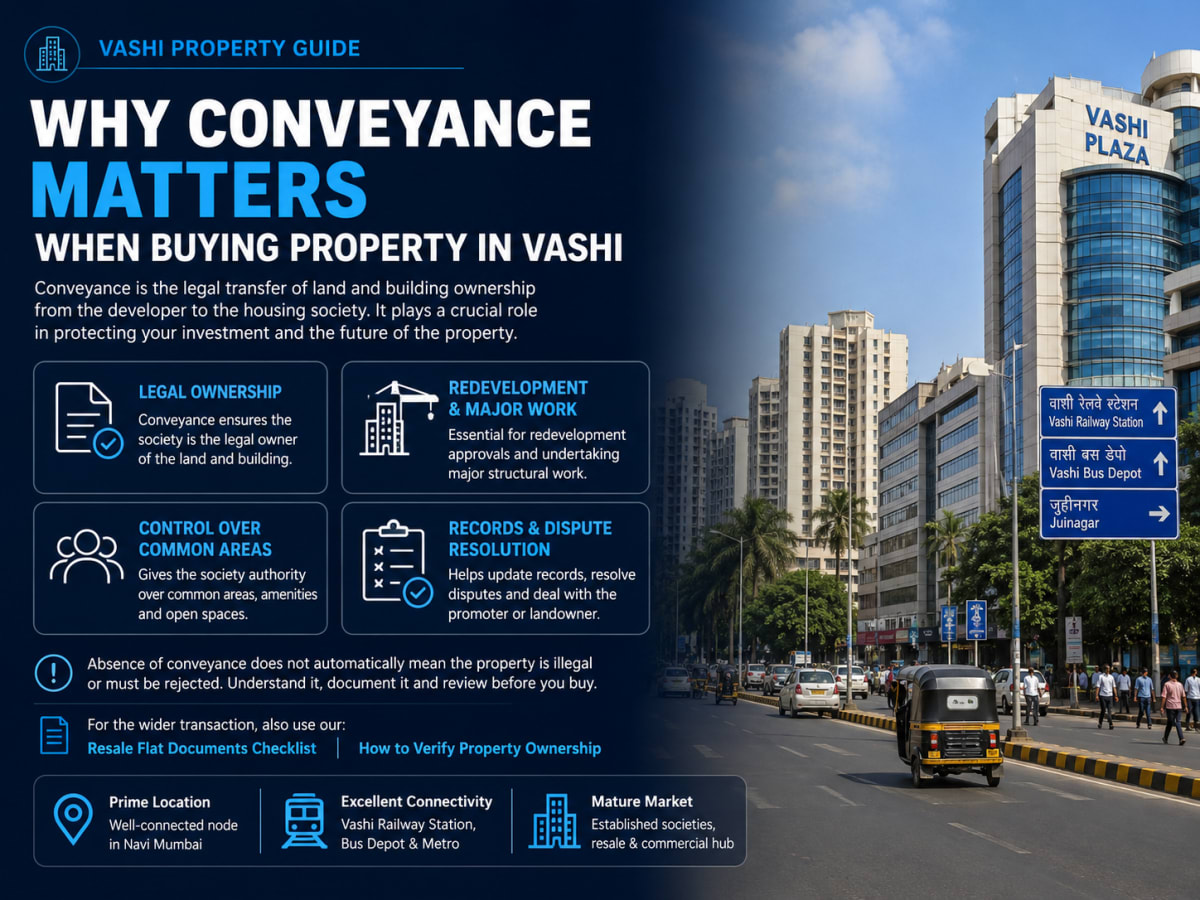
Vashi is one of Navi Mumbai’s established property markets. It has older cooperative housing societies, resale apartments, commercial development and buildings that may be considering major repairs or redevelopment. When buyers visit a resale flat, they normally check:
- The carpet area.
- Interior condition.
- Parking.
- Floor and view.
- Maintenance charges.
- Railway-station access.
- The seller’s expected price.
These checks are important. But they do not answer one society-level question: Has the land and building been properly conveyed to the housing society? A society’s conveyance position may become important when it wants to:
- Undertake redevelopment.
- Carry out major structural work.
- Establish control over common areas.
- Update land or property records.
- Deal with the original promoter or landowner.
- Understand unused development rights.
- Resolve disputes about the plot area.
The absence of conveyance does not automatically mean that every flat in the building is illegal or that the property must be rejected. It means the issue should be understood, documented and reviewed before the buyer proceeds. For the wider transaction, also use our Resale Flat Documents Checklist and How to Verify Property Ownership guides.
What Is a Conveyance Deed?
A conveyance deed is a registered document used to transfer rights or ownership in an immovable property from one party to another. In a cooperative housing society, it generally refers to the transfer of the land, building and relevant common rights from the promoter, builder, landowner or lessor to the society. This is different from the registered agreement or sale deed through which a person purchases an individual flat.
Individual flat ownership and society conveyance are different
| Document | What it generally shows |
| Registered flat agreement or sale deed | Transfer of the individual flat to the buyer |
| Society share certificate | Membership and shares held in the cooperative society |
| Society conveyance deed | Transfer of relevant land, building and common rights to the society |
| Occupancy Certificate | Permission connected with occupation of the completed building |
| Property-tax record | Municipal assessment and tax-payment record |
| Property card or land record | Government record connected with the plot or property |
| Index II | Summary of information from a registered document |
One document does not replace all the others. For example, a share certificate supports the seller’s membership in the society. It should not be treated as independent proof that the society has received title to the land. Similarly, an Occupancy Certificate does not confirm society conveyance. Read our guide on OC vs CC vs Possession Letter to understand the difference.
Sale Deed vs Conveyance Deed
A sale deed is one type of conveyance document. However, the words are often used differently in housing-society transactions.
| Sale deed or flat agreement | Society conveyance deed |
| Deals with the individual flat | Deals with the land, building and common rights |
| Usually executed between the flat seller and buyer | Usually executed in favour of the society or association |
| Forms part of the seller’s ownership chain | Forms part of the society’s title and land records |
| Must be checked for every resale transaction | Must be checked at the society or project level |
A buyer should therefore verify both the flat documents and the society-level documents.
Regular Conveyance and Deemed Conveyance
A Vashi society may have obtained either regular conveyance or deemed conveyance.
| Type | Simple meaning |
| Regular conveyance | The promoter or landowner voluntarily executes the conveyance in favour of the society |
| Deemed conveyance | The society uses a statutory process because the promoter or landowner has not voluntarily completed the conveyance |
The Maharashtra Department of Co-operation regulates and guides cooperative housing societies. Its official portal publishes laws, rules, circulars and access to an online deemed-conveyance management system.[1]
What does deemed conveyance mean?
Deemed conveyance is a legal remedy available to an eligible society when the promoter or landowner has not voluntarily transferred the required rights. The competent authority reviews the society’s application, supporting documents and objections before deciding the matter. The buyer should not assume that every society using the words “deemed conveyance” has completed the same stage. The society may have:
- Started collecting documents.
- Submitted an application.
- Received a hearing notice.
- Received an order from the competent authority.
- Registered the final conveyance instrument.
- Applied for or completed the related property-record update.
These are different stages.
Order received does not always mean every step is complete
Ask the society:
- Has the competent authority issued the order?
- Has the final conveyance deed been registered?
- Is an Index II available?
- Has the society applied for the corresponding land-record update?
- Are any objections or proceedings still pending?
Request actual documents instead of accepting a verbal statement from the seller, broker or committee member.
What Does RERA Say About Conveyance?
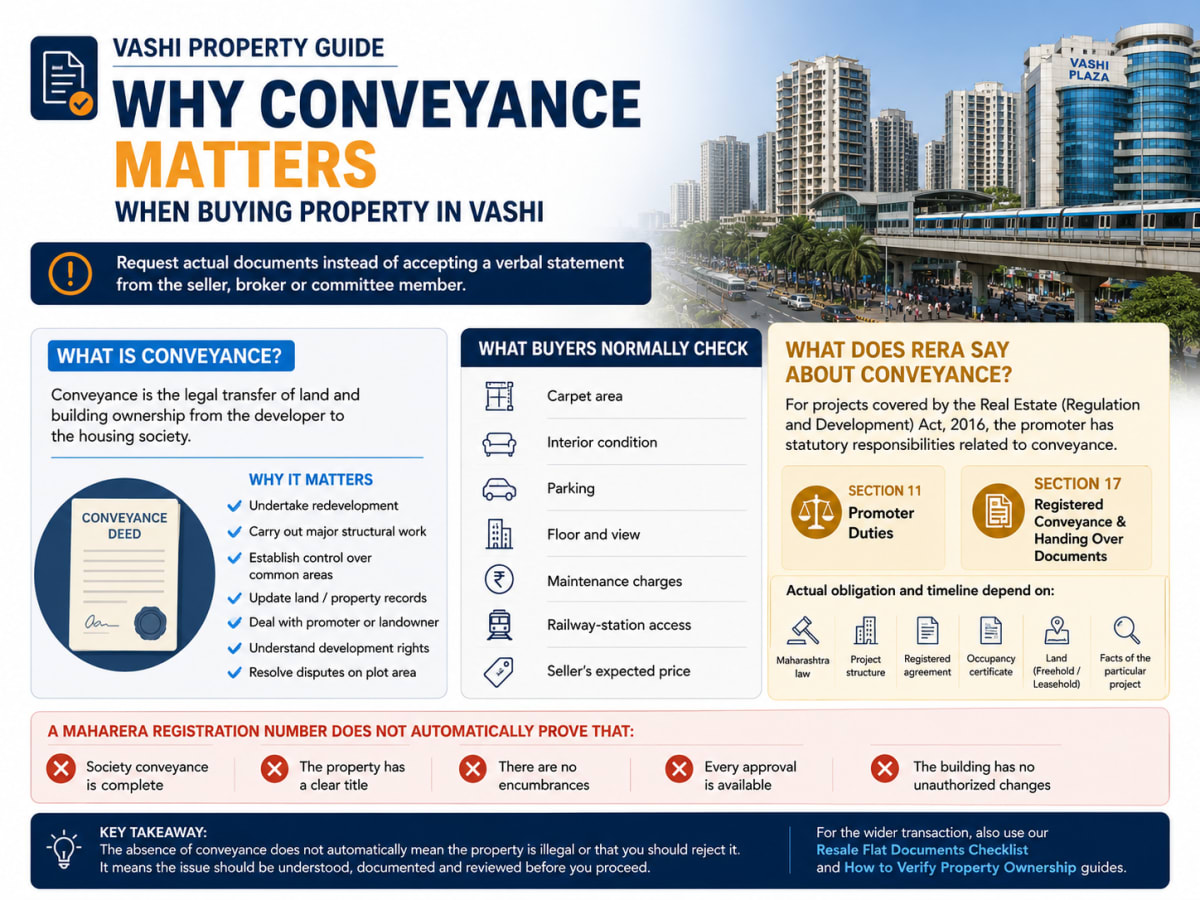
For projects covered by the Real Estate (Regulation and Development) Act, 2016, the promoter has statutory responsibilities connected with the execution of the registered conveyance deed and handing over relevant documents. Section 11 of the Act covers promoter duties. Section 17 deals with the execution of a registered conveyance and the handing over of necessary documents and plans.[2] The precise obligation and timeline may depend on:
- The applicable Maharashtra law.
- The project structure.
- The registered agreement.
- The Occupancy Certificate.
- Whether the land is freehold or leasehold.
- The facts of the particular project.
A MahaRERA registration number does not automatically prove that:
- Society conveyance is complete.
- The property has a clear title.
- There are no encumbrances.
- Every approval is available.
- The building has no unauthorized changes.
For an applicable project, conduct a MahaRERA Project Search and compare the portal disclosures with the documents given by the seller and society.
The CIDCO Angle in Vashi
Some Vashi properties may have CIDCO-linked allotment, lease or transfer records. However, buyers should not assume that every Vashi property has the same land tenure or transfer conditions. The first step is to read the actual registered documents. The property may be:
- Freehold.
- Leasehold.
- CIDCO-allotted.
- Held under an agreement to lease.
- Assigned under specific transfer conditions.
- Subject to another lessor or landowner arrangement.
CIDCO’s official portal provides online CFC services, permissions, payments, development-related services and current notices, including transfer-charge information.[3]
If CIDCO appears in the property documents, check:
- Original allotment letter.
- Agreement to lease.
- Registered lease deed.
- Name of the original lessee.
- Lease period.
- Permitted use of the plot.
- Transfer or assignment conditions.
- Earlier CIDCO transfer permissions.
- Ground rent or service-charge dues.
- Transfer charges or premium, where applicable.
- Mortgage permission, where applicable.
- Name appearing in CIDCO estate records.
- Whether the rights claimed by the society were actually transferable under the lease.
Do not accept statements such as:
- “CIDCO permission is never required.”
- “Every Vashi society follows the same rule.”
- “The land is now automatically freehold.”
- “There are no dues because the society is old.”
The applicable position must be checked from the specific plot’s documents and current authority records. Where CIDCO appears in the title chain, also read our CIDCO Transfer Process guide.
Who Issues and Registers a Conveyance Deed?
A regular conveyance is generally executed by the person or entity transferring the rights, such as the promoter, landowner or lessor, in favour of the housing society or association. The conveyance instrument is then registered with the relevant Sub-Registrar under Maharashtra’s registration system. In a deemed-conveyance matter, the competent authority under the applicable Maharashtra framework examines the application and supporting documents. After the required order or certificate is issued, the society must follow the applicable registration and record-update process.
Where buyers should verify the documents
| What needs to be checked | Where to verify |
| Registered conveyance deed | IGR Maharashtra or the jurisdictional Sub-Registrar |
| Index II and registration particulars | Registration records or Sub-Registrar |
| Society status and deemed-conveyance process | Maharashtra Department of Co-operation |
| MahaRERA project documents | MahaRERA portal |
| CIDCO lease and transfer matters | CIDCO records and services |
| Sanctioned plan and municipal records | Relevant authority, including NMMC where applicable |
| Property card or land record | Applicable land-record or City Survey office |
| Society membership and dues | Housing society records |
Online records are useful starting points. They should be cross-checked with the complete registered documents.
Step-by-Step Vashi Conveyance Verification Process
Step 1: Verify the seller’s flat ownership separately
Start by checking whether the seller has the right to sell the individual flat. Ask for:
- Registered agreement for sale or sale deed.
- Previous ownership-chain documents.
- Index II copies.
- Share certificate.
- Society membership record.
- Loan and mortgage details.
- Inheritance or succession documents, where applicable.
- Power of attorney, where applicable.
Do not begin with the conveyance deed and forget the individual flat’s ownership chain.
Step 2: Ask the society for written conveyance status
Request a written response confirming whether the society has:
- Registered regular conveyance.
- Registered deemed conveyance.
- Only a deemed-conveyance order.
- A pending application.
- No conveyance.
- A dispute with the promoter, landowner or lessor.
The society’s answer should be supported by documents.
Step 3: Obtain the complete registered conveyance document
Ask for:
- Conveyance deed or deemed-conveyance deed.
- Registration number.
- Registration date.
- Index II.
- Full property schedules.
- Plot description.
- Building and wing details.
- Annexures and plans attached to the instrument.
- Competent-authority order, where applicable.
A society resolution or one-page document summary is not a substitute for the registered deed.
Step 4: Check the names of the parties
Verify who appears as:
- Promoter or builder.
- Original landowner.
- Lessor.
- CIDCO, where applicable.
- Transferee society.
- Authorized society representative.
The names should be compared with the title chain, lease documents, society registration and other records.
Step 5: Match the plot and building details
Compare the conveyance deed with the property card, lease papers, sanctioned plan and society records.
| Detail | What to compare |
| Plot number | Lease deed, allotment letter and sanctioned layout |
| Sector and node | Title documents and society records |
| Plot area | Conveyance deed, property card and approved plan |
| CTS or survey number | Property card and registered documents |
| Building and wings | Sanctioned plan, OC and deed schedule |
| Boundaries | Conveyance deed and land records |
| Common areas | Agreement, approved layout and conveyance schedule |
A difference may have a genuine explanation, such as an old numbering system, subdivision or record update. It should still be resolved before purchase.
Step 6: Verify registration details
Use the registration details to confirm:
- Document number.
- Year of registration.
- Names of parties.
- Property description.
- Registration office.
- Index II.
- Certified copy, where necessary.
Older documents may not always be fully available online. A certified copy may need to be obtained from the relevant Sub-Registrar.
Step 7: Check the property card or land record
Compare the conveyance deed with the latest available:
- Property card.
- Mutation entry.
- City Survey record.
- CIDCO estate record, where applicable.
- Other relevant land record.
A property card is an important supporting record. It should not be treated as the only proof of clear and marketable title. If the record still shows the promoter or original owner, ask:
- Whether a mutation application is pending.
- Whether the conveyance registration was completed.
- Whether there is an objection.
- Whether the record relates to a leasehold arrangement.
- Whether any follow-up procedure remains incomplete.
Step 8: Verify the sanctioned plan and OC separately
Conveyance does not confirm that every part of the physical building is approved. Check:
- Sanctioned building plan.
- Commencement Certificate.
- Occupancy Certificate.
- Completion documents, where applicable.
- Approved number of floors.
- Approved wings.
- Flat layout.
- Enclosed balconies.
- Terraces.
- Merged flats.
- Additional rooms or lofts.
Use our Building Plan Approval guide before accepting a major difference between the approved plan and the actual flat.
Step 9: Review the society’s repair and redevelopment position
Older societies in Vashi may have undertaken major repairs or may be discussing redevelopment. Ask for:
- Structural-audit report.
- Major repair history.
- NMMC notices, if any.
- Society resolutions.
- Redevelopment feasibility report.
- Developer-selection documents.
- Development agreement.
- Power of attorney.
- Member-consent records.
- Pending litigation.
Do not buy only because someone says the building will soon be redeveloped. Redevelopment should be evaluated from documents, not verbal promises.
Step 10: Obtain an independent title review
An independent property lawyer should examine:
- The seller’s ownership of the flat.
- The society’s conveyance and land rights.
- CIDCO or leasehold restrictions, where applicable.
- Mortgages and encumbrances.
- Litigation.
- Building approvals.
- Redevelopment agreements.
- Any mismatch between records.
A housing-loan approval can be a useful input, but it is not a guarantee that every legal, physical or society-level issue has been checked for your transaction.
Documents Checklist for a Vashi Resale Flat
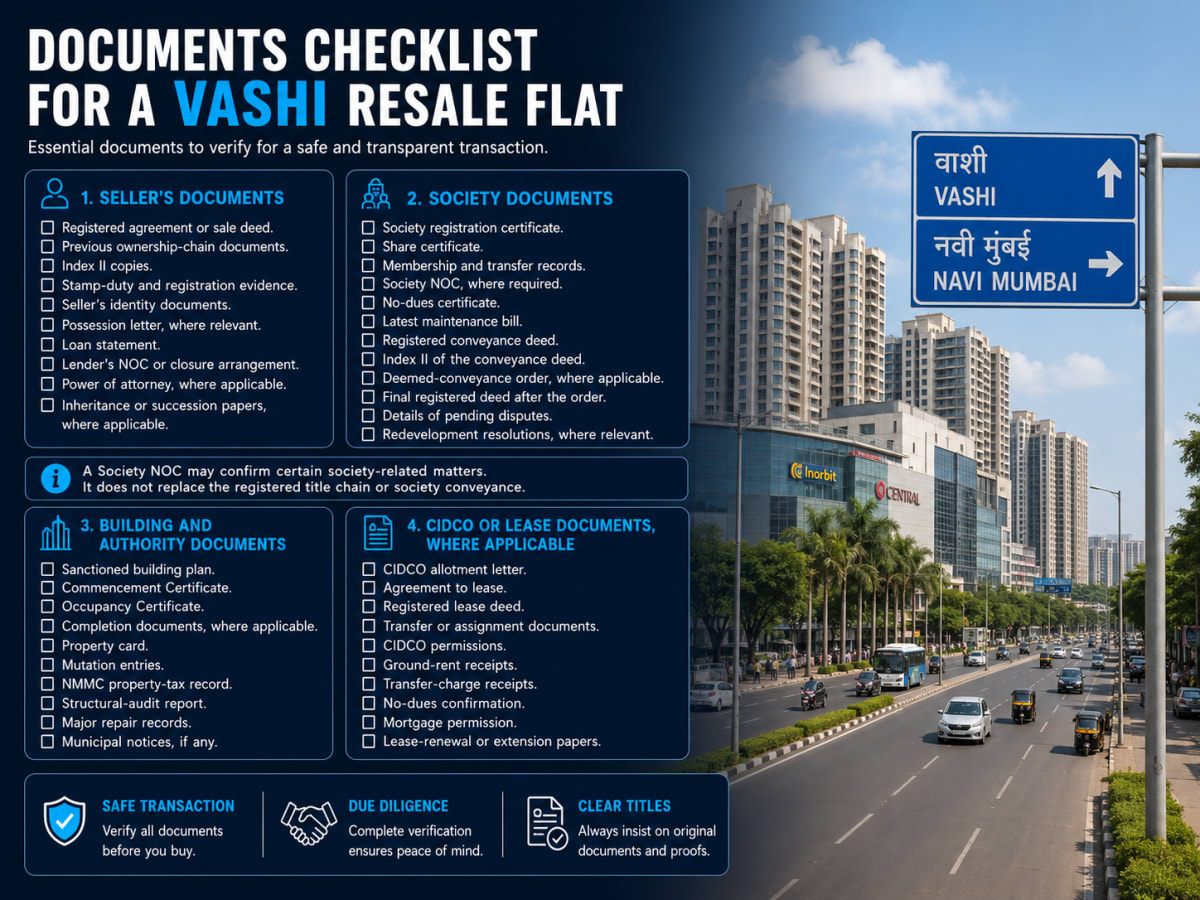
Seller’s documents
- [ ] Registered agreement or sale deed.
- [ ] Previous ownership-chain documents.
- [ ] Index II copies.
- [ ] Stamp-duty and registration evidence.
- [ ] Seller’s identity documents.
- [ ] Possession letter, where relevant.
- [ ] Loan statement.
- [ ] Lender’s NOC or closure arrangement.
- [ ] Power of attorney, where applicable.
- [ ] Inheritance or succession papers, where applicable.
Society documents
- [ ] Society registration certificate.
- [ ] Share certificate.
- [ ] Membership and transfer records.
- [ ] Society NOC, where required.
- [ ] No-dues certificate.
- [ ] Latest maintenance bill.
- [ ] Registered conveyance deed.
- [ ] Index II of the conveyance deed.
- [ ] Deemed-conveyance order, where applicable.
- [ ] Final registered deed after the order.
- [ ] Details of pending disputes.
- [ ] Redevelopment resolutions, where relevant.
A Society NOC may confirm certain society-related matters. It does not replace the registered title chain or society conveyance.
Building and authority documents
- [ ] Sanctioned building plan.
- [ ] Commencement Certificate.
- [ ] Occupancy Certificate.
- [ ] Completion documents, where applicable.
- [ ] Property card.
- [ ] Mutation entries.
- [ ] NMMC property-tax record.
- [ ] Structural-audit report.
- [ ] Major repair records.
- [ ] Municipal notices, if any.
CIDCO or lease documents, where applicable
- [ ] CIDCO allotment letter.
- [ ] Agreement to lease.
- [ ] Registered lease deed.
- [ ] Transfer or assignment documents.
- [ ] CIDCO permissions.
- [ ] Ground-rent receipts.
- [ ] Transfer-charge receipts.
- [ ] No-dues confirmation.
- [ ] Mortgage permission.
- [ ] Lease-renewal or extension papers.
New Flat vs Resale Flat: What Changes?
| Check | New or under-construction flat | Vashi resale flat |
| Main party being checked | Promoter and project | Seller, society and original project records |
| Ownership chain | Usually begins with allotment and agreement | May include several previous owners |
| RERA check | Important where registration applies | Useful where the project has MahaRERA records |
| Society conveyance | May be completed at a later statutory stage | Existing position should be checked now |
| Share certificate | May be issued after society formation | Seller should have valid membership records |
| OC status | May still be pending | Should be checked for the occupied building |
| CIDCO documents | Promoter’s land and lease papers | Original lease plus later transfers and society records |
| Physical risk | Construction progress and quality | Age, repairs, alterations and structural condition |
| Redevelopment | Usually not relevant immediately | May be an active or future consideration |
For a resale purchase, the conveyance deed is only one part of the due diligence. Use our complete Resale Flat Documents Checklist before proceeding.
Practical Red Flags
Pause and investigate if:
- The society refuses to share the conveyance deed.
- Only an application receipt is shown.
- The society has an order but no registered deed.
- Registration details cannot be verified.
- The plot area differs across important documents.
- CIDCO appears in the title papers but the lease deed is unavailable.
- Lease dues or transfer charges are unclear.
- The seller’s name does not match the registered agreement.
- A link in the ownership chain is missing.
- The building’s OC status is unclear.
- The physical flat has major unapproved changes.
- Redevelopment benefits are promised only verbally.
- The seller demands a large token before sharing documents.
- The price is unusually low without a documented reason.
These points do not automatically make the property unsuitable. They are signals that the buyer needs more information before proceeding.
Common Mistakes Vashi Buyers Make
1. Checking only the individual flat agreement
The seller’s agreement does not confirm whether the society has received the land and building rights.
2. Treating the share certificate as complete ownership proof
The share certificate is important, but it should be checked with the registered agreement, title chain and society records.
3. Confusing OC with conveyance
An OC relates to occupation and building compliance. Conveyance relates to property rights.
4. Assuming every Vashi property follows the same CIDCO process
The applicable conditions depend on the individual plot’s lease, allotment and transfer documents.
5. Accepting “deemed conveyance is done” without documents
Ask whether the society has only received an order or has also registered the final instrument.
6. Ignoring building condition
A society may have proper papers but still require major structural repairs. Legal and physical due diligence should be conducted together.
7. Paying token money before document review
Once a dispute begins over the refund, the buyer’s options may become more complicated. Put the token conditions in writing.
Who Should Buy Property in Vashi?
Vashi can suit buyers who want an established Navi Mumbai location rather than an early-stage developing area.
Vashi may suit:
- Families looking for an established residential environment.
- Professionals working in Vashi, Turbhe, Sanpada, Airoli or nearby commercial areas.
- Buyers who depend on rail and road connectivity.
- Buyers seeking an active resale market.
- Investors looking at established rental demand.
- Buyers comfortable conducting detailed society and building checks.
Vashi may not suit:
- Buyers whose only priority is the lowest entry price.
- Buyers looking only for new township-style developments.
- Buyers who do not want to deal with older society documents.
- Investors expecting guaranteed short-term appreciation.
- Buyers selecting a property only on the basis of interiors.
- Buyers unwilling to investigate structural repairs or redevelopment status.
The right choice depends on the specific society, sector, building condition, title documents, purchase price and your own requirements. Do not treat every Vashi property as equal.
What to Check Before Paying Token Money
Before paying token money for a Vashi flat, confirm:
- [ ] Seller identity matches the registered documents.
- [ ] Complete ownership chain is available.
- [ ] Share certificate and membership are verified.
- [ ] Society conveyance status is confirmed.
- [ ] Registered conveyance deed and Index II are available.
- [ ] CIDCO or lease documents are reviewed, where applicable.
- [ ] OC and sanctioned plan are checked.
- [ ] Physical alterations are compared with the approved plan.
- [ ] Society and authority dues are disclosed.
- [ ] Existing loan or mortgage is disclosed.
- [ ] Litigation and redevelopment status are checked.
- [ ] Structural-audit and repair history are reviewed.
- [ ] Token amount and refund terms are written.
- [ ] Payment is subject to satisfactory document verification.
Do not pay token money only because the flat looks attractive or the seller is offering a limited-time price.
Final Buyer Decision Table
| Question | What the buyer should do |
| Does the seller own the flat? | Verify the registered ownership chain |
| Does the society have conveyance? | Obtain the registered deed and Index II |
| Does the society have only an order? | Check final registration and record-update status |
| Is CIDCO mentioned? | Review the allotment, lease, transfer conditions and dues |
| Does the building have an OC? | Verify the OC for the correct building and wing |
| Has the flat been altered? | Compare it with the sanctioned plan |
| Is redevelopment proposed? | Review resolutions, agreements and society rights |
| Is there an existing loan? | Obtain a documented loan-release process |
| Are records inconsistent? | Pause payment and obtain clarification |
| Is the token refundable? | Record verification and refund terms in writing |
Need Help Shortlisting Property in Vashi?
Navi Mumbai Property Deals helps homebuyers identify and shortlist property options with a buyer-first approach. Before proceeding with a Vashi flat, collect the seller, society, approval and CIDCO-related documents. Use them as the starting point for property verification in Navi Mumbai and obtain an independent professional review where required. A good property decision should be based on the flat, building, society and documents together, not only on the site visit.
Disclaimer
This article is for general educational purposes and is not legal advice. Property title, conveyance, CIDCO lease conditions, authority records and society documents can differ from one transaction to another. Verify the latest position with the Maharashtra Department of Co-operation, CIDCO, MahaRERA, IGR Maharashtra, NMMC, the relevant Sub-Registrar and an independent property lawyer before making a transaction.
Frequently Asked Questions
What is a conveyance deed in a Vashi housing society?
It is a registered document through which relevant rights in the land, building and common areas are transferred from the promoter, landowner or other transferor to the society. The exact rights depend on the property’s title and lease documents.
Is a flat sale deed the same as a society conveyance deed?
No. The flat sale deed or registered agreement relates to the individual flat. The society conveyance deed relates to the land, building and common rights transferred to the society.
Can I buy a Vashi flat if the society has no conveyance?
It may still be possible, but the reason, current legal position and practical effect should be investigated. Ask whether a deemed-conveyance application is pending and get the documents independently reviewed before paying a major amount.
What is deemed conveyance in Maharashtra?
Deemed conveyance is a statutory process available to an eligible society when the promoter or landowner does not voluntarily complete the required conveyance.
Is a deemed-conveyance order enough?
Do not assume that the order completes every later step. Check whether the final instrument has been registered and whether any related property-record update remains pending.
How can I check if a conveyance deed is registered?
Ask for the registration number, registration year, Index II and complete deed. Cross-check the details through IGR Maharashtra or the jurisdictional Sub-Registrar.
Does a society share certificate prove ownership?
It supports membership and shareholding in the society. It should be checked with the registered flat agreement, ownership chain and other title documents.
Does an Occupancy Certificate mean conveyance is complete?
No. An OC and a conveyance deed serve different purposes. The OC relates to occupation of the building, while conveyance concerns the transfer of property rights.
What should I check in a CIDCO-linked Vashi property?
Check the allotment letter, lease deed, lease term, permitted use, transfer conditions, previous permissions, applicable dues and the name appearing in CIDCO’s records.
Does MahaRERA registration confirm that the title is clear?
No. MahaRERA provides important project disclosures, but buyers should still independently check title, encumbrances, approvals, conveyance and physical construction.
Does bank-loan approval guarantee a clear property title?
No. Bank approval is useful but should not replace the buyer’s independent review of the specific flat, society and land documents.
Can missing conveyance affect redevelopment?
It may create questions about the society’s rights over the land, common areas or development potential. The actual effect depends on the documents and circumstances of the society.
Who should buy property in Vashi?
Vashi may suit families, professionals, resale buyers and investors looking for an established Navi Mumbai location. The decision should be based on the specific building, society, documents, condition and purchase price.
What is the biggest mistake a Vashi resale buyer can make?
A common mistake is paying a large token after checking only the interiors and seller’s agreement, without examining society conveyance, CIDCO or lease papers, OC, sanctioned plans, dues and structural condition.