Vashi Commercial Influence on the Residential Market: Rates, Rents and Buyer Guide**
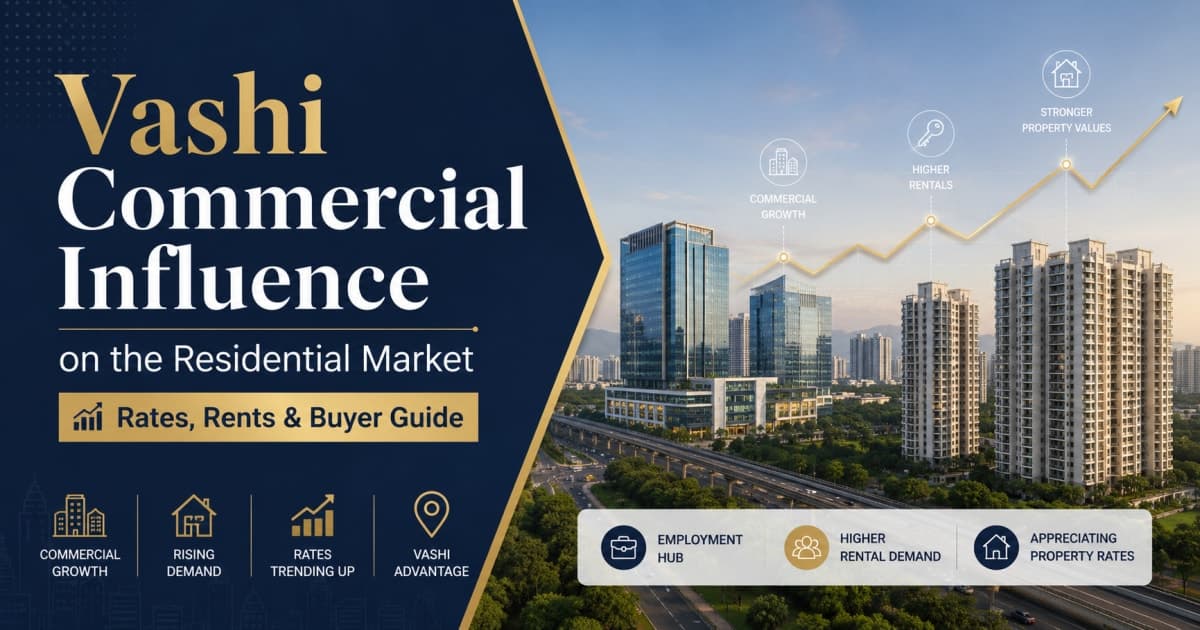
Vashi’s established offices, shops, business parks, railway connectivity and wholesale-market ecosystem can support residential rental demand and resale liquidity. However, commercial activity does not automatically make every nearby flat more valuable. The final impact depends on the exact sector, building condition, parking, traffic, noise, approved property use and distance from the busiest commercial pockets. Buyers should compare similar properties and verify the building documents before paying token money.
 Why Vashi’s Commercial Market Matters to Homebuyers
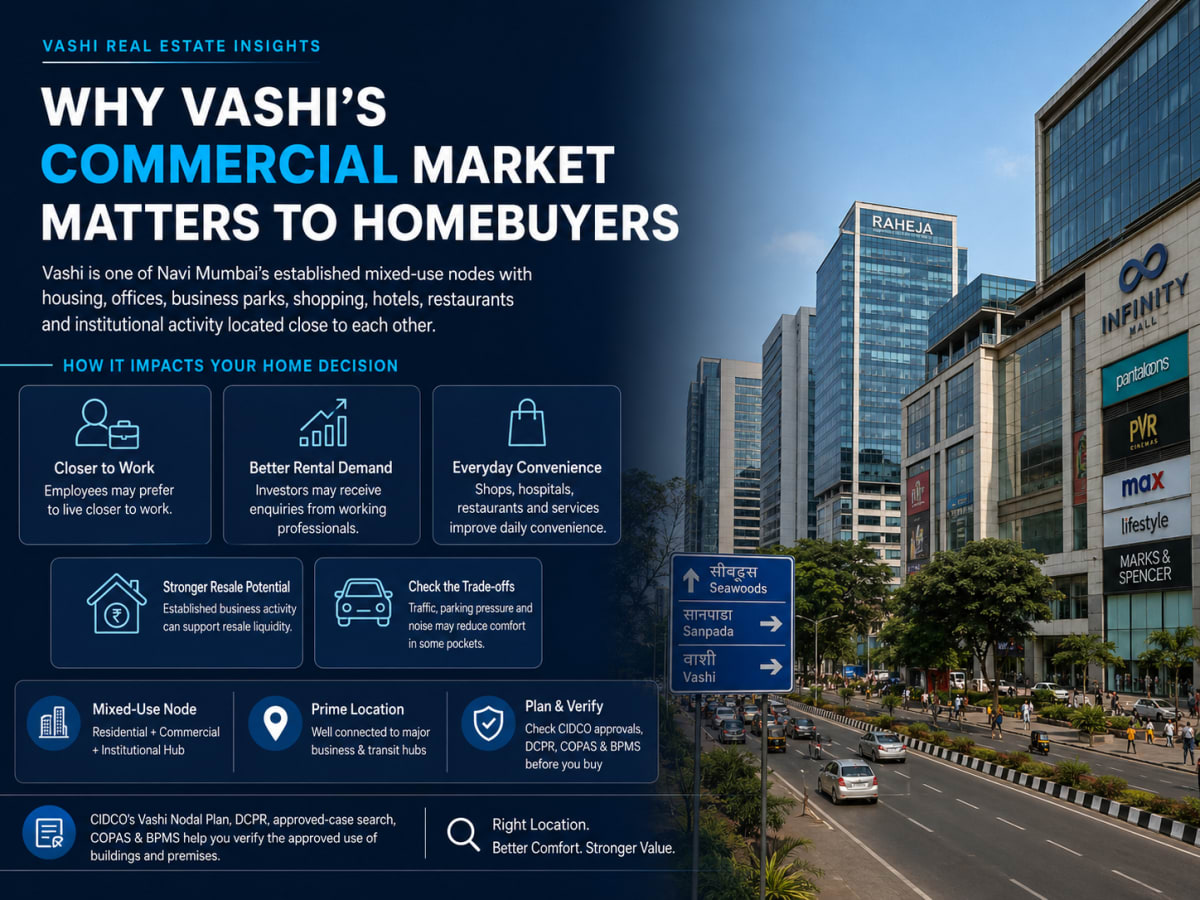
Vashi is not only a residential locality. It is one of Navi Mumbai’s established mixed-use nodes, with housing societies, offices, business parks, shopping areas, hotels, restaurants and institutional activity located close to each other. CIDCO’s official planning portal separately lists the Vashi nodal plan. Its building-permission section also provides access to development-control rules, approved-case searches and online systems such as COPAS and BPMS. These records are important when checking the approved use of a building or premises. This commercial base can influence the residential market in five ways:
- Employees may prefer to live closer to work.
- Investors may receive enquiries from working professionals.
- Shops, hospitals, restaurants and services improve convenience.
- Established business activity can support resale liquidity.
- Traffic, parking pressure and noise may reduce residential comfort in some pockets.
That is why the question is not simply, “Is commercial growth good for Vashi property?” The better question is: Does this particular commercial location improve the value and usability of this particular residential property?
How Commercial Activity Influences Residential Demand
1. It creates employment-linked housing demand
An office cluster brings employees, consultants, business owners and service providers into the area. Some of these people prefer to rent or buy homes closer to work. This can support demand for:
- Compact 1-BHK and 2-BHK flats
- Furnished rental homes
- Homes with easy railway access
- Flats with reliable parking
- Well-maintained buildings near office areas
However, employees working in Vashi may also live in Sanpada, Nerul, Kopar Khairane, Ghansoli or other nearby areas. Commercial demand therefore benefits the wider catchment, not only the building next to the office.
2. It improves everyday convenience
Commercial development can give residents easier access to:
- Grocery and daily-needs shops
- Banks and professional services
- Restaurants and cafés
- Healthcare facilities
- Shopping centres
- Public transport
- Business and employment opportunities
This convenience can make Vashi attractive to buyers who want an established locality rather than a developing area where services may still be limited.
3. It may improve rental liquidity
Rental liquidity means how easily a property can find a suitable tenant. A flat near employment, public transport and daily services may receive more rental enquiries. But higher enquiry does not always mean higher net return. The owner must still consider:
- Society restrictions
- Vacancy between tenants
- Brokerage
- Repairs and furnishing
- Property tax
- Monthly maintenance
- Tenant profile
- Condition and age of the building
4. It can create traffic and parking pressure
The same commercial activity that improves convenience can create problems for residents. A flat located near a busy office, shopping or wholesale-market area may experience:
- Peak-hour congestion
- Visitor parking pressure
- Delivery and loading activity
- Noise during business hours
- Crowded internal roads
- Commercial vehicles near residential access
- Reduced privacy on lower floors
Visit the property on a weekday morning, weekday evening and weekend before making a decision. A peaceful Sunday visit may not show the actual working-day conditions.
5. It can support redevelopment interest, but not guarantee it
Commercially valuable locations may attract redevelopment interest, especially where older societies occupy well-located plots. However, redevelopment is not automatic. It depends on factors such as:
- Society title and conveyance
- Plot conditions
- CIDCO lease or allotment terms, where applicable
- Member consent
- Development potential
- Existing occupants
- Planning permissions
- Financial feasibility
- Developer capability
- Pending disputes
Never pay a premium only because someone says, “This society will definitely go for redevelopment.” Ask for written society records and verify the proposal separately.
Vashi Commercial Rates and Rents Explained
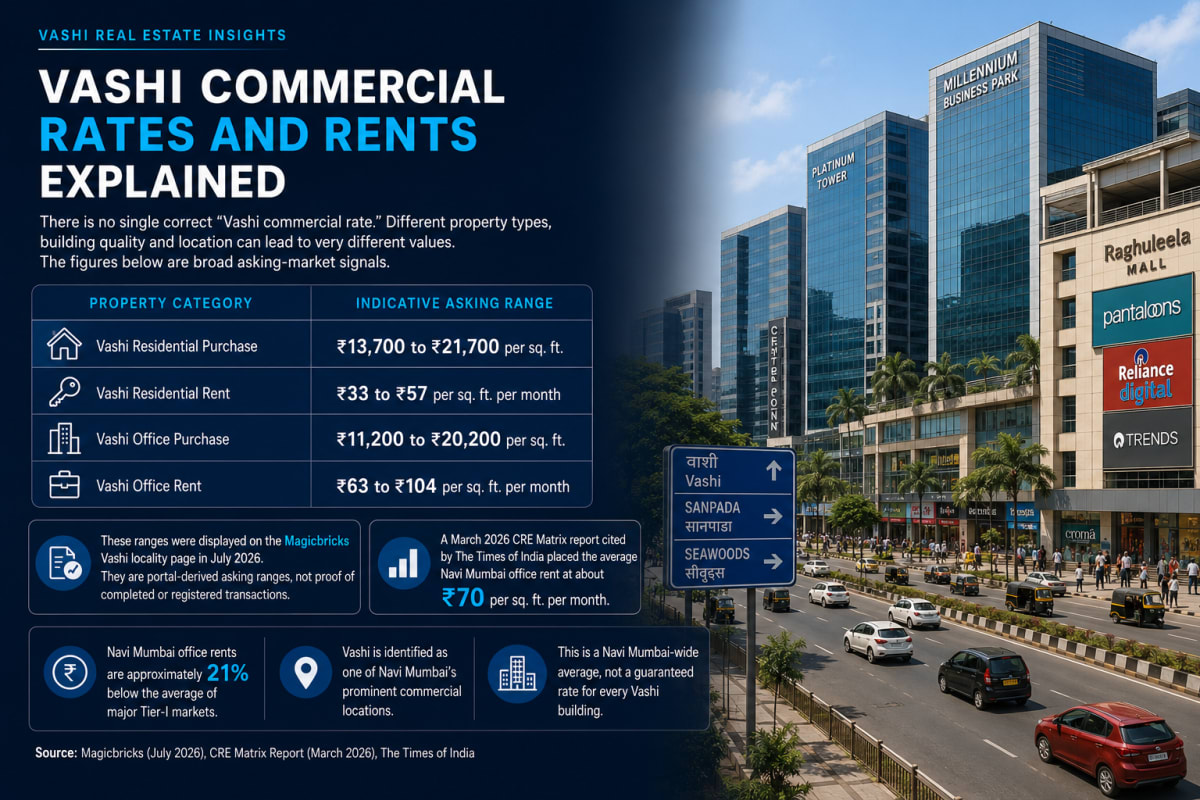
There is no single correct “Vashi commercial rate.” An office in a modern business building cannot be compared directly with an older office in a small commercial complex. A ground-floor shop with road frontage cannot be compared with an upper-floor office. The following figures are useful only as broad asking-market signals.
| Property category | Indicative asking range |
| Vashi residential purchase | ₹13,700 to ₹21,700 per sq. ft. |
| Vashi residential rent | ₹33 to ₹57 per sq. ft. per month |
| Vashi office purchase | ₹11,200 to ₹20,200 per sq. ft. |
| Vashi office rent | ₹63 to ₹104 per sq. ft. per month |
These ranges were displayed on the Magicbricks Vashi locality page in July 2026. They are portal-derived asking ranges, not proof of completed or registered transactions. A March 2026 CRE Matrix report cited by The Times of India placed the average Navi Mumbai office rent at about ₹70 per sq. ft. per month. It also reported that Navi Mumbai office rents were approximately 21% below the average of major Tier-I markets. The report identified Vashi as one of Navi Mumbai’s prominent commercial locations. This is a Navi Mumbai-wide average, not a guaranteed rate for every Vashi building.
Why the actual office rate may be higher or lower
The final rate depends on:
| Factor | Why it matters |
| Carpet area | A rate based on usable carpet area will look higher than one based on super built-up area |
| Building grade | Newer, professionally managed buildings may command better rents |
| Floor and view | Some tenants prefer higher floors; customer-facing businesses may prefer lower floors |
| Parking | Dedicated parking can materially affect usability |
| Railway access | Walkable station access may improve tenant demand |
| Furnishing | A fitted office may attract a higher rent but also requires maintenance |
| Power and internet | Businesses need sufficient electrical load and connectivity |
| CAM charges | High common-area maintenance reduces the tenant’s affordability |
| Building age | Older lifts, common areas and services may reduce demand |
| Approved use | The premises must be approved for the activity being carried out |
| Lease quality | A reliable tenant and properly registered lease can affect investment value |
Why Shop Rates Need Separate Analysis
Shop rates are often more uneven than office rates. A ground-floor shop facing a busy road may command a very different price from:
- An internal shop inside a commercial complex
- A first-floor retail unit
- A small kiosk
- A shop with weak visibility
- A shop with no loading or parking space
- A unit dependent on mall or complex footfall
Before comparing shop rates, check:
- Carpet area
- Frontage width
- Floor level
- Visibility from the road
- Daily pedestrian movement
- Vehicle access
- Loading access
- Permitted business use
- Existing tenant
- CAM and other charges
Do not use the asking price of a prime ground-floor shop to justify the price of an internal office or upper-floor unit.
Commercial Premium vs Livability Discount
Commercial activity may produce a premium in one property and a discount in another.
| Property situation | Possible residential effect |
| Home within convenient distance of offices | May support rental demand |
| Home near railway and business areas | May improve tenant convenience |
| Well-maintained society near daily services | May attract families and professionals |
| Flat directly above noisy retail activity | May reduce family appeal |
| Building with poor visitor parking | May create daily inconvenience |
| Property near loading and wholesale activity | May face commercial traffic |
| Quiet internal-sector flat near commercial facilities | May offer a useful balance |
| Old society with unclear redevelopment claims | May carry additional uncertainty |
| Flat with good parking and access | May perform better than a cheaper but congested option |
The best residential property is often not inside the busiest commercial lane. It may be a short distance away, where the buyer receives the convenience without the maximum congestion.
Practical Vashi Micro-Market View
Station and Sector 30/30A side
Properties near the railway station and major office buildings may benefit from commuter access and tenant demand. Buyers should pay special attention to:
- Peak-hour traffic
- Visitor parking
- Building management
- Office vacancy
- Last-mile walking conditions
- Waterlogging around access roads
- Distance from residential daily needs
Sector 17 and established market areas
Sector 17 and nearby shopping areas are known for established commercial and retail activity. The area may suit buyers who value convenience. But residential buyers should check whether the building is fully residential, mixed-use or affected by commercial movement. Inspect the property during actual market hours, not only during a quiet afternoon.
Sectors 19C, 19D and 19E
These areas contain a mix of offices, commercial buildings, retail premises and residential development. For offices and shops, compare:
- Building quality
- Parking
- Floor plate
- Lift capacity
- Fire-safety records
- CAM
- Tenant profile
- Approved commercial use
For nearby homes, assess traffic and noise at different times.
Palm Beach-linked residential pockets
Residential buildings with access to Palm Beach Road may attract buyers looking for stronger road connectivity and a more residential environment. However, do not pay a large premium only for a road-facing location. Check:
- Actual entry and exit
- Traffic noise
- Parking
- View protection
- Building age
- Society maintenance
- Approved plans
- Future construction nearby
APMC and Turbhe-facing side
Wholesale and logistics-linked activity can provide employment and commercial relevance. It can also mean truck movement, loading activity and congestion in certain approaches. The impact varies widely by exact location. A map distance of one kilometre does not tell you the real traffic experience.
Does Commercial Growth Guarantee Residential Appreciation?
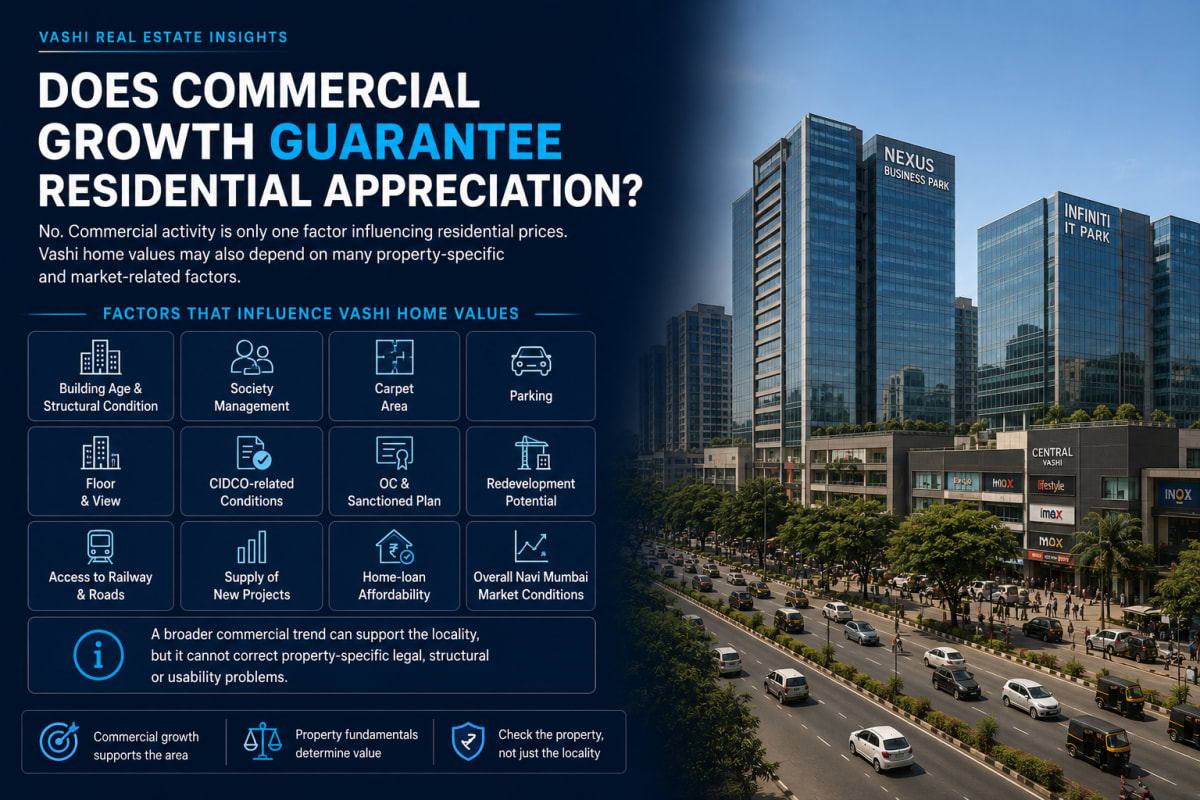
No. Commercial activity is only one factor influencing residential prices. Vashi home values may also depend on:
- Building age and structural condition
- Society management
- Carpet area
- Parking
- Floor and view
- CIDCO-related conditions
- OC and sanctioned plan
- Redevelopment potential
- Access to railway and roads
- Supply of new projects
- Home-loan affordability
- Overall Navi Mumbai market conditions
A broader commercial trend can support the locality, but it cannot correct property-specific legal, structural or usability problems.
New Flat vs Resale Flat in Vashi
| Check | New or under-construction flat | Resale flat |
| MahaRERA | Check project registration, promoter disclosures and completion timeline | May apply if the project remains within MahaRERA coverage |
| Area | Confirm RERA carpet area | Measure and compare actual usable area |
| Price comparison | Compare base price and all extra charges | Compare with similar registered and asking transactions |
| OC | Check possession and OC status | Verify the OC covering the building, wing and unit |
| Society | May not yet be formed | Check share certificate, dues and society records |
| Building condition | Construction quality and delivery risk | Structural condition, repairs and ageing systems |
| Title | Check promoter’s rights and project land records | Check the complete ownership chain of the seller |
| Parking | Verify the written allotment and approved layout | Check actual usage and society records |
| Redevelopment | Usually not relevant immediately | May affect older societies, but must be document-backed |
For a resale property, use a detailed resale flat documents checklist and verify how to confirm property ownership before negotiation. For a new project, complete a MahaRERA project search and compare the portal information with the sales brochure and agreement. As of June 2026, MahaRERA project searches, promoter information, uploaded disclosures and complaint services are being handled through the MahaCRITI platform after the earlier portal was discontinued. MahaRERA information is an important check, but it should not be treated as a substitute for title verification, sanctioned-plan review or professional legal scrutiny.
How to Verify a Vashi Property Step by Step
Step 1: Identify the exact property
Collect:
- Building name
- Sector
- Plot number
- Unit number
- Floor
- Carpet area
- Current use
- Seller or promoter name
- Society name
- Parking details
Do not begin rate comparison until you know the exact carpet area and approved use.
Step 2: Compare similar properties
Compare the property only with units that have similar:
- Building age
- Carpet area
- Floor
- Condition
- Parking
- Location
- Approved use
- Furnishing
- Possession status
An advertised rate is only an opening point for negotiation.
Step 3: Check Ready Reckoner and registered records
Use the IGR Maharashtra services to check the applicable Annual Statement of Rates or Ready Reckoner benchmark for the relevant zone and property category. The Ready Reckoner rate is a government valuation reference. It is not necessarily the property’s final market price. Also review available registered-document and Index II records with a property lawyer. These records can support verification but may not reveal every side payment, condition or dispute.
Step 4: Verify ownership
Check:
- Seller’s identity
- Original purchase document
- Registered Agreement for Sale or Sale Deed
- Previous ownership documents
- Index II
- Loan and mortgage status
- Release or no-dues letter from the lender
- Succession documents, if inherited
- Power of Attorney, if someone else is signing
For a safer process, follow a complete Flat Buying Documents Checklist instead of depending only on the broker’s document summary.
Step 5: Check CIDCO conditions where applicable
Some Navi Mumbai properties may be affected by CIDCO allotment, lease, transfer or use conditions. Ask for:
- Original allotment letter
- Lease deed
- Transfer records
- Permitted use
- Outstanding dues
- Relevant CIDCO permissions
Do not assume every Vashi property follows identical CIDCO conditions. The actual plot and transaction documents must be checked.
Step 6: Check the sanctioned plan and approved use
Confirm whether the premises is approved as:
- Residential
- Office
- Shop
- Showroom
- Another commercial use
Check the Building Plan Approval before accepting any modified layout. Watch for:
- Unauthorized mezzanine floors
- Enclosed passages
- Combined units
- Converted terraces
- Structural changes
- Residential units being marketed as offices
- Shops using common areas
CIDCO’s official building-permission page provides development-control references and links to approved-case and online permission systems. The exact authority and record applicable to the property must still be identified from its documents.
Step 7: Verify OC and CC
Ask for the complete document, not only a WhatsApp image of its first page. Check:
- Project name
- Plot number
- Building or wing
- Floors covered
- Date
- Issuing authority
- Conditions, if any
Also understand OC vs CC vs Possession Letter. These documents do not mean the same thing. The abbreviation “CC” may be used for a Commencement Certificate or Completion Certificate depending on the context. Ask for the full document name.
Step 8: Review society and building condition
For an older Vashi society, check:
- Society registration
- Share certificate
- Maintenance dues
- Major repair records
- Structural-audit report
- Lift condition
- Waterproofing history
- Fire-safety arrangements
- Building insurance
- NMMC notices
- Redevelopment resolutions
- Conveyance or deemed conveyance
A Society NOC or no-dues letter is helpful, but it does not by itself prove clear ownership.
Step 9: Check the lease for a pre-leased office or shop
A “pre-leased property” means the premises already has a tenant. Verify:
- Tenant identity
- Registered agreement
- Monthly rent
- Rent payment history
- Security deposit
- Lock-in period
- Escalation
- Notice period
- Termination rights
- CAM responsibility
- GST and tax treatment
- Renewal terms
Calculate net yield after maintenance, vacancy, repairs, taxes, brokerage and other costs.
Step 10: Conduct physical visits
Visit at least three times:
- Weekday morning
- Weekday evening
- Weekend
Check:
- Traffic
- Parking
- Noise
- Building entry
- Lift waiting time
- Water pressure
- Security
- Loading activity
- Street condition
- Emergency access
- Actual commercial footfall
Documents Checklist
Residential property documents
- Seller’s PAN and identity proof
- Allotment letter, where applicable
- Registered Agreement for Sale or Sale Deed
- Complete ownership chain
- Index II
- CIDCO lease or allotment records, where applicable
- Sanctioned plan
- Commencement Certificate
- Completion Certificate, where applicable
- Occupancy Certificate
- Society registration certificate
- Share certificate
- Society NOC, if required
- No-dues letter
- Maintenance statements
- Property-tax receipts
- Loan-release documents
- Parking records
- Structural-audit report for an older building
- Redevelopment records, if applicable
Additional office or shop documents
- Approved commercial use
- Fire-safety documents where applicable
- Lift and electrical compliance records
- Electricity-load details
- CAM statements
- Parking rights
- Signage rights
- Existing lease agreement
- Tenant KYC
- Rent receipts
- Security-deposit proof
- Lock-in and termination clauses
- Fit-out approvals
- Business-specific permissions where required
Red Flags
Be careful when:
- The quoted rate does not mention carpet or built-up area.
- A shop rate is used to justify an office price.
- The seller refuses to share the title chain.
- Commercial use is claimed without approved-use documents.
- The unit has an unauthorized mezzanine or enclosure.
- The OC does not clearly cover the building or wing.
- MahaRERA information does not match the sales claim.
- CIDCO transfer or lease conditions are unclear.
- Society dues or disputes are hidden.
- An older building has no structural-audit record.
- “Guaranteed rent” is offered without a reliable tenant.
- A pre-leased unit has an easy tenant-exit clause.
- Token money is demanded before document review.
- Redevelopment is promised without society records.
- The buyer is pressured to decide immediately.
- Commercial growth is presented as guaranteed appreciation.
Common Mistakes Buyers Make
Comparing unlike properties
A Grade-A office, old commercial office and road-facing shop are different products. Their rates cannot be compared directly.
Using only online asking prices
Property portals show seller expectations. They do not automatically show the final negotiated or registered consideration.
Ignoring CAM and vacancy
A high rent may look attractive until CAM, vacancy, property tax, repairs and brokerage are deducted.
Assuming commercial proximity is always positive
Being near offices can improve convenience. Being inside the most congested lane can reduce comfort.
Trusting redevelopment rumours
Ask for society resolutions, developer appointment records and authority documents.
Paying token before legal checks
A low price or “urgent deal” is not a reason to skip verification.
Final Buyer Checklist
Before paying token money for a Vashi property, confirm:
- Exact carpet area
- Residential or commercial approved use
- Seller identity
- Complete ownership chain
- Registered agreements and Index II
- CIDCO records, where applicable
- Sanctioned building plan
- OC and relevant certificates
- MahaRERA details, if applicable
- Society share certificate and dues
- Structural condition
- Parking rights
- Loan or mortgage status
- Existing tenant and lease terms
- CAM and recurring costs
- Traffic and noise during peak hours
- Written token-payment conditions
- Property lawyer’s document review
Do not pay token money only because the property appears cheaper than nearby listings.
Final Verdict
Vashi’s commercial base is a genuine advantage for many residential buyers. It supports employment access, tenant demand, shopping, services and connectivity. But the impact is not equal across every sector or building. A well-maintained home located close to commercial activity, but away from severe traffic and parking pressure, may offer a better balance than a property directly inside the busiest business lane. For investors, the correct approach is to study both sides:
- Commercial demand and rent potential
- Residential livability and building quality
The stronger deal is not always the property with the highest quoted rent. It is the property with clear documents, suitable use, realistic pricing, manageable costs and steady user demand.
Need Help Shortlisting a Vashi Property?
Navi Mumbai Property Deals focuses on buyer-first property information and practical verification. Before you pay token money for a Vashi flat, office or shop, collect the complete document set, compare realistic rates and confirm the property’s approved use. You can use Navi Mumbai Property Deals as a starting point for shortlisting and property-related guidance, while taking independent legal advice for the final transaction.
Frequently Asked Questions
1. Does Vashi’s commercial market increase residential prices?
Commercial activity can support housing demand, rental enquiries and resale liquidity. However, it does not automatically increase the value of every property. Building condition, sector, parking, traffic, title and approvals also matter.
2. What are the current office rates in Vashi?
A July 2026 property-portal snapshot showed indicative office asking rates of approximately ₹11,200 to ₹20,200 per sq. ft. Actual rates may differ by carpet area, building grade, parking, floor, age and lease status.
3. What is the office rent in Vashi?
A portal-derived range showed approximately ₹63 to ₹104 per sq. ft. per month for office listings in Vashi. A separate CRE Matrix report placed the wider Navi Mumbai average near ₹70 per sq. ft. per month. Both figures are indicators, not guaranteed achieved rents.
4. Why are Vashi shop rates higher in some locations?
Ground-floor frontage, visibility, pedestrian movement, parking, loading access and permitted business use can make one shop more valuable than another.
5. Is a flat near Vashi railway station good for rental income?
It may attract tenants who value commuting convenience. Check noise, traffic, walking access, parking, society rules and the flat’s condition before estimating rent.
6. Are online property rates reliable?
They are useful for understanding asking-market expectations. They should be cross-checked with similar properties, registered records, Ready Reckoner benchmarks and local transaction evidence.
7. Does MahaRERA registration guarantee a clear title?
No. MahaRERA records support project verification, but buyers should separately check title, sanctioned plans, approvals, OC, agreements and property-specific risks.
8. How can I check whether an office or shop has approved commercial use?
Ask for the sanctioned plan and approval documents. Cross-check the property with the competent planning authority’s building-permission records.
9. What should I check in an old Vashi society?
Check the title, conveyance, structural audit, repair history, society dues, NMMC notices, lift condition, OC, parking and redevelopment records.
10. Is buying a pre-leased office in Vashi safe?
It may provide immediate rental income, but the lease and tenant must be verified. Check rent receipts, deposit, lock-in, escalation, exit rights, CAM and tenant credibility.
11. Is NAINA approval normally relevant to a Vashi flat?
NAINA generally concerns the notified airport-influence planning area, not a routine Vashi apartment transaction. Confirm the actual authority from the property documents instead of assuming jurisdiction.
12. What should I check before paying token money?
Check ownership, approved use, title documents, sanctioned plan, OC, society dues, CIDCO conditions where applicable, loan status and written refund conditions.
- WebPage
- Organization
Do not use Product, Offer or property-price markup unless the page contains a genuine, current and clearly defined offer.