Uran Property Document Checklist: What Buyers Must Verify
Buying a flat or plot in Uran involves more than checking the price, location and future connectivity. You must verify who owns the property, whether it has the required approvals, and whether the seller is legally authorised to complete the transaction. The exact checklist depends on what you are buying. Documents for an under-construction flat are different from those required for a resale flat, CIDCO property or village plot.
Quick Answer
Before buying property in Uran, verify the seller’s identity, ownership chain, registered documents, land records, MahaRERA status where applicable, sanctioned plan, Commencement Certificate, Occupancy Certificate, tax dues and existing loans. For a plot, also check its survey number, zoning, NA status, sanctioned layout, legal access, measurement and planning authority. Do not pay token money until the important documents have been independently reviewed.
Quick Uran Property Document Checklist
| Check | What you should verify | Where to check |
| Seller identity | Seller’s name matches the ownership records | Registered documents and identity records |
| Ownership chain | How the property reached the current seller | Previous agreements, conveyances and IGR records |
| Land records | Survey number, area, recorded holder and mutation entries | Mahabhumi and local land-record office |
| Registration history | Earlier sales, mortgages and registered transactions | IGR Maharashtra e-Search |
| MahaRERA status | Project status, promoter, approvals and completion date | MahaRERA portal |
| Sanctioned plan | Approved building, wing, floor or plot layout | Competent planning authority |
| Commencement Certificate | Construction permitted up to the relevant stage | Planning authority and MahaRERA disclosures |
| Occupancy Certificate | OC covers the correct building, wing and floor | Issuing civic or planning authority |
| Property dues | Tax, maintenance, utility and authority dues | Society, municipal council or applicable authority |
| CIDCO status | Lease, allotment, transfer conditions and dues | CIDCO, if applicable |
| Plot zoning | Permitted land use, reservations and restrictions | Applicable planning authority |
| Legal access | Registered right to reach the plot | Title documents, layout and survey records |
Why Document Verification in Uran Needs Extra Care
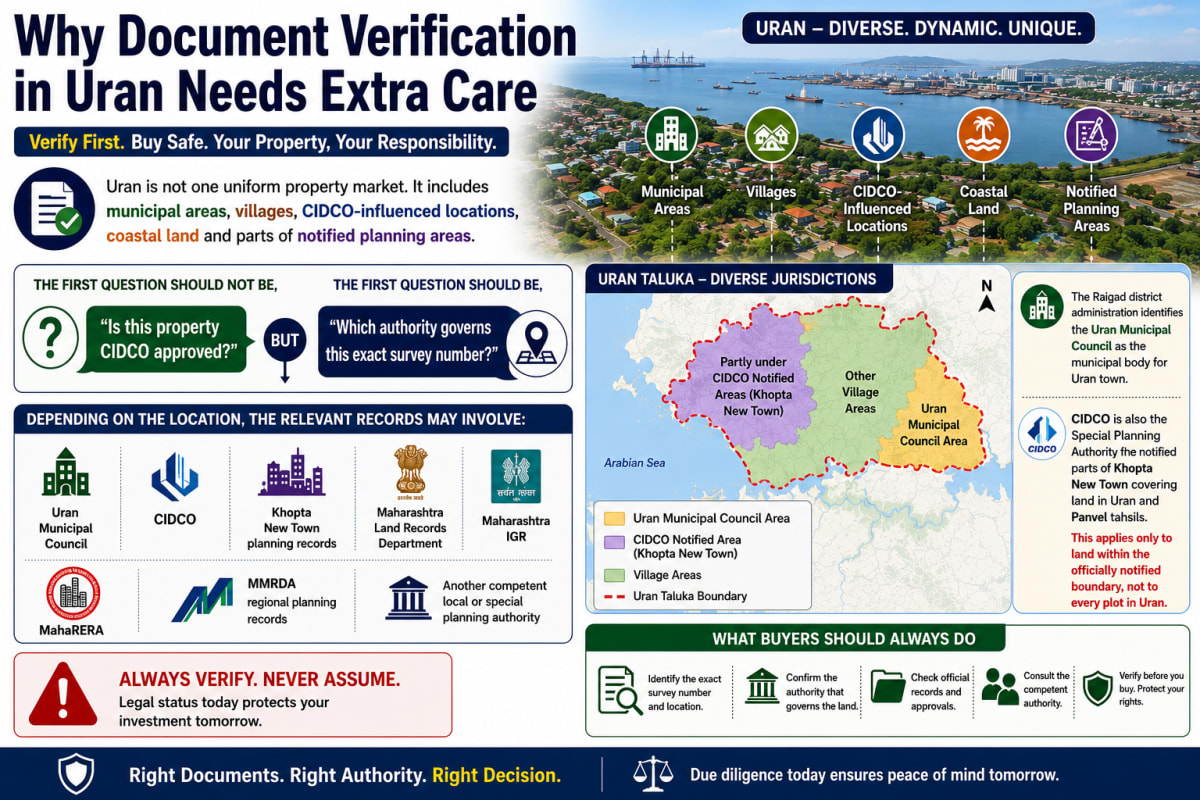 Uran is not one uniform property market. It includes municipal areas, villages, CIDCO-influenced locations, coastal land and parts of notified planning areas. The first question should not be, “Is this property CIDCO approved?” The first question should be, “Which authority governs this exact survey number?” Depending on the location, the relevant records may involve:
- Uran Municipal Council
- CIDCO
- Khopta New Town planning records
- Maharashtra Land Records Department
- Maharashtra IGR
- MahaRERA
- MMRDA regional planning records
- Another competent local or special planning authority
The Raigad district administration identifies the Uran Municipal Council as the municipal body for Uran town. However, this does not mean that every property marketed as being “in Uran” falls within the same municipal or planning limits. CIDCO is also the Special Planning Authority for notified parts of Khopta New Town covering land in Uran and Panvel tahsils. This applies only to land within the officially notified boundary, not to every plot in Uran.
Start by Identifying the Exact Property
Do not begin verification using only a project name or marketing location. Ask the seller or developer for:
- Village name
- Taluka and district
- Survey, Gat or CTS number
- Plot number and total area
- Building and wing name
- Floor and flat number
- MahaRERA registration number, where applicable
- Seller’s full legal name
- Property tenure, such as leasehold or freehold
Names such as “Uran airport belt,” “near JNPT” or “Third Mumbai plot” are marketing descriptions. They do not identify the land in government records. The survey or CTS number is the more reliable starting point.
Who Issues or Maintains the Important Records?
| Document or information | Authority or source |
| Registered sale and mortgage documents | Maharashtra IGR |
| Index II and registered document copies | Maharashtra IGR |
| 7/12, 8A, Property Card and mutation entries | Mahabhumi and Land Records Department |
| Project registration and promoter disclosures | MahaRERA |
| Building plan and Commencement Certificate | Competent planning authority |
| Occupancy Certificate | Competent civic or planning authority |
| CIDCO allotment, lease and transfer records | CIDCO Estate Department |
| Society records and dues | Registered cooperative housing society |
| Municipal property tax | Applicable municipal council or civic authority |
| Zoning and development plan | Applicable planning or special planning authority |
| CRZ information | Official coastal-zone maps and competent environmental authority |
Maharashtra IGR’s e-Search service allows users to search transactions using property or document details and obtain scanned copies of registered documents. Mahabhumi provides access to digitally signed 7/12 extracts, 8A records, mutation entries and Property Cards. Its Digital Satbara portal states that digitally signed 7/12, 8A and Property Card records can be used for official and legal purposes. However, access to an official record does not mean that one document alone confirms a clear and transferable title.
Important Property Terms Explained Simply
Title
Title means the legally supportable ownership interest through which a person claims the right to sell a property. A sale deed may form an important part of the title, but a lawyer normally checks the entire history and not just the seller’s latest document.
Title Chain
The title chain is the sequence showing how the property passed from one owner to another. For example, the chain may include an original allotment, previous sale agreements, inheritance documents, conveyances, lease papers and the current seller’s registered agreement.
Index II
Index II is a summary generated from a registered document. It normally contains the names of the parties, property details and transaction information. It is useful for searching the registration history, but it is not a replacement for reading the complete registered document.
7/12 Extract
A 7/12 extract is a rural land record containing information about the land, recorded holders and relevant entries. It helps with verification, but a 7/12 extract alone does not guarantee clear ownership, residential zoning or permission to construct.
Mutation Entry
A mutation entry, also called Ferfar, records a reported change in the revenue record after a sale, inheritance, partition or another event. Mutation helps update land records. It does not independently create ownership.
Sanctioned Plan
A sanctioned plan is the building or layout plan approved by the competent authority. The actual flat, floor, wing and layout should match this approved plan.
Commencement Certificate
A Commencement Certificate allows construction to begin or continue to a permitted stage. A developer may have approval only up to a certain stage. Buyers should check whether the approval covers the building or floor in which they are purchasing.
Occupancy Certificate
An Occupancy Certificate confirms that the competent authority has permitted occupation of the approved completed construction. MahaRERA’s possession-stage guidance explains that an OC is issued by the civic authority and signifies completion in accordance with the approved plan and building laws. Always check whether the OC is full or partial and whether it covers your building, wing and floor.
Step-by-Step Uran Property Verification Process
Step 1: Confirm the Seller’s Identity
Compare the seller’s full name with:
- Registered ownership document
- Index II
- Land record, where applicable
- Society share certificate
- Property-tax record
- PAN and other identification
- CIDCO records, if applicable
A small spelling difference may be explainable. A major mismatch should be resolved through proper documents before proceeding. If the seller is acting through a Power of Attorney, verify whether the document is registered, valid and wide enough to permit the proposed sale. For an inherited property, check the relevant succession, heirship, probate, family settlement or release documents according to the circumstances.
Step 2: Verify the Ownership Chain
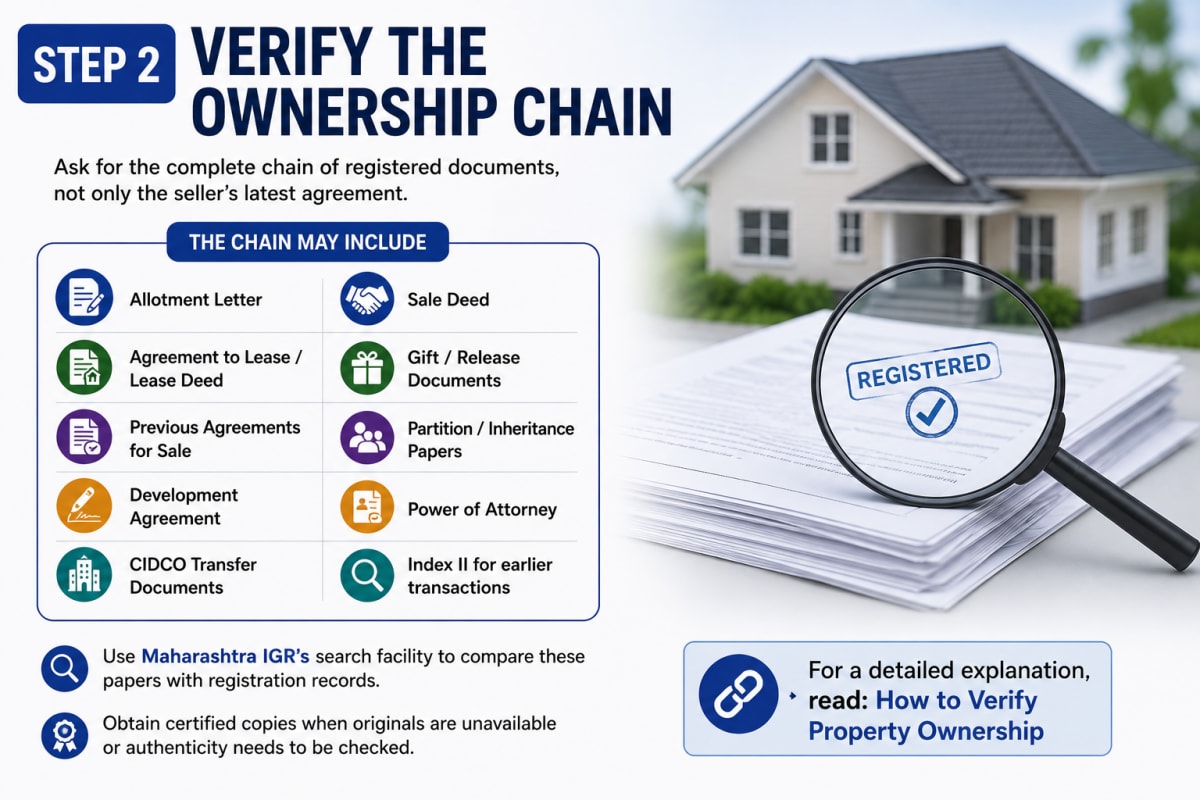 Ask for the complete chain of registered documents, not only the seller’s latest agreement. The chain may include:
- Original allotment letter
- Agreement to Lease or Lease Deed
- Previous Agreements for Sale
- Sale Deed or Conveyance Deed
- Gift or release documents
- Partition or inheritance papers
- Development agreement
- Power of Attorney
- CIDCO transfer documents
- Index II for earlier transactions
Use Maharashtra IGR’s search facility to compare these papers with registration records. Obtain certified copies when originals are unavailable or authenticity needs to be checked. For a detailed explanation, add an internal link to How to Verify Property Ownership.
Step 3: Check for Loans and Other Claims
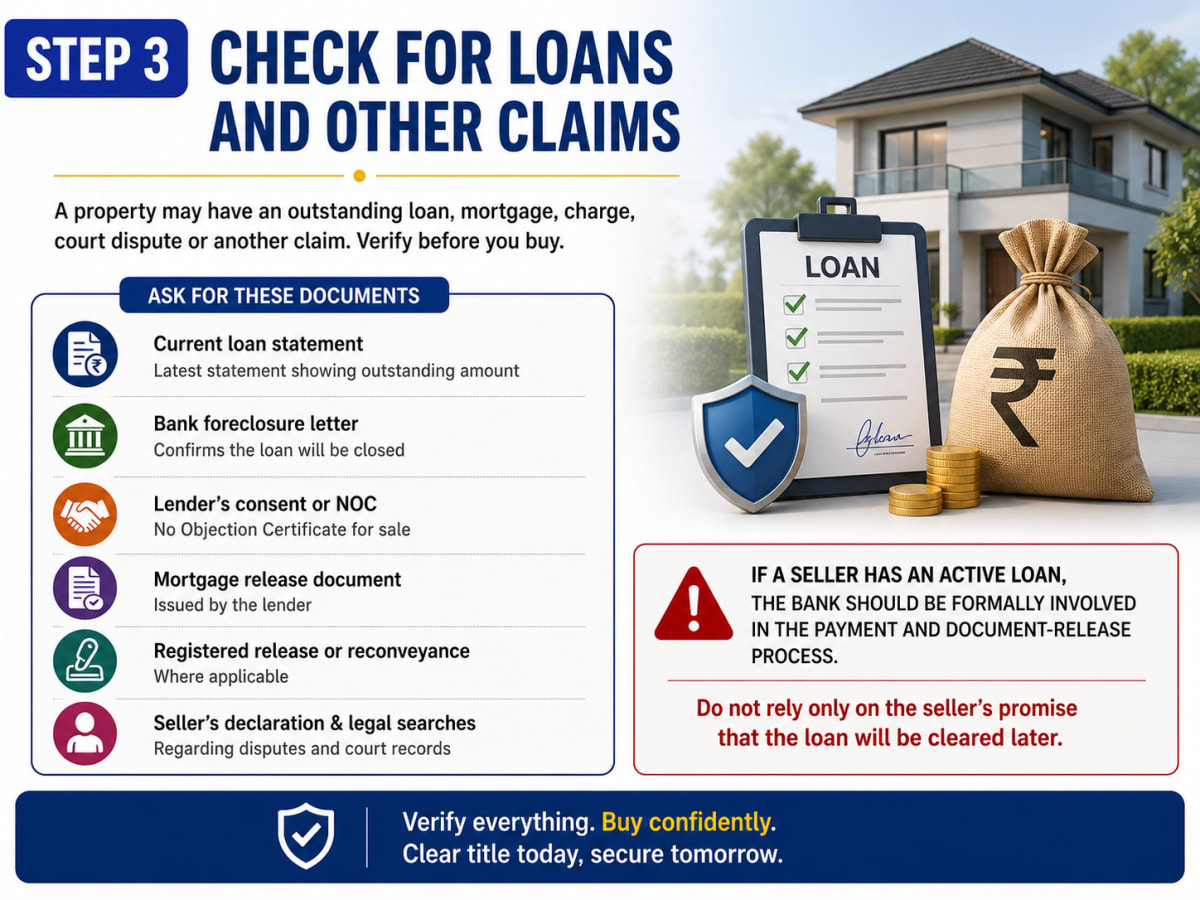 A property may have an outstanding home loan, mortgage, charge, court dispute or another claim. Ask for:
- Current loan statement
- Bank foreclosure letter
- Lender’s consent or NOC
- Mortgage release document
- Registered release or reconveyance, where applicable
- Seller’s declaration regarding disputes
- Independent registration and court-record searches
If a seller has an active loan, the bank should be formally involved in the payment and document-release process. Do not rely only on the seller’s promise that the loan will be cleared later.
Step 4: Check Land Records
For land and plot transactions, obtain the latest digitally signed:
- 7/12 extract
- 8A extract
- Property Card, where applicable
- Mutation entries
- Village map
- Survey or measurement map
Compare the following details across every document:
| Detail | What must match |
| Owner name | Seller or legally explained predecessor |
| Survey/Gat/CTS number | Exact property being offered |
| Land area | Title document, land record and measurement |
| Mutation entries | Supported by sale, inheritance or other documents |
| Land classification | Consistent with the proposed use |
| Boundaries | Match the actual site and survey plan |
A land record is one part of due diligence. It must be read together with registered title documents and planning records. For more detail, link to How to Verify Property Ownership and the relevant Uran land-record guide.
Step 5: Confirm the Planning Authority and Zoning
This is one of the most important checks for an Uran plot. Ask the competent authority to confirm:
- Current land-use zone
- Reservation or proposed public purpose
- Acquisition status
- Permitted development
- Applicable development regulations
- NA status, where required
- Layout or subdivision approval
- Coastal or environmental restrictions
- Access-road requirements
MMRDA publishes regional-plan land-use maps, including maps for Uran Taluka, through its official regional-plan map portal. These maps can help with initial screening. For a transaction, obtain the latest parcel-specific zoning or part-plan information from the competent authority. Do not assume that land is residential merely because nearby construction exists.
Step 6: Verify MahaRERA Details
For a project required to be registered, search it through the MahaRERA project search. Check:
- Project and promoter name
- Registration status and validity
- Declared completion date
- Landowner and promoter details
- Title report
- Encumbrance information
- Sanctioned plans
- Commencement Certificate
- Building and wing information
- Quarterly updates
- Litigation disclosures
- Complaints and orders, where relevant
MahaRERA’s stage-wise buyer guidance tells buyers to examine the project’s title, approvals, services, amenities and agreement terms. MahaRERA registration improves transparency, but it does not guarantee that the project has no legal, financial or delivery risk. Add an internal link to MahaRERA Project Search in this section.
Step 7: Verify the Sanctioned Plan and Construction Permission
Do not rely on a brochure, sample-flat drawing or sales presentation. Obtain the sanctioned plan and confirm:
- Project name and plot details
- Approved buildings and wings
- Number of floors
- Your flat’s location
- Approved carpet area
- Staircase and lift position
- Parking arrangement
- Common areas
- Approved amenities
- Current Commencement Certificate stage
A flat being physically constructed does not prove that the floor or configuration is approved. Add an internal link to Building Plan Approval for readers who need a detailed plan-verification guide.
Step 8: Check the Occupancy Certificate
For a ready-to-move or resale flat, obtain the OC and verify it with the issuing authority. Check whether:
- The certificate is genuine
- The property details match
- It covers the correct building and wing
- It covers the floor containing the flat
- It is full or partial
- The completed structure matches the approved plan
Do not treat a possession letter, architect’s certificate or electricity bill as a substitute for an applicable OC. Add an internal link to OC vs CC vs Possession Letter.
Step 9: Verify Tax, Society and Authority Dues
Ask for the latest:
- Property-tax receipt
- Society maintenance statement
- Society no-dues letter
- Water and electricity bills
- CIDCO dues statement, if applicable
- Lease rent or service-charge records
- Other authority demands or penalties
Check that each receipt refers to the correct property. A paid tax bill is useful for checking dues, but it does not establish clear ownership.
Step 10: Review the Agreement Before Paying
The draft agreement should correctly mention:
- Names of all parties
- Complete property description
- Survey, plot, building and flat details
- Carpet area
- Total consideration
- Payment schedule
- Possession date
- Parking rights
- Amenities
- Taxes and charges
- Existing mortgage
- Default and cancellation terms
- Token refund terms
- Documents to be handed over
- CIDCO or society transfer costs, where applicable
Have the draft reviewed independently. A standard-looking agreement can still contain property-specific errors.
What to Check Before Paying Token Money
Do not pay token money only because the price looks attractive or another buyer is supposedly waiting. Before paying, confirm at least the following:
- Seller identity
- Basic ownership chain
- Exact survey, plot or flat details
- MahaRERA status, where applicable
- Planning authority
- Sanctioned plan
- OC for a completed property
- Land records for a plot
- Existing bank loan
- Society or CIDCO dues
- Written refund and cancellation terms
- Payment receipt and purpose of payment
The receipt should identify the property, amount, parties and conditions under which the token is refundable or adjustable.
Documents for Different Types of Uran Property
Under-Construction Flat Checklist
| Document | Why it matters |
| MahaRERA project record | Shows registration, disclosures and project status |
| Title report | Helps examine the developer’s or landowner’s rights |
| Development agreement | Shows the developer’s authority where it does not own the land |
| Sanctioned plan | Confirms the approved project configuration |
| Commencement Certificate | Shows the approved construction stage |
| Draft Agreement for Sale | Records the buyer’s contractual rights |
| Carpet-area details | Allows comparison with approved and offered area |
| Quarterly project updates | Shows declared progress and compliance position |
| Payment schedule | Should be clear and consistent with the agreement |
| Approvals and NOCs | Must match the project and competent authority |
Ready-to-Move Flat Checklist
- Registered ownership or allotment documents
- MahaRERA details, where applicable
- Sanctioned plan
- Commencement Certificate
- Applicable Occupancy Certificate
- Possession letter
- Property-tax assessment
- Utility dues
- Society formation status
- Conveyance status
- Maintenance statement
- Actual-flat inspection
Resale Flat Checklist
A resale transaction focuses more heavily on the seller’s title and unpaid liabilities. Verify:
- Seller’s registered purchase agreement
- Index II
- Complete previous title chain
- Original allotment and possession documents
- Occupancy Certificate
- Sanctioned plan
- Society registration certificate
- Share certificate
- Society maintenance ledger
- Society no-dues letter
- Existing home-loan documents
- Bank NOC and release process
- Property-tax and utility dues
- Approved internal alterations
- Inheritance papers, if applicable
- CIDCO transfer documents, if applicable
A Society NOC helps with the society process, but it does not replace ownership verification, an OC or statutory approvals. Add internal links to Resale Flat Documents Checklist and Society NOC.
Plot or Land Checklist for Uran
Plot purchases need a wider review because ownership, land use and construction rights are separate questions. Ask for:
- Digitally signed 7/12 and 8A
- Property Card, where applicable
- All mutation entries
- Registered title chain
- Village map
- Survey map
- Official measurement
- Boundary demarcation
- Zone certificate or applicable part plan
- NA order or status, where required
- Sanctioned subdivision or layout
- Development permission
- Legal access documents
- Acquisition and reservation status
- Transfer restrictions
- CRZ status where relevant
- Existing structure approvals
- CIDCO or Khopta records where applicable
A visible road beside a plot does not necessarily give the plot a legal right of access. Access should be supported by the sanctioned layout, title documents or a registered right.
CIDCO Property Documents Where Applicable
Not every Uran property is a CIDCO property. Ask for CIDCO documents only after confirming that CIDCO allotment, tenure or transfer conditions apply. The checklist may include:
- Allotment letter
- Possession receipt
- Agreement to Lease
- Lease Deed
- Tripartite Agreement
- Conveyance document
- Approved transfer history
- Current allottee or lessee record
- CIDCO dues
- Mortgage permission
- Lender’s release
- Building permission
- Sanctioned plan
- Occupancy Certificate
- Scheme-specific papers for PAP or 12.5% property
CIDCO’s Estate Department process manual refers to the transfer of leasehold rights and the use of instruments such as tripartite agreements or conveyance deeds depending on the property. This is why buyers should not demand one standard CIDCO document for every transaction. The correct papers depend on the original allotment and tenure.
New Flat vs Resale Flat: Main Differences
| Check | New or under-construction flat | Resale flat |
| Main seller | Developer or promoter | Existing owner |
| Key title check | Developer’s rights over project land | Seller’s complete ownership chain |
| MahaRERA | Major verification source where applicable | Relevant if the project was registered |
| Construction approval | Current sanctioned plan and CC | Sanctioned plan and completed-building records |
| OC | Usually checked at possession | Should be checked before purchase |
| Loan check | Project and unit encumbrances | Seller’s active home loan |
| Society documents | May not exist initially | Share certificate, ledger and transfer papers |
| Dues | Builder and authority charges | Society, tax, utility and loan dues |
| Agreement | Builder-buyer Agreement for Sale | Resale Agreement for Sale or conveyance |
| Physical changes | Compare promised unit with plan | Check unauthorised alterations |
Red Flags Buyers Should Not Ignore
Pause the transaction if:
- The seller refuses to provide the survey or CTS number.
- Only an electricity bill or tax receipt is shown as ownership proof.
- Names or property numbers differ across documents.
- A plot is called “CIDCO approved” without an identifiable approval.
- Agricultural land is promoted as immediately buildable.
- The MahaRERA project status does not match the sales claim.
- The advertised wing or floor is absent from the sanctioned plan.
- Possession is offered without an applicable OC.
- A partial OC is presented as approval for the entire project.
- The seller has a loan but avoids involving the bank.
- Important mutation entries are pending or disputed.
- The seller refuses an independent plot measurement.
- Physical access exists but there is no documented access right.
- Token money is demanded without written refund terms.
- The buyer is pressured to make a large cash payment.
- Airport, Atal Setu or port-related appreciation claims are used to avoid document questions.
A red flag does not automatically mean that the property is fraudulent. It means the issue should be explained and resolved through proper records before proceeding.
Common Mistakes Uran Buyers Make
Assuming Every Property Is Under CIDCO
CIDCO has important roles in several Navi Mumbai and notified planning areas, but every property marketed as Uran property is not automatically a CIDCO property. Confirm the jurisdiction for the exact survey number.
Treating 7/12 as Complete Ownership Proof
A 7/12 extract is an important land record. It should be checked with registered documents, mutation history, measurement and legal title.
Confusing Registration With Approval
Registration of a sale document records a transaction. It does not automatically regularise an unauthorised building, incorrect land use or unapproved layout.
Believing Bank Approval Is a Guarantee
A lender conducts checks for its own loan decision. The buyer still needs independent title, approval and agreement verification.
Checking the OC but Not Its Coverage
An OC may cover only a specific building, wing or stage. Match the certificate to the exact flat.
Ignoring Physical Measurement
The area and boundaries shown by a broker may differ from official survey records. This is especially important when purchasing an individual plot.
Paying Token Before Reviewing the Draft Terms
A vague token receipt can create refund disputes. Record the conditions in writing before making payment.
Final Buyer Checklist
Before completing an Uran property transaction, confirm:
- [ ] Exact village and survey/CTS number identified
- [ ] Correct planning authority confirmed
- [ ] Seller’s identity verified
- [ ] Complete ownership chain reviewed
- [ ] IGR registration search completed
- [ ] Land records checked where applicable
- [ ] Mutation entries examined
- [ ] Existing mortgage and lender process verified
- [ ] Zoning and land-use status confirmed
- [ ] Legal access verified for plots
- [ ] MahaRERA project checked where applicable
- [ ] Sanctioned plan matched with the property
- [ ] Commencement Certificate stage checked
- [ ] Applicable OC authenticated
- [ ] CIDCO tenure and transfer records checked where relevant
- [ ] Society, tax and utility dues checked
- [ ] Physical property inspected and measured
- [ ] Draft agreement independently reviewed
- [ ] Token and refund terms recorded in writing
- [ ] Key searches repeated close to registration
Final Takeaway
A good property checklist does not mean collecting the same 15 documents for every purchase. For an under-construction flat, your main focus may be MahaRERA, project title, sanctioned plans, current permissions and agreement terms. For a resale flat, seller ownership, the OC, society records, loan closure and dues become more important. For an Uran plot, the biggest questions are often different: Who owns the exact parcel? What is its zoning? Does it have legal access? Can it legally be developed? Which authority controls it? The safest approach is to identify the exact property first and then build the checklist around its location, tenure and transaction type.
Need Help Shortlisting Property in Navi Mumbai?
Navi Mumbai Property Deals is building buyer-first property information for people who want to understand documents before making a decision. If you are comparing a flat, resale property or plot in Uran, use our verification guides to ask better questions before paying token money. For legal title or transaction-specific advice, consult an independent property lawyer.
Disclaimer
This article is for general buyer education and is not legal advice. Property title, planning jurisdiction, land use, approvals and transfer conditions can differ by plot and project. Rules, authority boundaries, planning proposals, MahaRERA status and land records can change. Verify current records with the relevant authority and obtain an independent property lawyer’s opinion before paying token money or signing an agreement. Last reviewed: July 2026
Suggested Schema Markup Types
- Article
- BreadcrumbList
- FAQPage
- ItemList for the document checklist
- Organization
- WebPage
Use FAQPage schema only when the questions and answers are visible on the published page. Do not mark promotional claims as factual structured data.
Internal Links to Add
- Flat Buying Documents Checklist
Suggested anchor: documents to check before buying a flat
- OC vs CC vs Possession Letter
Suggested anchor: difference between OC, CC and a possession letter
- MahaRERA Project Search
Suggested anchor: check a project on MahaRERA
- Resale Flat Documents Checklist
Suggested anchor: resale flat document checklist
- How to Verify Property Ownership
Suggested anchor: verify who owns a property
- Building Plan Approval
Suggested anchor: verify a sanctioned building plan
- Society NOC
Suggested anchor: what a Society NOC does and does not prove
External Sources Used
- MahaRERA Guidance for Homebuyers
- MahaRERA Project Search
- MahaRERA Stage-Wise Guidance
- MahaRERA Possession-Stage Guidance
- IGR Maharashtra e-Search
- Mahabhumi Services
- Digitally Signed 7/12 and Property Card Portal
- CIDCO Estate Department Process Manual
- Uran Municipal Council, Raigad District
- MMRDA Regional-Plan Maps
- Maharashtra Directorate of Town Planning
Frequently Asked Questions
1. What documents should I check before buying property in Uran?
Check the seller’s registered ownership document, title chain, Index II, land records where applicable, existing loans, sanctioned plan, Commencement Certificate, Occupancy Certificate, tax dues and society records. For an applicable project, also check its current MahaRERA details.
2. Is a 7/12 extract enough to buy land in Uran?
No. A 7/12 extract is an important revenue record, but it should be checked with the registered title chain, mutation entries, zoning, measurement, legal access, NA status where required and development approvals.
3. How can I verify who owns a property in Uran?
Start with the seller’s registered title document and search the registration history through Maharashtra IGR. For land, compare it with the latest digitally signed land records. An independent property lawyer should examine the complete chain and possible claims.
4. Does every Uran property come under CIDCO?
No. The relevant authority depends on the property’s exact location and notified jurisdiction. Verify the village and survey or CTS number before applying a CIDCO checklist.
5. Does NAINA apply to Uran property?
Do not assume that NAINA applies merely because the property is in the wider Navi Mumbai region. NAINA has a notified jurisdiction. Confirm the applicable planning authority for the exact parcel through official records.
6. How do I check an Uran project on MahaRERA?
Search using the project name, promoter name or registration number on the official MahaRERA portal. Compare the project’s validity, declared completion date, title details, approvals, building information and quarterly updates with the developer’s claims.
7. Can I buy a resale flat without an Occupancy Certificate?
The missing OC requires careful investigation. Check why it is unavailable, whether any partial OC exists, what the issuing authority’s records show and how the absence may affect occupation, finance and resale. Obtain professional advice before proceeding.
8. Does a Society NOC prove ownership?
No. A Society NOC or no-dues letter supports the society-transfer process. It does not replace the seller’s registered title documents, statutory approvals or an independent title review.
9. Does bank approval mean a property is legally safe?
No. Bank approval should not be treated as a legal guarantee. The bank conducts checks for its own lending purpose. The buyer should still verify title, approvals, OC, agreement terms and property-specific risks independently.
10. What should I check before paying token money?
At minimum, verify the seller’s identity, basic title chain, exact property details, planning jurisdiction, MahaRERA status where applicable, building or layout approval, OC for completed property, land records for plots and existing bank loans. Put the refund conditions in writing.