Uran NAINA Guide: Boundaries, Approvals and Panvel Housing Demand

Quick Answer
Do not assume that a property comes under NAINA simply because it is in Uran, near Panvel or close to Navi Mumbai International Airport. Recent official CIDCO planning documents state that three villages from Uran taluka and 77 villages from Pen taluka were excluded from NAINA through a Maharashtra Government notification dated 4 March 2024. CIDCO consequently remained the Special Planning Authority for 94 villages in Raigad district. This makes survey-number-level verification essential. Before paying token money, confirm the property’s village, survey number, current planning authority, land-use zone, title records and project approvals. Railways and highways can support housing demand around Panvel and Uran. But operational connectivity, proposed connectivity and legal property approval are three separate matters. Good connectivity does not make an unauthorised or wrongly marketed property safe to buy.
Uran NAINA Guide at a Glance
| Buyer question | Practical answer |
| Does all of Uran come under NAINA? | No such assumption should be made. Check the latest notified boundary and the property’s exact village and survey number. |
| Is every Panvel property inside NAINA? | No. Panvel covers different planning and civic jurisdictions. |
| Does “NAINA approved” mean the title is clear? | No. Planning approval and ownership verification are separate checks. |
| Does a 7/12 extract prove ownership? | It supports verification but does not by itself establish a clear and marketable title. |
| Can railway connectivity improve housing demand? | It can support daily commuting, rental demand and end-user interest, especially where last-mile access is practical. |
| Do highways guarantee price growth? | No. They improve regional access, but prices also depend on approvals, livability, supply and real buyer demand. |
| What should be checked first? | Village, survey number, planning authority, zoning, ownership chain and project approvals. |
Why This Matters for Uran and Panvel Property Buyers
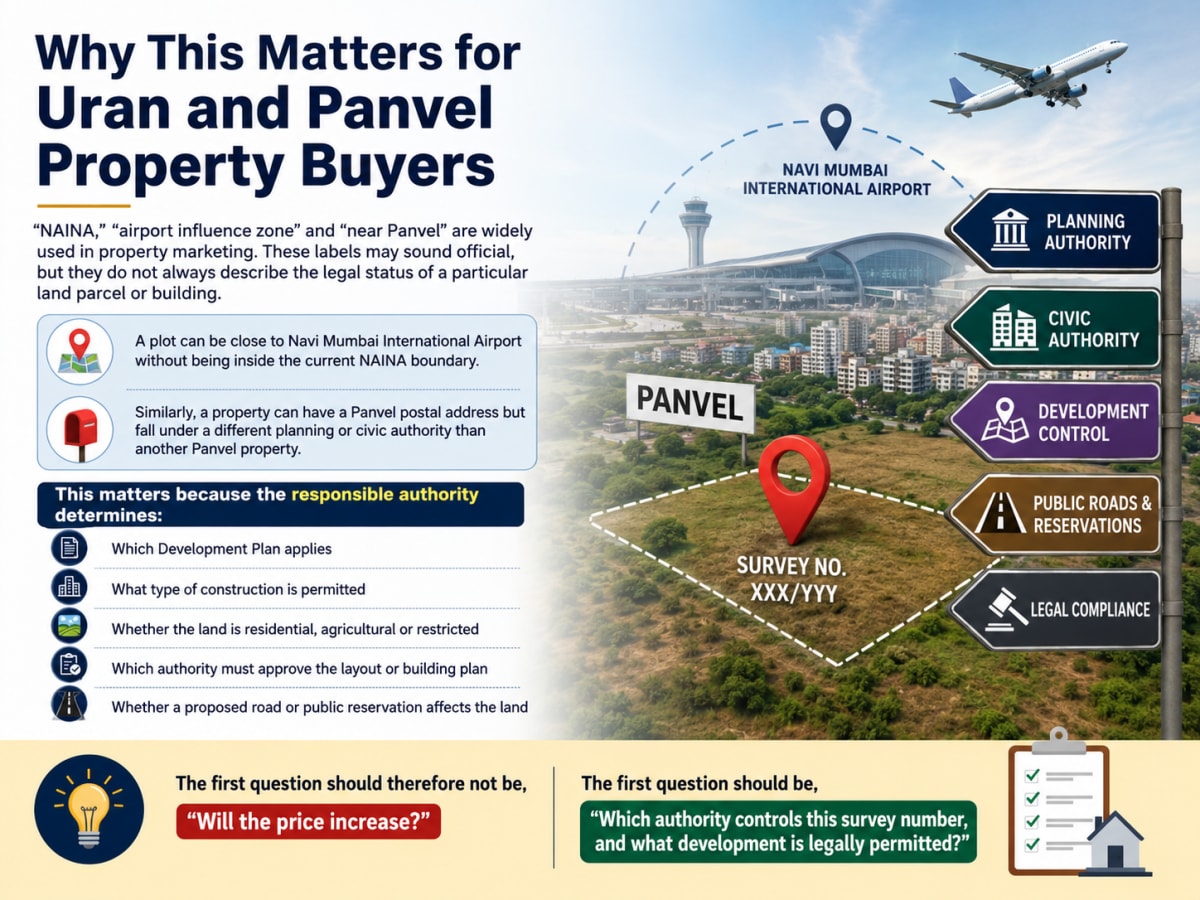
“NAINA,” “airport influence zone” and “near Panvel” are widely used in property marketing. These labels may sound official, but they do not always describe the legal status of a particular land parcel or building. A plot can be close to Navi Mumbai International Airport without being inside the current NAINA boundary. Similarly, a property can have a Panvel postal address but fall under a different planning or civic authority than another Panvel property. This matters because the responsible authority determines:
- Which Development Plan applies
- What type of construction is permitted
- Whether the land is residential, agricultural or restricted
- Which authority must approve the layout or building plan
- Whether a proposed road or public reservation affects the land
The first question should therefore not be, “Will the price increase?” The first question should be, “Which authority controls this survey number, and what development is legally permitted?”
What Is NAINA?
NAINA stands for Navi Mumbai Airport Influence Notified Area. It was created to guide and control planned development in the wider area influenced by Navi Mumbai International Airport. CIDCO was appointed as the Special Planning Authority for the notified NAINA jurisdiction. In simple terms, this means CIDCO prepares planning proposals, regulates development and implements Town Planning Schemes within the area placed under its NAINA authority. However, NAINA is not:
- Proof that a seller owns the property
- A guarantee of residential zoning
- A guarantee that construction is approved
- A promise that infrastructure will arrive by a fixed date
- A guarantee that property prices will increase
NAINA is a planning jurisdiction. Every property inside or near it still requires separate checks for title, zoning, construction approval, MahaRERA registration and other applicable permissions.
Does Uran Currently Come Under NAINA?
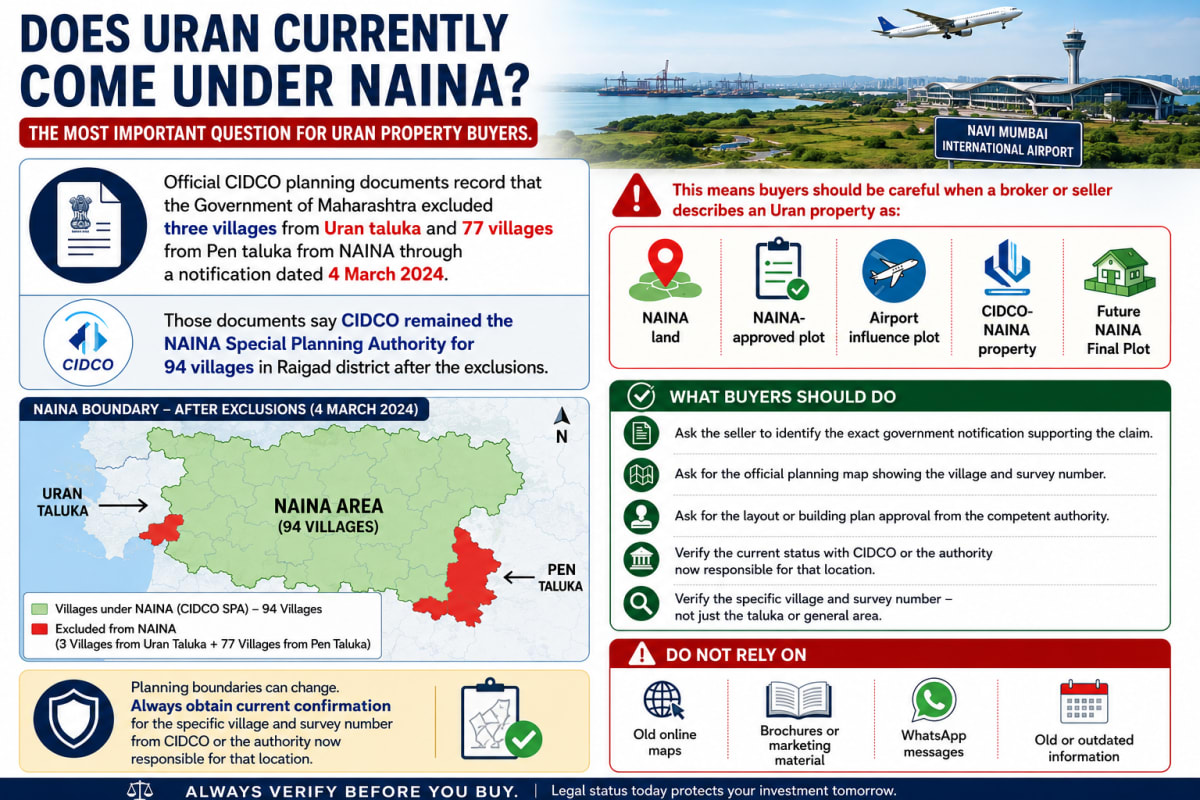 This is the most important question for buyers searching for an Uran NAINA guide. Official CIDCO planning documents record that the Government of Maharashtra excluded three villages from Uran taluka and 77 villages from Pen taluka from NAINA through a notification dated 4 March 2024. Those documents say CIDCO remained the NAINA Special Planning Authority for 94 villages in Raigad district after the exclusions. This means buyers should be careful when a broker or seller describes an Uran property as:
- NAINA land
- NAINA-approved plot
- Airport influence plot
- CIDCO-NAINA property
- Future NAINA Final Plot
Ask the seller to identify the exact government notification, planning map and approval supporting the claim. Because planning boundaries can change, obtain current confirmation for the specific village and survey number from CIDCO or the authority now responsible for that location. Do not rely on old online maps, brochures or WhatsApp messages.
NAINA Property, CIDCO Property and Airport-Area Property Are Not the Same
These expressions are often used as if they mean the same thing. They do not.
| Expression | What it may mean | What to verify |
| NAINA property | Property within a notified planning jurisdiction | Current village list, survey number, planning map and zoning |
| CIDCO property | Land owned, allotted, leased or developed by CIDCO | Allotment letter, lease deed, transfer status and CIDCO records |
| NAINA TPS plot | Land affected by a NAINA Town Planning Scheme | TPS number, Original Plot, Final Plot and scheme stage |
| Airport-area property | Property geographically near the airport | Actual authority, zoning, title and airport-related restrictions |
| Panvel property | Property marketed using the wider Panvel location | Exact village, municipal limits and planning authority |
| Uran property | Property situated in Uran taluka or marketed as Uran | Current authority, land records, zoning and access |
A private land parcel inside a CIDCO planning jurisdiction does not automatically become CIDCO-owned land. Similarly, a seller cannot prove NAINA approval merely by showing that the property is near the airport.
What Is a NAINA Town Planning Scheme?
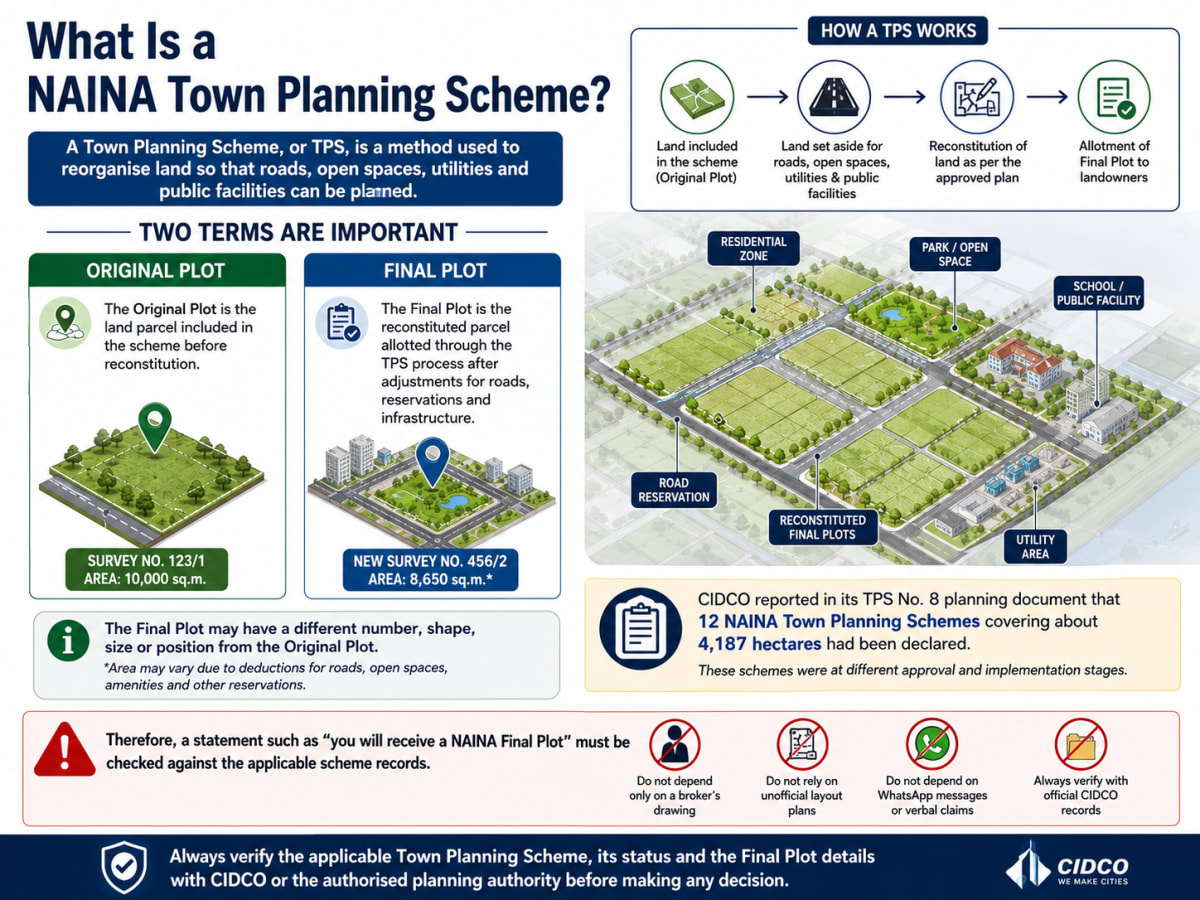 A Town Planning Scheme, or TPS, is a method used to reorganise land so that roads, open spaces, utilities and public facilities can be planned. Two terms are important:
Original Plot
The Original Plot is the land parcel included in the scheme before reconstitution.
Final Plot
The Final Plot is the reconstituted parcel allotted through the TPS process after adjustments for roads, reservations and infrastructure. The Final Plot may have a different number, shape, size or position from the Original Plot. CIDCO reported in its TPS No. 8 planning document that 12 NAINA Town Planning Schemes covering about 4,187 hectares had been declared. These schemes were at different approval and implementation stages. Therefore, a statement such as “you will receive a NAINA Final Plot” must be checked against the applicable scheme records. Do not depend only on a broker’s drawing or an unofficial layout.
How NAINA Can Influence Panvel Housing Demand
NAINA can influence housing demand by creating a framework for roads, public facilities, land use and organised development. But its effect is not immediate or equal everywhere. A notified plan can improve long-term confidence only when it moves from paper to implementation. Buyers should look for evidence such as completed roads, usable access, water supply, drainage, approved construction and growing occupancy.
Potential positive effects
- Better-planned road networks
- More organised land development
- Space for public amenities
- Greater developer interest
- New housing supply
- Improved connections between settlements
- Long-term urban expansion around Panvel
Practical limitations
- Town Planning Schemes progress at different speeds
- Infrastructure may take time to become usable
- New housing supply can be much higher than present demand
- Local water, drainage and access may remain weak during early development
- Planning inclusion does not clear private title disputes
- A future road shown on a plan is not the same as a completed road
NAINA should therefore be treated as one part of the property assessment, not the complete investment argument.
How Rail Connectivity Affects Panvel and Uran Housing Demand
Rail connectivity usually has the strongest direct effect on people who commute daily. A working railway service can widen the number of locations from which a person can travel to employment, education and commercial centres.
Uran suburban railway
Phase 2 of the Uran-Kharkopar railway line was dedicated in January 2024. It extended suburban services from Kharkopar towards Uran, improving railway access for the Uran side of Navi Mumbai. This can support end-user interest where buyers have reasonable access to stations. But the impact will differ from one property to another. Check:
- Walking or driving distance to the station
- Frequency and timing of trains
- Interchange requirements
- Auto, bus and last-mile availability
- Safety and road conditions near the station
- Total door-to-door travel time
A property advertised as “ten minutes from Uran station” may take much longer during peak traffic or monsoon conditions.
Panvel-Karjat suburban corridor
The Panvel-Karjat suburban corridor is part of Mumbai Urban Transport Project Phase III. Official government information lists it as a 29.6 km suburban project. MRVC’s project summary explains that the corridor is intended to facilitate suburban services between Panvel and Karjat. This may eventually improve accessibility for settlements along the route and increase interest in housing near useful stations. However, buyers should verify the latest construction and operational status. A project under implementation should not be described as an operational daily commuting option until the railway authorities confirm that services have started.
How Highway Connectivity Affects Panvel Housing Demand
Panvel sits near important regional road connections towards Mumbai, Pune, Goa and the JNPA-Uran side. This gives it a wider catchment than a locality dependent on one road or railway line. Highway connectivity can support:
- Intercity travel
- Logistics and employment access
- Car-based commuting
- Township development
- Commercial activity
- Weekend and second-home travel
- Access between Panvel, Uran and other parts of Navi Mumbai
But a highway near a project does not always mean easy access. A property may be geographically close to a highway but separated by:
- A railway crossing
- An incomplete service road
- A difficult junction
- A toll section
- A narrow village road
- A proposed interchange that is not operational
- A road reservation without a completed road
Visit the location during morning and evening peak hours. Measure the actual travel time from the property gate to the highway, station, workplace and market.
Rail, Highway and NAINA: Which Has the Strongest Demand Impact?
| Factor | Immediate effect | Long-term effect | Main limitation |
| Operational suburban railway | Can support commuting and rental enquiries | May expand end-user demand | Station frequency and last-mile access matter |
| Existing highway | Improves regional road access | Can support commercial and residential growth | Congestion and difficult entry points can reduce the benefit |
| Under-construction railway | Creates future interest | May improve accessibility after opening | Completion and service frequency remain uncertain |
| Proposed road | May influence investor expectations | Useful only after implementation | Alignment and timeline can change |
| NAINA planning | Provides a framework for organised development | Can support planned urban expansion | Planning does not equal completed infrastructure |
| Airport proximity | Can support employment and business interest | May influence surrounding development | Does not establish approval, title or guaranteed appreciation |
For an end-use buyer, operational connectivity and present livability usually matter more than a distant promise. For an investor, planned infrastructure may be relevant, but only after checking approvals, holding period, housing supply and resale demand.
Step-by-Step: How to Verify an Uran or Panvel Property
Step 1: Identify the exact property
Collect the complete details:
- Village
- Taluka
- Survey number
- Hissa number
- CTS or property-card number, if available
- Plot number
- Building and wing
- Project name
- MahaRERA registration number
- Map location
Do not begin verification with only a project nickname or Google Maps pin.
Step 2: Confirm the current planning authority
Ask which authority controls development for the survey number. Depending on the location, this may involve CIDCO-NAINA, CIDCO’s notified Navi Mumbai area, Panvel Municipal Corporation or another Special Planning Authority. Request documentary support. If the boundary is unclear, obtain written clarification from the relevant authority or ask a qualified town-planning professional to verify it.
Step 3: Check zoning and reservations
Confirm the land-use classification in the current Development Plan. Check whether the land is:
- Residential
- Agricultural
- Industrial
- A public reservation
- A proposed road
- Open space
- Environmentally restricted
- Affected by another planning proposal
A seller calling land “residential” does not make it legally residential.
Step 4: Check whether a TPS applies
If the land is affected by a NAINA Town Planning Scheme, verify:
- TPS number
- Current scheme stage
- Original Plot number
- Final Plot number
- Area included in the scheme
- Roads or reservations affecting it
- Official plot record or property card
Confirm whether the seller owns the Original Plot, the Final Plot or only claims a future entitlement.
Step 5: Verify land records
Use the official Mahabhumi portal to access the applicable land records. Compare:
- Owner’s name
- Survey and hissa numbers
- Total area
- Mutation entries
- Tenure
- Other rights or remarks
A digitally signed 7/12 extract can be used for official purposes, but it should still be cross-checked with registered title deeds and the ownership chain. Read our [Internal Link: How to Verify Property Ownership] guide before relying on the seller’s papers.
Step 6: Search registered documents
Use the IGR Maharashtra e-Search service to search registered transactions using property or document details. A property lawyer should examine:
- Sale deeds
- Previous agreements
- Index II records
- Gift or release deeds
- Powers of attorney
- Mortgage and release documents
- Inheritance papers
- Complete ownership chain
An online search helps identify records, but it is not a substitute for a professional title search.
Step 7: Verify building and layout approvals
For a flat or plotted development, ask for:
- Approved layout
- Sanctioned building plan
- Development permission
- Commencement Certificate
- Land-title documents
- Phase-specific approval
- Occupancy Certificate for a completed building
Our [Internal Link: Building Plan Approval] guide explains how to compare the approved plan with what is being sold.
Step 8: Check MahaRERA
Search the project on the official MahaRERA Project Search portal. Compare:
- Project name
- Promoter name
- Survey numbers
- Building or phase
- Approved plans
- Declared completion date
- Extensions
- Encumbrances
- Complaints and orders, where displayed
- Construction progress
Use [Internal Link: MahaRERA Project Search] for a detailed project-verification process. Remember that MahaRERA registration helps buyers access project disclosures. It does not guarantee a clear title or remove every project risk.
Step 9: Verify each connectivity claim
Place every advertised project into one of these categories:
- Operational
- Under construction
- Tendered or awarded
- Officially approved but not started
- Proposed or reported
Ask for the official source supporting the claim. Do not accept a social-media post or sales presentation as confirmation.
Step 10: Get a professional review before paying
For a flat, get the agreement and title disclosures checked by a property lawyer. For land, you may also need a surveyor, architect or town-planning professional to verify the boundary, zoning, legal access, TPS implications and development potential.
Documents Checklist
Land or plotted property
| Document | Why it matters |
| Digitally signed 7/12 extract | Shows current revenue-record information |
| 8A extract | Helps cross-check account and landholding details |
| Mutation entries | Shows changes recorded in the revenue record |
| Village map | Helps locate the survey parcel |
| Measurement plan | Helps verify boundaries and area |
| Property card, if applicable | Records property details in surveyed urban or TPS areas |
| Registered title deed | Shows how the seller acquired the property |
| Ownership chain | Helps trace previous transfers |
| Index II and document search | Helps identify registered transactions |
| Zone confirmation | Shows the applicable planning use |
| Development Plan extract | Helps identify roads and reservations |
| NA permission or applicable order | Helps establish permitted non-agricultural use |
| Approved layout | Confirms the authorised plot arrangement |
| TPS records | Establish Original Plot, Final Plot and scheme status |
| Legal access proof | Confirms that the property has a lawful approach |
| Title-search report | Provides professional review of the title chain |
Under-construction flat
- MahaRERA project details
- Sanctioned plan
- Commencement Certificate
- Title disclosure
- Approved building and phase details
- Draft Agreement for Sale
- Carpet-area statement
- Payment schedule
- Possession date
- Extension orders, if applicable
- Access-road and utility approvals
Also use [Internal Link: Flat Buying Documents Checklist] before booking.
Completed or resale flat
- Registered agreement
- Previous agreement chain
- Occupancy Certificate
- Sanctioned plan
- Society share certificate
- Society registration details
- Maintenance-dues statement
- Property-tax receipt
- Electricity bill
- Loan closure letter or bank NOC
- Seller identity documents
- Succession documents, if inherited
Read [Internal Link: Resale Flat Documents Checklist] and [Internal Link: Society NOC] for the transaction-specific checks.
New Flat, Resale Flat and Plot: What Changes?
| Verification area | New flat | Resale flat | Plot or land |
| MahaRERA | Usually central to verification | Check if the original project was registered | Applicable for registered plotted projects |
| Building approval | Check sanctioned plan and CC | Compare building with sanctioned plan | Check approved layout and development permission |
| OC | Required for completed occupation, where applicable | Important for completed resale buildings | Not applicable to vacant land |
| Society documents | Usually not available at the booking stage | Important | Usually not applicable |
| Land records | Review project land disclosures | Usually indirect through project title | Directly important |
| TPS records | Check if project land is affected | Check if relevant to the building land | Critical when the parcel is within a scheme |
| Ownership chain | Promoter’s project title | Seller plus previous flat agreements | Complete land-title chain |
| Main risk | Delay or approval mismatch | Missing OC, dues or title-chain gap | Zoning, access, title and boundary risk |
For completed properties, understand the [Internal Link: OC vs CC vs Possession Letter] before accepting possession-related claims.
Red Flags Buyers Should Not Ignore
Be cautious if:
- The seller says “NAINA approved” but cannot show an approval number
- An Uran property is marketed using an old NAINA map
- The planning authority is not clearly identified
- Survey numbers differ across the 7/12, deed and layout
- Agricultural land is sold as a ready residential plot
- A future Final Plot is promised without official TPS records
- The approach road exists physically but not legally
- A proposed road is shown as completed
- One MahaRERA registration is used to market another phase
- The project name differs from the official MahaRERA record
- Only a 7/12 extract is offered as proof of title
- The seller refuses to provide the ownership chain
- Token money must be paid before document review
- The price includes a large “airport premium” without present livability
- Infrastructure completion dates are given without official sources
These signs do not automatically prove fraud. They mean you should pause and verify before proceeding.
Common Mistakes Buyers Make
Assuming NAINA means CIDCO ownership
CIDCO may act as a planning authority without owning the land. Ask whether the property is privately owned, CIDCO-allotted or affected by a TPS.
Using an old NAINA village list
NAINA’s notified jurisdiction has changed. Always check the latest official notification.
Checking only the 7/12 extract
The 7/12 is useful, but it is not a complete title investigation. Registered deeds, mutations, access, zoning, mortgages and litigation also matter.
Confusing a proposed Final Plot with an allotted Final Plot
A seller’s expectation is not an official allotment. Check the TPS stage and plotwise records.
Believing that RERA registration clears every risk
MahaRERA provides important project disclosures. Buyers must still check title, authority approval, phase details and agreement terms.
Paying for future infrastructure too early
A railway or road may improve demand after becoming usable. Paying a large premium years in advance increases investment risk.
Measuring only map distance
A project may look close to Panvel station or a highway on a map but have difficult last-mile access.
What to Check Before Paying Token Money
Before paying any token amount, confirm:
- Seller’s identity
- Seller’s authority to sell
- Ownership chain
- Survey and hissa numbers
- Current planning authority
- Land-use zone
- Road and reservation status
- Legal access
- TPS status, if applicable
- NA or permitted-use status
- MahaRERA details, if applicable
- Sanctioned plan and CC
- OC for a completed building
- Existing mortgage or lender claim
- Society dues for a resale flat
- Written refund and cancellation terms
Do not pay token money only because the price appears attractive or another buyer is supposedly waiting.
Final Buyer Checklist
Use this simple decision test:
- [ ] I know the exact village and survey number.
- [ ] I have confirmed the current planning authority.
- [ ] I have checked whether the property is currently inside NAINA.
- [ ] I have verified the land-use zone.
- [ ] I have checked road and public reservations.
- [ ] I understand whether a TPS affects the property.
- [ ] I have matched the Original Plot and Final Plot records, if relevant.
- [ ] The owner’s name and property details match across documents.
- [ ] A lawyer has reviewed the ownership chain.
- [ ] I have checked IGR Maharashtra records.
- [ ] The approved plan matches the property being sold.
- [ ] I have verified the exact MahaRERA phase.
- [ ] I know which transport links are operational.
- [ ] I have inspected present water, roads, drainage and livability.
- [ ] Token payment and refund terms are in writing.
- [ ] I am not depending on guaranteed appreciation.
Final Takeaway
NAINA, railway expansion and highway connectivity can support the long-term development of the Panvel region. Uran’s suburban railway connection can also improve practical access for residents on the Uran side. But these infrastructure advantages do not replace property verification. The latest CIDCO planning records show that NAINA’s jurisdiction has changed, including the exclusion of three Uran taluka villages in March 2024. Therefore, “Uran NAINA property” should never be accepted only as a marketing description. Verify the exact survey number, authority, zoning, ownership chain and approvals before paying. Buy based on documented facts and present usability, not only on future-development promises.
Need Help Shortlisting a Property?
Navi Mumbai Property Deals follows a buyer-first approach to property discovery. We help buyers ask the right questions about location, project documents, authority jurisdiction and practical connectivity before they shortlist a property. Explore verified property guidance on Navi Mumbai Property Deals before making your next buying decision.
Disclaimer
This article provides general property-education information and does not constitute legal, financial or investment advice. Planning boundaries, approvals, project status and infrastructure timelines can change. Verify the latest position with CIDCO, MahaRERA, the relevant planning authority and a qualified property lawyer before completing a transaction.
Suggested Schema Markup Types
- Article
- BlogPosting
- FAQPage
- BreadcrumbList
- Organization
- WebPage
Do not use Review, AggregateRating or LocalBusiness rating schema unless genuine, visible and policy-compliant information is available on the page.
Internal Links to Add
- [Internal Link: Flat Buying Documents Checklist]
- [Internal Link: OC vs CC vs Possession Letter]
- [Internal Link: MahaRERA Project Search]
- [Internal Link: Resale Flat Documents Checklist]
- [Internal Link: How to Verify Property Ownership]
- [Internal Link: Building Plan Approval]
- [Internal Link: Society NOC]
External Sources Used
- CIDCO NAINA Town Planning Scheme No. 5
- CIDCO NAINA Town Planning Scheme No. 4
- CIDCO NAINA TPS No. 8 Report
- MahaRERA Project Search
- MahaRERA Property-Buying Guidance
- Mahabhumi Land Records Portal
- IGR Maharashtra e-Search
- PIB: Uran-Kharkopar Railway Phase 2
- PIB: Panvel-Karjat Suburban Corridor Details
- MRVC: Panvel-Karjat Project Executive Summary
- NHAI Panvel NH-66 Document
Frequently Asked Questions
1. Does Uran currently come under NAINA?
Recent CIDCO documents state that three villages from Uran taluka were excluded from NAINA through a notification dated 4 March 2024. Buyers should verify the exact village and survey number against the latest official notification instead of assuming that an Uran property is inside NAINA.
2. Are all Panvel properties part of NAINA?
No. The wider Panvel market includes different planning and civic jurisdictions. The applicable authority must be checked for the exact village, plot and survey number.
3. What does “NAINA approved property” mean?
The phrase is incomplete unless the seller identifies the specific approval. Ask for the planning authority’s approval number, sanctioned layout, development permission and other documents applicable to the property.
4. Is NAINA property the same as CIDCO property?
No. CIDCO may regulate development as a Special Planning Authority without owning the private land. CIDCO-allotted or leasehold property has a different document and transfer process.
5. Does a 7/12 extract prove clear ownership?
No. It is an important revenue record, but it does not by itself establish a clear and marketable title. The registered ownership chain, mutations, mortgages, access and other rights must also be checked.
6. What is a Final Plot in NAINA?
A Final Plot is a reconstituted parcel created through a Town Planning Scheme. It may differ from the owner’s Original Plot in area, location, shape and number. Its status must be verified through official TPS records.
7. Can the Uran railway increase housing demand?
Operational railway connectivity can improve commuting and make some locations more practical for residents. The actual benefit depends on station distance, train frequency, last-mile transport and local livability.
8. Will the Panvel-Karjat corridor increase property prices?
It may improve accessibility and buyer interest after becoming operational, but price growth cannot be guaranteed. Supply, employment, approvals, civic services and current purchase price also matter.
9. Do highways automatically make a Panvel project a good investment?
No. Highways improve regional access, but buyers must check legal approach roads, congestion, service roads, project approvals, local infrastructure and actual housing demand.
10. What should I verify before buying an Uran plot?
Verify the planning authority, current NAINA status, survey number, 7/12 extract, mutation entries, title chain, zoning, legal access, NA status, layout approval, reservations, mortgages and litigation before paying token money.