Uran KSC New Town Guide for Property Buyers

Uran KSC New Town Guide: What Property Buyers Must Verify
KSC New Town is attracting attention because of its connection with Uran, Atal Setu, Navi Mumbai International Airport and the wider “Third Mumbai” plan. But there is one important point every buyer should understand: A property being advertised as “inside KSC New Town” does not automatically mean it is residential, approved for construction or legally safe to purchase. You must verify the village, survey number, land use, ownership and planning approvals separately. This guide explains what KSC New Town means, which authority controls it and how to verify a plot, flat or under-construction project before paying a token amount.
Quick Answer
Karnala-Sai-Chirner New Town, commonly called KSC New Town, is a notified development area covering specified villages in Uran, Panvel and Pen talukas of Raigad district. The Maharashtra government appointed the Mumbai Metropolitan Region Development Authority, or MMRDA, as the New Town Development Authority for this area through a notification dated 15 October 2024. According to MMRDA, the notified area covers approximately 323.44 square kilometres across 124 villages. However, KSC is still a developing planning area. Buyers should not assume that every parcel inside a notified village can be used for housing. Before buying, confirm:
| Question | Where to verify |
| Is the village included in KSC? | MMRDA notification |
| Does the exact survey number fall within the boundary? | MMRDA and official land maps |
| Who owns the property? | 7/12, registered deeds and title search |
| Is residential development permitted? | MMRDA or competent planning authority |
| Is the plotted layout sanctioned? | Approved layout and permission letter |
| Is the project registered? | MahaRERA Project Search |
| Is the land affected by acquisition or reservation? | MMRDA planning and land records |
| Does a ready building have an OC? | Competent authority and OC document |
What Is KSC New Town?
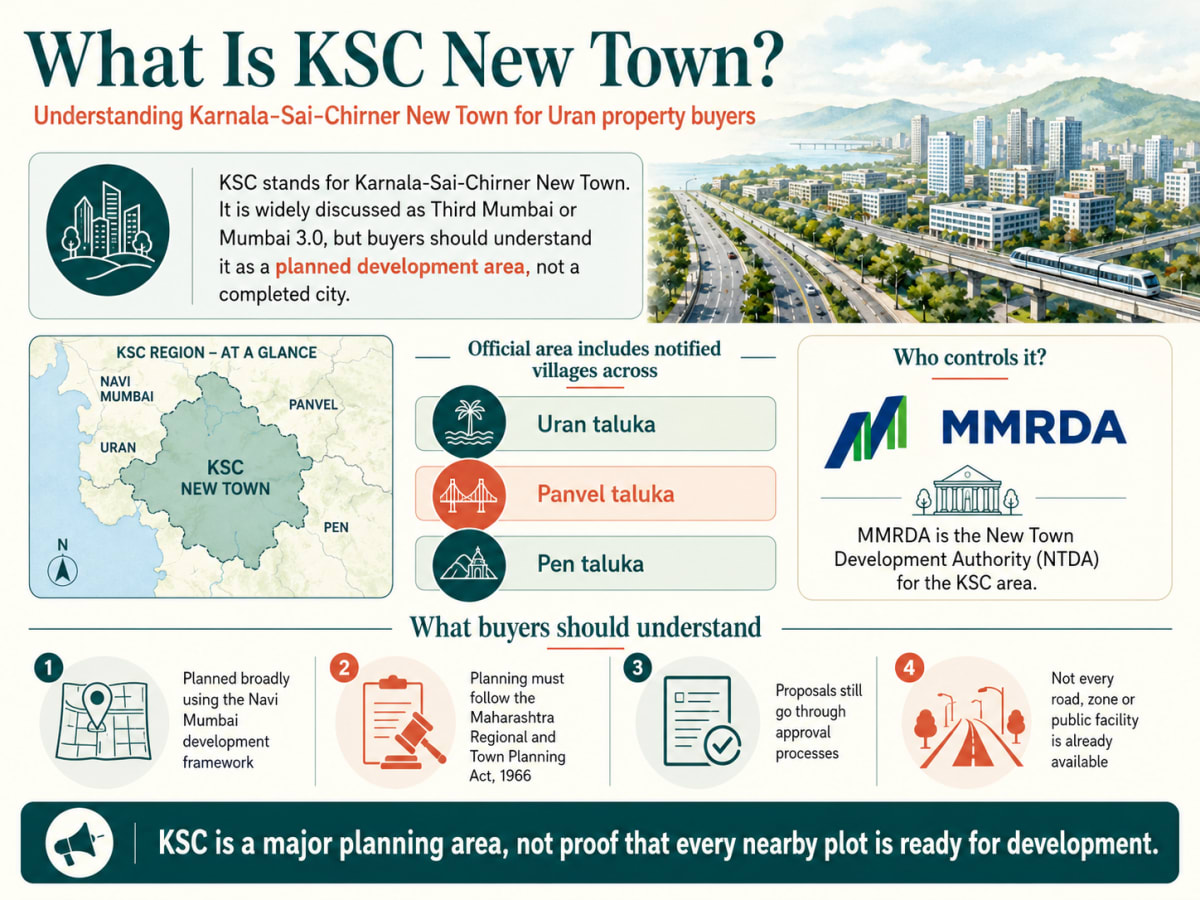
KSC stands for Karnala-Sai-Chirner New Town. It is also widely discussed as “Third Mumbai” or “Mumbai 3.0” in property advertisements and news reports. The official KSC area includes notified villages across:
- Uran taluka
- Panvel taluka
- Pen taluka
The Maharashtra government appointed MMRDA as the New Town Development Authority for the area. MMRDA says the new town is being planned broadly using the development framework followed for CIDCO’s Navi Mumbai. According to the official MMRDA NTDA overview, planning proposals must follow the Maharashtra Regional and Town Planning Act, 1966, and go through the required approval process. This means KSC should be understood as a major planned development area, not as a completed city where every road, zone and public facility is already available.
Is All of Uran Part of KSC New Town?
No. Buyers should not assume that all land in Uran falls inside KSC New Town. The government notification covers a specific list of 124 villages across Uran, Panvel and Pen. Even when a village is included, the exact effect on a particular parcel may depend on its survey number, boundary and planning status. For example, a broker may advertise land as:
- Near KSC New Town
- Inside Third Mumbai
- KSC-approved
- Near Chirner growth centre
- Atal Setu influence plot
These phrases do not prove anything about the legal status of the property. Ask for the exact:
- Village name
- Taluka
- Survey or gat number
- Hissa number
- Plot area
- Boundary description
- Approval number, if any
Then match those details with the official notification and authority records.
Who Controls Planning in KSC New Town?
MMRDA is the New Town Development Authority for the notified KSC area. The government notification dated 15 October 2024 appointed MMRDA for the specified area. The notification identifies approximately 323.44 square kilometres covering 124 villages. This is important because some Uran and Panvel properties may have older documents connected with CIDCO, NAINA, Khopta New Town or another authority. An old CIDCO approval should not be accepted or rejected without checking:
- Whether it covers the same survey number
- What exactly was approved
- Whether its conditions were fulfilled
- Whether construction followed the sanctioned plan
- Which authority now handles further permissions
- Whether a revised approval is required
When jurisdiction is unclear, request written clarification from MMRDA or the relevant authority. Do not depend only on a broker’s explanation.
KSC Land Policy: What Buyers Should Understand
The Maharashtra government approved a land acquisition and land-allocation policy for MMRDA’s New Town Development Authority through a Government Resolution dated 16 March 2026. MMRDA has described the approach as a participatory model involving acquisition, allocation and land-pooling options. The authority has also opened a KSC consent-submission process for landowners. Land pooling generally means that land is assembled for planned development and eligible owners may receive compensation or a defined portion of developed land under the applicable policy. But buyers should be careful with one common sales claim:
“Buy this land now and you will definitely receive 22.5% developed land.” Do not accept this without official parcel-level verification. Eligibility can depend on the land, ownership, policy conditions, acquisition process and option selected by the lawful owner. A buyer should check the MMRDA KSC project documents and obtain professional advice before relying on any compensation or developed-plot promise.
Being Inside KSC Does Not Mean the Plot Is Residential
This is perhaps the most important part of the guide. A property can fall within a notified planning area and still have restrictions on development. You must separately verify:
- Present land use
- Proposed or sanctioned zoning
- Agricultural or non-agricultural status
- Approved access
- Layout sanction
- Building permission
- Public reservations
- Proposed roads
- Acquisition proceedings
- Coastal or environmental restrictions
Understand these four different claims
| Seller’s claim | What it actually proves |
| “The village is in KSC” | Only possible inclusion within the wider notified area |
| “The land is NA” | A specific non-agricultural order may exist, but its use and conditions must be checked |
| “The layout is approved” | An authority may have sanctioned a specific layout, subject to conditions |
| “Construction is approved” | A building permission may exist for a specific plan and parcel |
One claim cannot replace the others. For example, an NA order does not automatically prove that a private plotted layout is sanctioned. Similarly, a sanctioned layout does not prove that every building constructed inside it has permission.
Step-by-Step KSC Property Verification Process
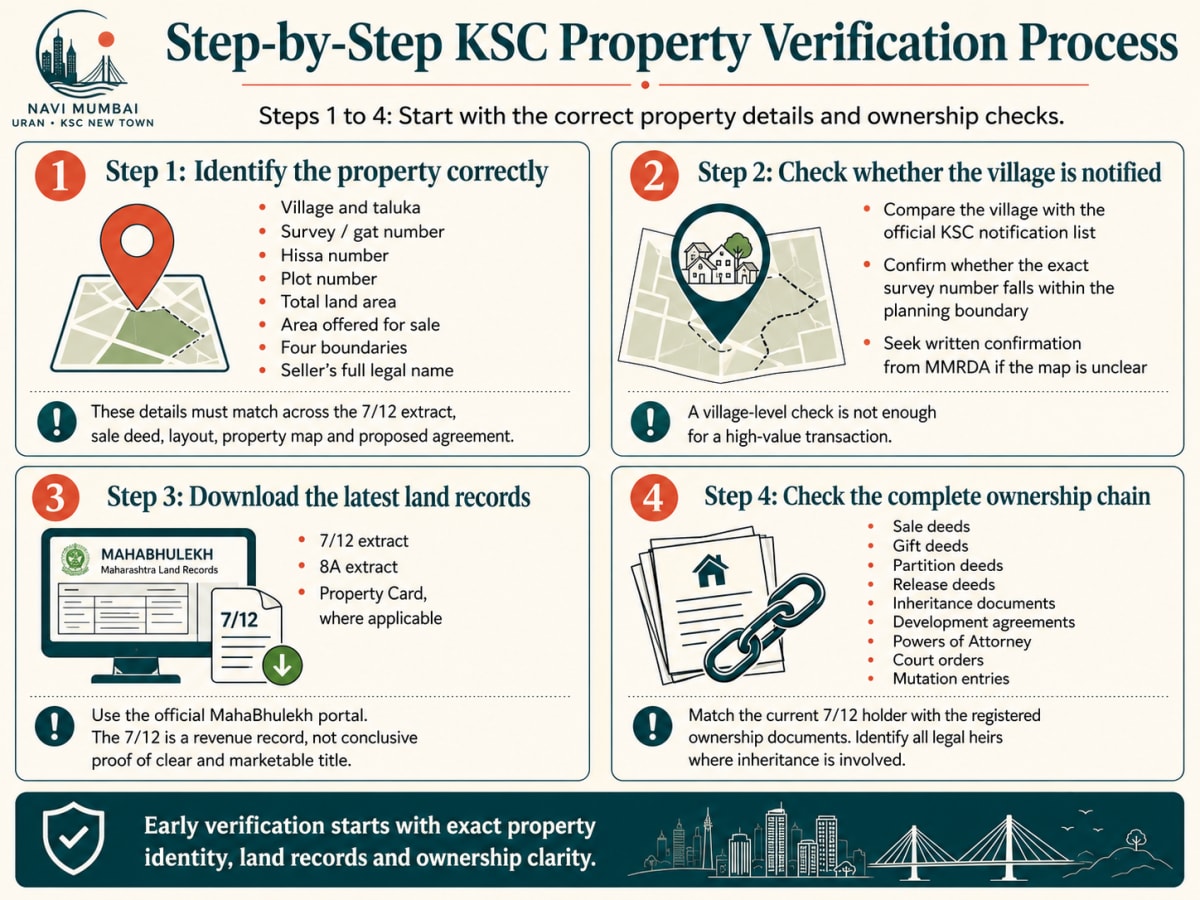
Step 1: Identify the property correctly
Do not begin verification with a project nickname or Google Maps pin. Ask the seller for:
- Village and taluka
- Survey or gat number
- Hissa number
- Plot number
- Total land area
- Area offered for sale
- Four boundaries
- Seller’s full legal name
These details must remain consistent across the 7/12 extract, sale deed, layout, property map and proposed agreement.
Step 2: Check whether the village is notified
Compare the village with the schedule attached to the official KSC notification. If the village appears in the list, confirm whether the exact survey number falls wholly or partly within the relevant planning boundary. Where the map is unclear, seek confirmation from MMRDA. A village-level check is not enough for a high-value transaction.
Step 3: Download the latest land records
Use the official MahaBhulekh portal to check the available:
- 7/12 extract
- 8A extract
- Property Card, where applicable
The 7/12 extract can show the recorded holder, land area, cultivation details and other entries. The 8A provides supporting landholding account information. However, a 7/12 extract is a revenue record. It should not be treated as conclusive proof of a clear and marketable title.
Step 4: Check the complete ownership chain
Collect the registered documents through which ownership changed over time. Depending on the property, these may include:
- Sale deeds
- Gift deeds
- Partition deeds
- Release deeds
- Inheritance documents
- Development agreements
- Powers of Attorney
- Court orders
- Mutation entries
The name on the current 7/12 should be matched with the registered ownership documents. If the property is inherited, identify every legal heir who may have rights. One family member should not sell the entire land unless that person has valid legal authority. Read our [Internal Link: How to Verify Property Ownership] guide for a detailed ownership-checking process.
Step 5: Search registered transactions
The IGR Maharashtra e-Search service allows citizens to search registered transactions using property or document details. Search using the available:
- District and village
- Survey or gat number
- Document number
- Registration year
- Seller and purchaser details
Obtain Index II and copies of relevant registered documents wherever available. This can help identify previous sales, mortgages or conflicting transactions. It should still be supported by an independent title search conducted by a property lawyer.
Step 6: Verify zoning and planning remarks
Ask the planning authority for written information about:
- Current land use
- Proposed land use
- Public reservation
- Proposed road
- Acquisition status
- Permissible development
- Applicable development-control rules
- Environmental restrictions
Do not rely on unofficial colour-coded KSC maps circulated on WhatsApp or property websites. Planning proposals can change during the statutory approval process.
Step 7: Verify the access road
Many land deals become difficult because the plot exists on paper but does not have a legally recorded approach road. Check whether access is:
- A public road
- A sanctioned layout road
- A recorded right of way
- A private road belonging to another owner
- Only an informal village pathway
A proposed road shown on a future plan is not the same as an existing legal access road. Inspect the site and compare the physical road with the registered documents and approved layout.
Step 8: Check the layout approval
For a plotted development, ask for the complete sanctioned layout and approval letter. Verify:
- Name of the approving authority
- Approval date and number
- Survey numbers covered
- Total approved area
- Number and dimensions of plots
- Internal roads
- Open spaces
- Amenity areas
- Conditions attached to approval
- Whether the offered plot appears in the sanctioned plan
A privately prepared drawing with plot numbers is not an approved layout. Read [Internal Link: Building Plan Approval] to understand how sanctioned plans should be checked.
Step 9: Search the project on MahaRERA
If you are buying in a residential project or plotted development covered by RERA registration requirements, search it on the official MahaRERA Project Search. Match the listing with:
- Official project name
- Promoter’s legal entity
- MahaRERA number
- Project phase
- Survey numbers
- Declared completion date
- Sanctioned plans
- Legal title report
- Encumbrance disclosure
- Agreement for Sale
- Complaints and authority orders
A project with a similar name is not enough. The phase and land survey numbers must match. Use our [Internal Link: MahaRERA Project Search] guide while checking the project page.
Step 10: Verify flat-related approvals
For an under-construction flat, check the sanctioned plan, Commencement Certificate and MahaRERA disclosures. For a ready flat, ask for the Occupancy Certificate. An OC generally confirms that the competent authority has permitted occupation of the completed building, subject to the certificate’s scope and conditions. A possession letter given by a developer is not a replacement for an OC. For a simple explanation, read [Internal Link: OC vs CC vs Possession Letter].
Step 11: Inspect and measure the property
Visit the site during daylight and check:
- Boundary stones
- Actual area
- Encroachments
- Road width
- Drainage
- Waterlogging
- High-tension lines
- Pipelines
- Hills, creeks or water bodies
- Existing occupants
- Distance from promised infrastructure
For land, consider using a licensed surveyor to match the physical boundaries with official measurements.
Step 12: Review everything before paying a token
Ask an independent property lawyer to review the title, authority approvals and proposed agreement. If you pay a small token before completing verification, the written token receipt should clearly state that the payment is refundable if title, zoning, access, acquisition, RERA or approval checks fail. Avoid large cash payments and oral refund promises.
KSC Property Documents Checklist
For raw land or a plotted development
| Document | Why you need it |
| Latest 7/12 and 8A | To check recorded land details |
| Mutation entries | To understand changes recorded in revenue records |
| Registered title chain | To trace how the seller obtained rights |
| Index II records | To identify registered transactions |
| Village and measurement maps | To verify location and boundaries |
| Title-search report | To identify ownership defects and encumbrances |
| NA order, if claimed | To verify permitted non-agricultural use |
| Zoning or planning remarks | To understand permitted development |
| Sanctioned layout | To confirm legal plot subdivision |
| Access-road documents | To establish lawful entry to the plot |
| Acquisition or reservation remarks | To identify possible planning impact |
| MahaRERA details, where applicable | To verify the registered plotted project |
| Tax and revenue receipts | To check stated dues and property details |
For an under-construction flat
- MahaRERA registration
- Legal title report uploaded on MahaRERA
- Encumbrance disclosure
- Sanctioned building plan
- Commencement Certificate
- Draft Agreement for Sale
- Deviation report
- Construction-linked payment plan
- Promised possession date
- Written amenity specifications
- Parking terms
For a ready or resale flat
- Registered seller agreement or Sale Deed
- Index II
- Ownership chain
- Occupancy Certificate
- Sanctioned building plan
- Society share certificate
- Society dues statement
- Property-tax receipts
- Electricity and water dues
- Loan closure or lender release
- Society transfer documentation
- Physical inspection report
Use [Internal Link: Resale Flat Documents Checklist] when examining a ready or previously owned flat.
KSC Property Buyer Guide
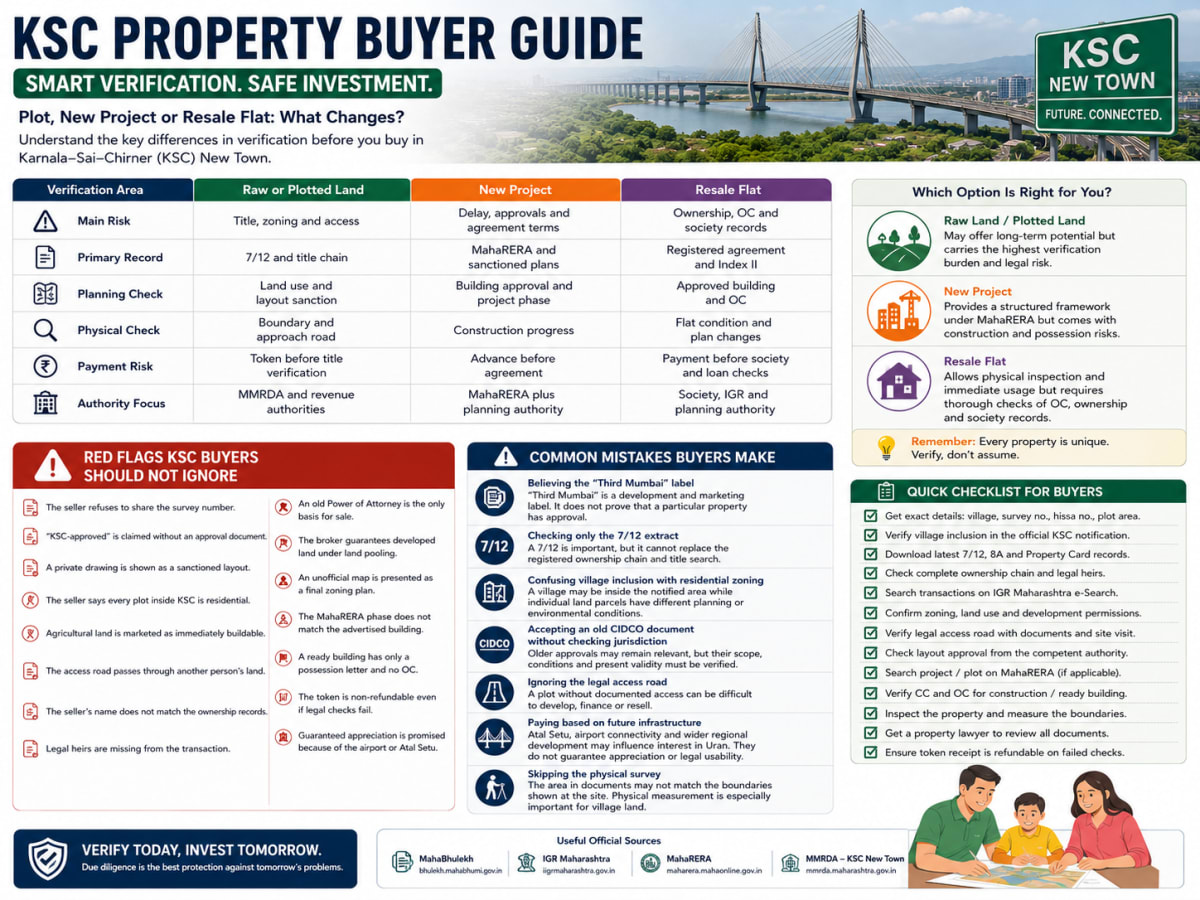
Plot, New Project or Resale Flat: What Changes?
| Verification area | Raw or plotted land | New project | Resale flat |
| Main risk | Title, zoning and access | Delay, approvals and agreement terms | Ownership, OC and society records |
| Primary record | 7/12 and title chain | MahaRERA and sanctioned plans | Registered agreement and Index II |
| Planning check | Land use and layout sanction | Building approval and project phase | Approved building and OC |
| Physical check | Boundary and approach road | Construction progress | Flat condition and plan changes |
| Payment risk | Token before title verification | Advance before agreement | Payment before society and loan checks |
| Authority focus | MMRDA and revenue authorities | MahaRERA plus planning authority | Society, IGR and planning authority |
The better option depends on your objective. Raw land may involve the highest verification burden. A new project may offer a clearer project structure but brings construction and possession risks. A resale flat can be physically inspected, but the buyer must check the OC, ownership chain, society documents and outstanding dues.
Red Flags KSC Buyers Should Not Ignore
Pause the transaction if:
- The seller refuses to share the survey number.
- “KSC-approved” is claimed without an approval document.
- A private drawing is shown as a sanctioned layout.
- The seller says every plot inside KSC is residential.
- Agricultural land is marketed as immediately buildable.
- The access road passes through another person’s land.
- The seller’s name does not match the ownership records.
- Legal heirs are missing from the transaction.
- An old Power of Attorney is the only basis for sale.
- The broker guarantees developed land under land pooling.
- An unofficial map is presented as a final zoning plan.
- The MahaRERA phase does not match the advertised building.
- A ready building has only a possession letter and no OC.
- The token is non-refundable even if legal checks fail.
- Guaranteed appreciation is promised because of the airport or Atal Setu.
A red flag does not always mean fraud. It means you need proper documents and clarification before moving forward.
Common Mistakes Buyers Make
Believing the “Third Mumbai” label
“Third Mumbai” is a development and marketing label. It does not prove that a particular property has approval.
Checking only the 7/12 extract
A 7/12 is important, but it cannot replace the registered ownership chain and title search.
Confusing village inclusion with residential zoning
A village may be inside the notified area while individual land parcels have different planning or environmental conditions.
Accepting an old CIDCO document without checking jurisdiction
Older approvals may remain relevant, but their scope, conditions and present validity must be verified.
Ignoring the legal access road
A plot without documented access can be difficult to develop, finance or resell.
Paying based on future infrastructure
Atal Setu, airport connectivity and wider regional development may influence interest in Uran. They do not guarantee that every property will appreciate or become legally developable.
Skipping the physical survey
The area mentioned in documents may not match the boundaries shown at the site. Physical measurement is especially important for village land.
Final Buyer Checklist
Before purchasing property marketed under KSC New Town, confirm that:
- [ ] The exact village is included in the official notification.
- [ ] The survey or gat number has been identified.
- [ ] The competent planning authority is confirmed.
- [ ] The latest 7/12 and 8A have been checked.
- [ ] The complete registered ownership chain is available.
- [ ] IGR transaction records have been searched.
- [ ] All owners and legal heirs are participating.
- [ ] Current land use and zoning have been verified.
- [ ] Acquisition and reservation status has been checked.
- [ ] Legal road access is documented.
- [ ] The layout approval matches the survey number.
- [ ] MahaRERA details match the advertised project and phase.
- [ ] Building approvals have been verified.
- [ ] A ready building has a valid OC covering the property.
- [ ] Physical boundaries have been inspected.
- [ ] An independent lawyer has reviewed the transaction.
- [ ] Refund conditions are written before paying a token.
Final Takeaway
KSC New Town may become an important part of the wider Navi Mumbai and Raigad growth corridor. MMRDA’s appointment as the New Town Development Authority gives the area an official planning framework. But buyers should separate the long-term KSC vision from the legal status of an individual property. The safest approach is simple: Verify the exact survey number, ownership, zoning, road access and approvals before discussing future returns. If you are evaluating a plot, new project or resale flat in Uran, Navi Mumbai Property Deals can help you understand which documents to request and which authority records should be checked. Our goal is to make property verification easier to understand before you make a major financial commitment.
Disclaimer
This article is for general educational purposes and does not constitute legal, financial or investment advice. Planning boundaries, land policies, project approvals and authority procedures can change. Verify the latest information with MMRDA, MahaRERA, IGR Maharashtra, the relevant revenue or planning authority and an independent property lawyer before entering into a transaction.