Seawoods Redevelopment Guide: Documents, Risks and Buyer Verification
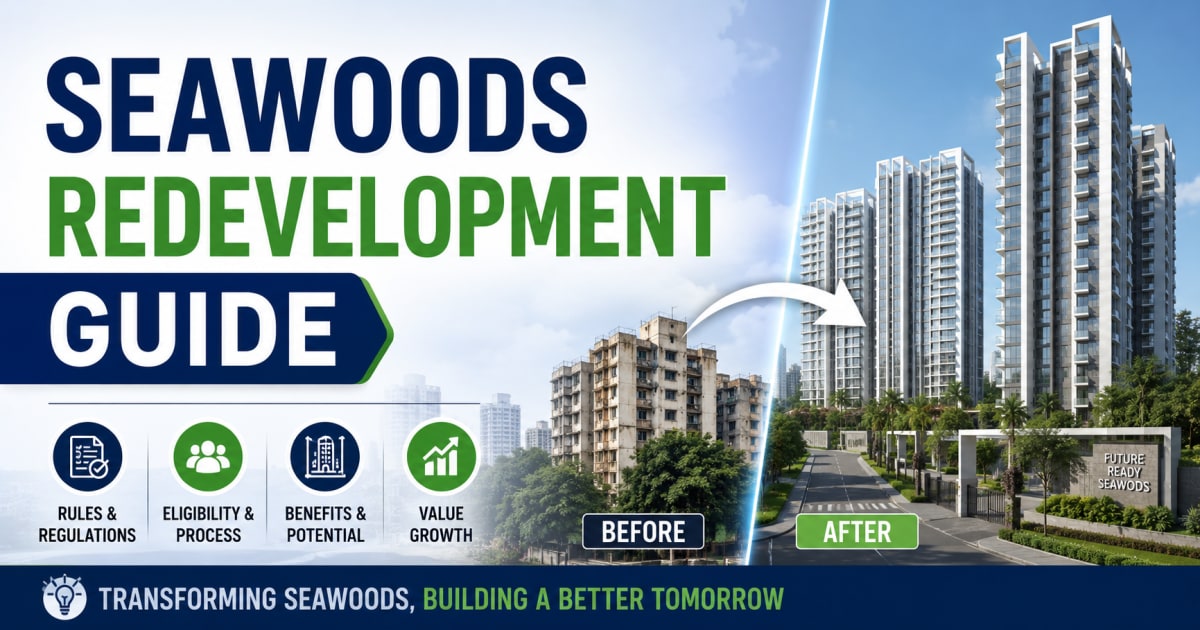
Quick Answer
Buying a flat in a Seawoods redevelopment project can be a good decision, but only after proper document verification. Before paying token money, check the society redevelopment papers, developer agreement, MahaRERA registration, commencement certificate, sanctioned building plan, title documents, society NOC, structural audit, and occupancy certificate status. Do not rely only on the words “redevelopment approved” or “OC coming soon.” In Navi Mumbai, especially in old societies around Seawoods, Nerul, Palm Beach Road and nearby sectors, the right question is not only “What is the price?” The right question is:Is the property legally, technically and practically ready for purchase?This guide explains the process in simple English.
Why Seawoods Redevelopment Matters for Navi Mumbai Buyers
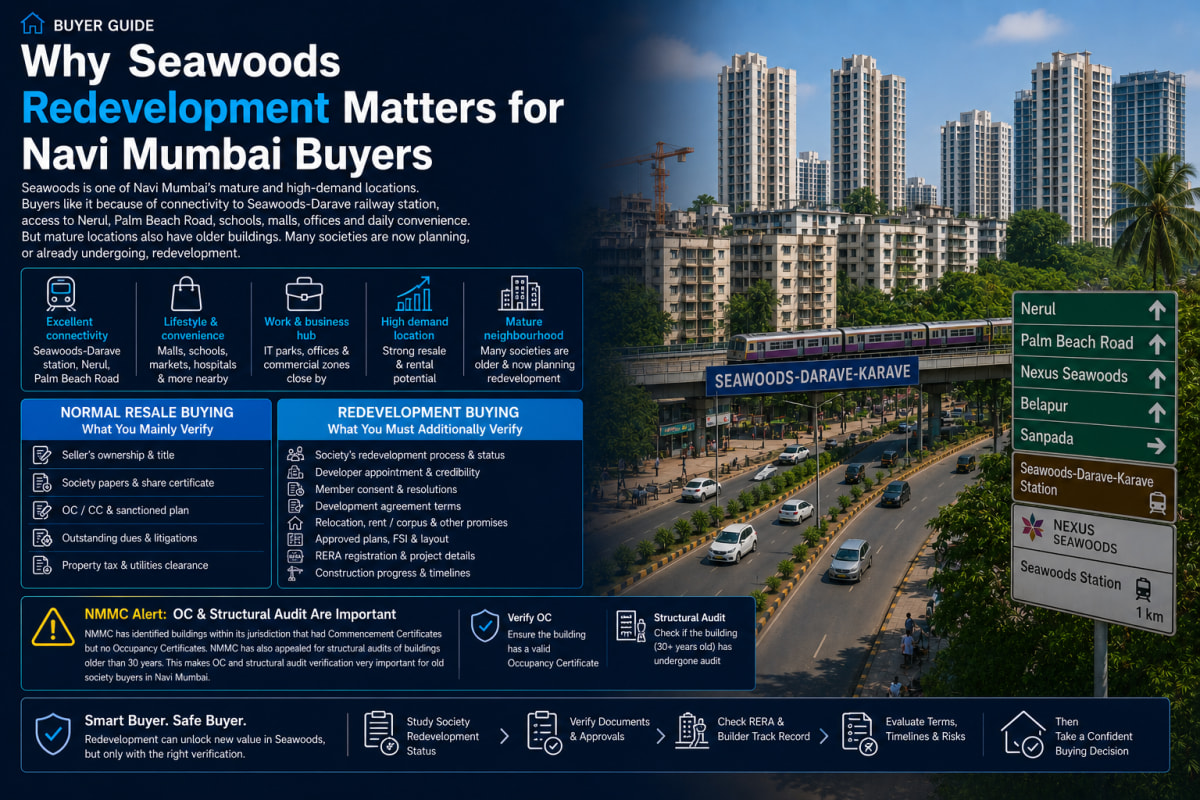
Seawoods is one of Navi Mumbai’s mature and high-demand locations. Buyers like it because of connectivity to Seawoods-Darave railway station, access to Nerul, Palm Beach Road, schools, malls, offices and daily convenience. But mature locations also have older buildings. Some societies may be planning redevelopment. Some may already have appointed a developer. Some may be under construction. Some may have new towers where old society members and new buyers both exist. That is why redevelopment buying is different from normal resale buying. In a normal resale flat, you mainly verify the seller’s ownership, society papers, OC/CC and dues. In a redevelopment property, you must also verify the society’s redevelopment process, builder appointment, member consent, development agreement, rent/corpus promises, approved plans and RERA status. NMMC has also highlighted the importance of occupancy certificates and structural audits in Navi Mumbai. Recent public reporting said NMMC identified buildings within its jurisdiction that had commencement certificates but no occupancy certificates, and also appealed for structural audits of buildings older than 30 years. This makes OC and structural audit verification very important for old society buyers in Navi Mumbai. [Source 5, Source 6]
What Redevelopment Means in Simple English
Redevelopment means an old building is demolished and rebuilt. Usually, the housing society gives development rights to a builder. The builder constructs a new building. Existing members get new flats, usually with better area or amenities. The builder may also get extra sale flats to recover cost and earn profit. For a buyer, redevelopment can involve three different situations:
| Buyer Situation | What You Are Buying | Main Risk |
| Old society resale flat | Flat in an old building before redevelopment | Future redevelopment uncertainty |
| Under-redevelopment flat | Flat linked to a project where old building is being rebuilt | Approval, delay, agreement and RERA risk |
| Newly redeveloped building | Flat in completed new building | OC, handover, title and society formation risk |
The same word “redevelopment” can mean different risk levels depending on the stage of the project.
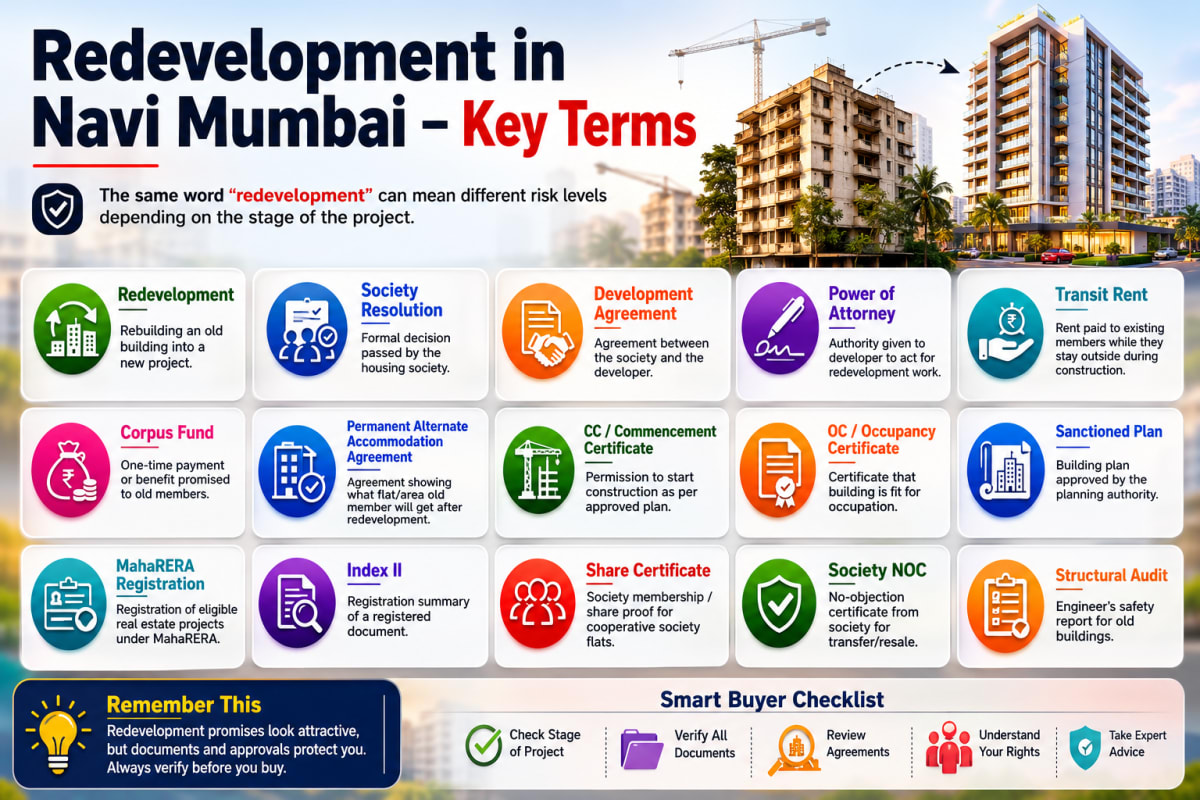
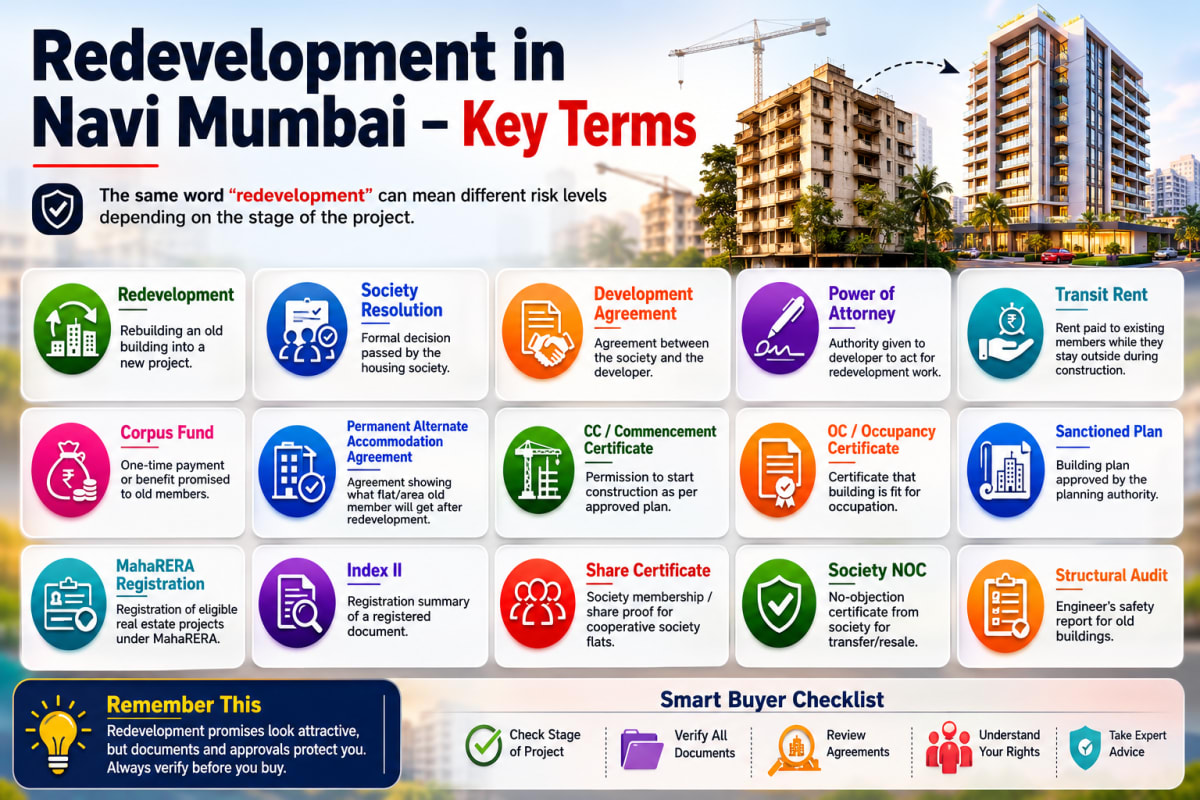
Key Terms Every Buyer Should Understand
| Term | Simple Meaning |
| Redevelopment | Rebuilding an old building into a new project |
| Society Resolution | Formal decision passed by the housing society |
| Development Agreement | Agreement between society and developer |
| Power of Attorney | Authority given to developer to act for redevelopment work |
| Transit Rent | Rent paid to existing members while they stay outside during construction |
| Corpus Fund | One-time payment or benefit promised to old members |
| Permanent Alternate Accommodation Agreement | Agreement showing what flat/area old member will get after redevelopment |
| CC / Commencement Certificate | Permission to start construction as per approved plan |
| OC / Occupancy Certificate | Certificate that building is fit for occupation |
| Sanctioned Plan | Building plan approved by the planning authority |
| MahaRERA Registration | Registration of eligible real estate projects under MahaRERA |
| Index II | Registration summary of a registered document |
| Share Certificate | Society membership/share proof for cooperative society flats |
| Society NOC | No-objection certificate from society for transfer/resale |
| Structural Audit | Engineer’s safety report for old buildings |
Who Issues or Verifies What?
In Seawoods and Navi Mumbai, different documents are checked with different authorities. Do not expect one single document to prove everything.
| Document / Status | Where to Verify |
| MahaRERA registration | MahaRERA official project search |
| Project completion date / promoter details | MahaRERA project page |
| Quarterly progress updates | MahaRERA project page |
| CC, OC, sanctioned plan | NMMC / relevant planning authority |
| Registered sale deed / Index II | IGR Maharashtra |
| CIDCO allotment / lease / transfer history, if applicable | CIDCO records |
| Society registration / society documents | Society records and relevant cooperative authority |
| Property tax | NMMC property tax department |
| Structural audit | Society + NMMC-registered structural engineer, where applicable |
| Litigation / title opinion | Property lawyer |
Important: MahaRERA registration is useful, but it is not a full legal clearance. It does not replace title verification, OC/CC verification, society document verification or lawyer due diligence.
Step-by-Step Verification Process Before Paying Token
Step 1: First Identify the Redevelopment Stage
Ask the seller or agent this first:
- Is the building only discussing redevelopment?
- Has the society passed a redevelopment resolution?
- Has the developer been selected?
- Is the development agreement signed?
- Is the old building demolished?
- Has construction started?
- Is the project registered with MahaRERA?
- Is CC received?
- Is OC received?
- Are new flats already occupied?
This one question changes your entire verification process. If the project is only in the discussion stage, do not value it like a confirmed redevelopment project.
Step 2: Verify the Society’s Decision
If a Seawoods society says redevelopment is confirmed, ask for proof. Check:
- Society meeting notice
- Redevelopment resolution
- Member consent records
- Tender process or developer selection process
- Development agreement
- Power of attorney
- Committee authorization
- Any dispute by members
Do not rely only on WhatsApp messages, broker statements or verbal promises.
Step 3: Check the Developer Agreement
The development agreement is one of the most important documents in redevelopment. It should clearly explain:
- Developer name
- Society name
- Plot/building details
- Existing members’ entitlement
- Extra carpet area
- Corpus amount, if any
- Transit rent
- Construction timeline
- Delay penalty
- Bank guarantee or security, if applicable
- Parking arrangement
- Common areas and amenities
- Responsibility for approvals
- Dispute handling
If the seller cannot show this document, be careful.
Step 4: Check MahaRERA Status
For eligible projects, RERA registration is important before marketing or sale. MahaRERA is the Maharashtra real estate regulator under the Real Estate (Regulation and Development) Act, 2016. Developers of registered projects are expected to disclose project details, approvals and updates through MahaRERA. [Source 1, Source 2] On MahaRERA, check:
- Project registration number
- Promoter name
- Project address
- Completion date
- Uploaded approvals
- Building / wing details
- Litigation section, if available
- Extension history
- Complaint/order history, if any
- Quarterly progress updates
MahaRERA has taken action against thousands of projects for failure to update quarterly progress reports, so stale or missing updates should be treated as a practical warning sign. [Source 7] Also check the MahaRERA registration certificate carefully. Recent reporting says MahaRERA certificates now include more project details such as buildings/wings, approved floors and parking information, which helps buyers verify what is actually approved. [Source 8]
Step 5: Verify CC, OC and Approved Plan
This is very important. A commencement certificate means construction permission has been given up to a certain level or phase. It does not mean the building is ready to occupy. An occupancy certificate means the building has been certified fit for occupation. For a completed or nearly completed redevelopment project, ask for:
- Commencement Certificate
- Latest sanctioned plan
- Revised plan approvals, if any
- Occupancy Certificate
- Completion-related documents, where applicable
- Fire and safety approvals, where applicable
If the building is occupied but OC is missing, ask why. NMMC has publicly acted on buildings operating without OCs, so this is not a small issue in Navi Mumbai. [Source 5] Internal link suggestion: Add a natural link here toOC vs CC vs Possession Letter.
Step 6: Check Title and Ownership Chain
For any flat in Seawoods, especially old society resale or redevelopment-linked resale, title verification is non-negotiable. Ask a lawyer to check:
- Original allotment / lease documents, where applicable
- Conveyance or deemed conveyance status
- Previous registered sale deeds
- Current seller’s sale deed
- Index II
- Share certificate
- Society membership records
- Encumbrance or mortgage
- Litigation search
- Family consent / succession documents, if required
Use IGR Maharashtra to verify registered document details. But remember: online record checking is only one part. A property lawyer should still review the chain of title. Internal link suggestion: Add a natural link here toHow to Verify Property Ownership.
Step 7: Check Society Dues and NOC
A flat can look attractive, but society dues can create problems later. Check:
- Society NOC
- Maintenance no-dues certificate
- Transfer charges
- Share certificate
- Parking allotment
- Pending repair fund dues
- Pending redevelopment contribution, if any
- Dispute with society
- Property tax and utility dues
Documents Checklist for Seawoods Redevelopment Buyers
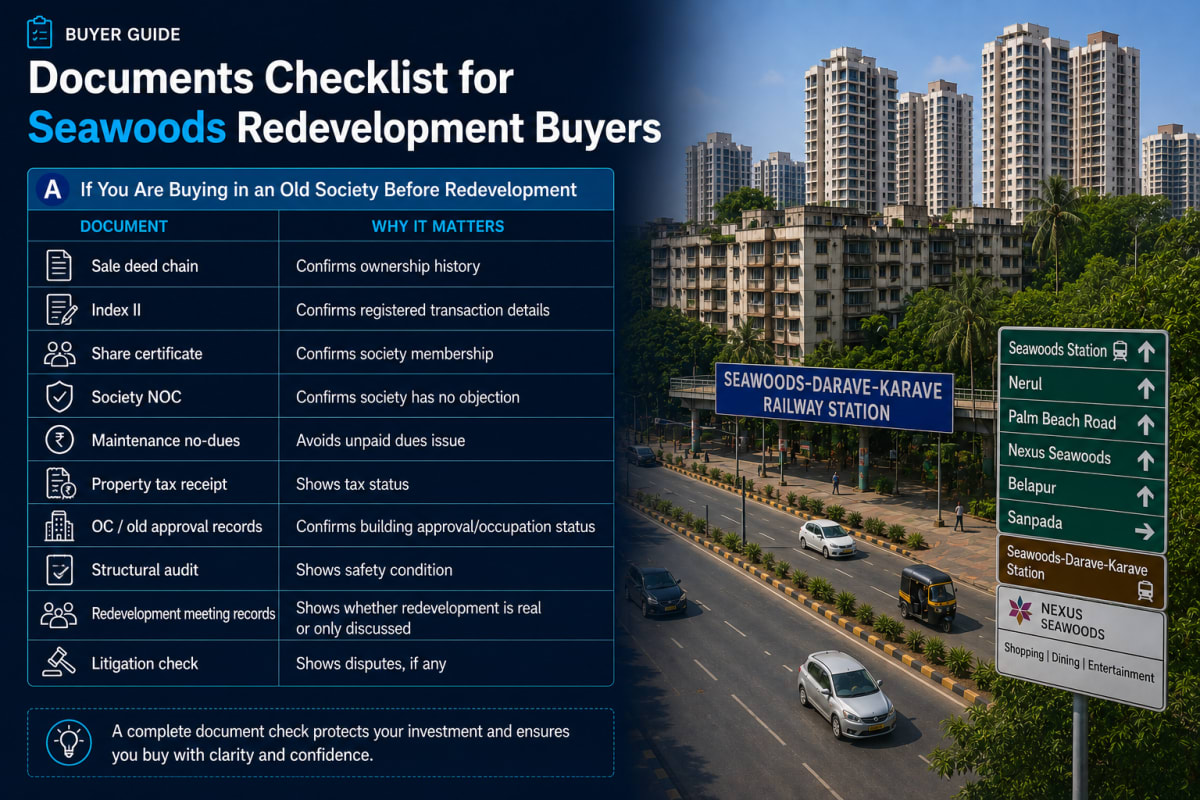
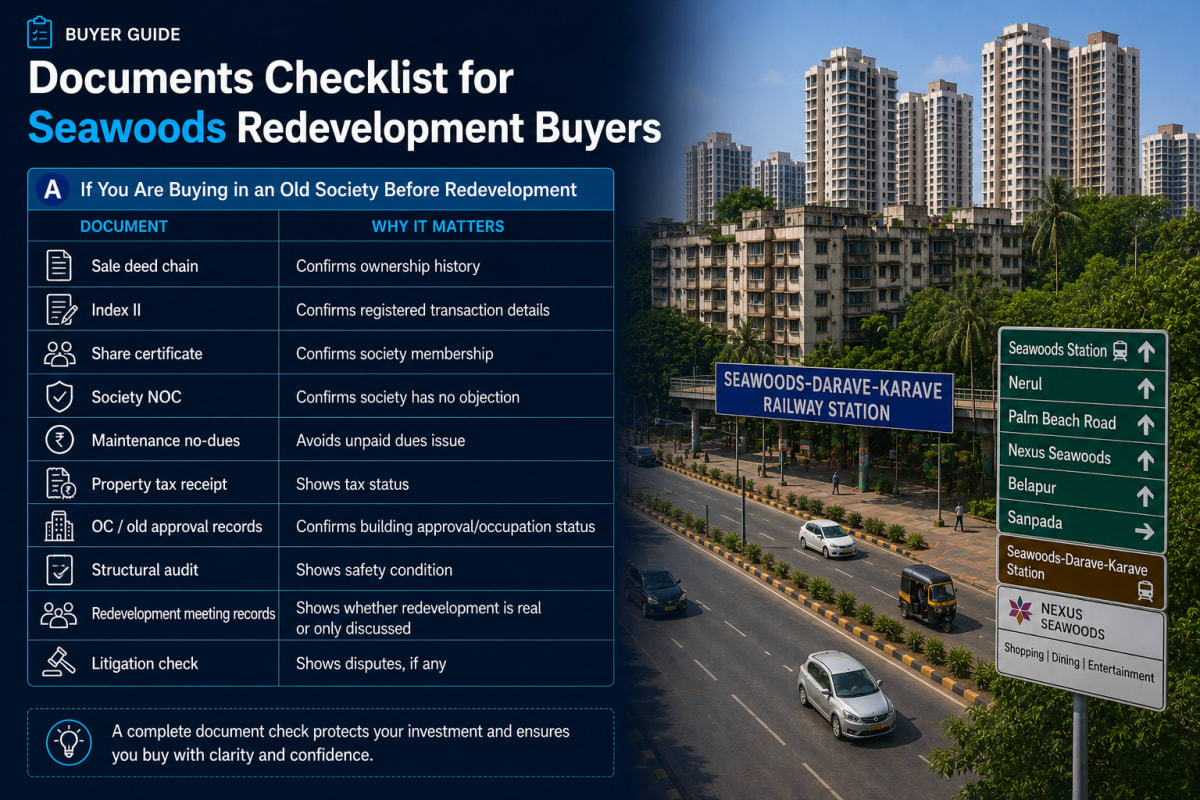
A. If You Are Buying in an Old Society Before Redevelopment
| Document | Why It Matters |
| Sale deed chain | Confirms ownership history |
| Index II | Confirms registered transaction details |
| Share certificate | Confirms society membership |
| Society NOC | Confirms society has no objection |
| Maintenance no-dues | Avoids unpaid dues issue |
| Property tax receipt | Shows tax status |
| OC / old approval records | Confirms building approval/occupation status |
| Structural audit | Shows safety condition |
| Redevelopment meeting records | Shows whether redevelopment is real or only discussed |
| Litigation check | Shows disputes, if any |
B. If You Are Buying in an Under-Redevelopment Project
| Document | Why It Matters |
| Society resolution | Shows formal redevelopment approval |
| Member consent records | Shows support from members |
| Development agreement | Main redevelopment contract |
| Power of attorney | Shows developer authority |
| MahaRERA registration | Shows registered project details |
| CC and sanctioned plan | Shows construction approval |
| Permanent Alternate Accommodation Agreement | Important if buying member entitlement |
| Rent/corpus terms | Shows written member benefits |
| Builder financial and delivery record | Helps judge practical risk |
| Litigation / complaint search | Finds disputes |
Internal link suggestion: Add a natural link here toMahaRERA Project Search.
C. If You Are Buying in a Newly Redeveloped Building
| Document | Why It Matters |
| OC | Most important for occupation |
| Latest sanctioned plan | Confirms approved layout |
| Sale deed | Confirms ownership transfer |
| Index II | Confirms registration |
| Society formation / handover status | Shows post-completion management |
| Parking allotment | Avoids parking disputes |
| Maintenance handover papers | Shows society control |
| Defect liability terms | Helps in leakage/quality issues |
| Property tax status | Avoids future dues |
| RERA completion details | Checks project status |
Internal link suggestion: Add a natural link here toFlat Buying Documents Checklist.
Red Flags to Watch Calmly
Do not panic if you see one issue. But do not ignore it either. Ask questions and verify.
| Red Flag | Why It Matters |
| Token demanded before document sharing | You may lose money before verification |
| “Redevelopment confirmed” but no resolution | It may only be discussion |
| No development agreement | Builder authority may be unclear |
| No MahaRERA number for eligible project | Marketing/sale may be risky |
| RERA updates are old or incomplete | Project monitoring may be weak |
| CC received but OC missing | Building may not be legally fit for occupation |
| Seller selling future entitlement | Needs careful legal review |
| Society members are in dispute | Project may get delayed |
| Structural audit shows serious repairs | Safety and redevelopment urgency matter |
| Extra area promised verbally | Verbal promises are hard to enforce |
| Parking not written | Common dispute after possession |
| CIDCO/lease transfer issue unclear | Transfer may get delayed |
| Building near sensitive land/wetland/DP reservation | Needs authority verification |
New Flat vs Resale Flat in Redevelopment: What Changes?
| Point | Resale in Old Society | New Redeveloped Flat |
| Main focus | Seller title + society records | OC + RERA + approved plan |
| Structural audit | Very important | Less important but quality check needed |
| Society NOC | Important | Important after society formation |
| RERA | Usually not for old resale | Important for eligible new project |
| OC | Check old OC status | Must check final OC |
| Risk type | Old building, title, future redevelopment | Delay, approval, OC, handover |
| Lawyer review | Strongly recommended | Strongly recommended |
Common Mistakes Buyers Make
Mistake 1: Believing “redevelopment hone wala hai”
Many sellers quote a higher price because redevelopment is “coming soon.” But unless the society has passed proper resolutions, appointed a developer and signed documents, it may not be confirmed.
Mistake 2: Checking only MahaRERA
MahaRERA is important, but it is not the full due diligence. You still need title, OC/CC, society and plan verification.
Mistake 3: Ignoring OC
Possession letter is not the same as OC. A flat may be physically ready, but the building may still not have final occupancy approval. Internal link suggestion: Add a natural link here toOC vs CC vs Possession Letter.
Mistake 4: Not checking the seller’s right to sell
In redevelopment, sometimes members try to sell future entitlement. This needs careful agreement review. Do not proceed without a property lawyer.
Mistake 5: Ignoring parking
In many Navi Mumbai societies, parking becomes a major dispute later. Ask whether parking is allotted, open, stilt, mechanical, stack or only first-come-first-served.
Mistake 6: Not checking old society dues
Maintenance dues, repair fund dues, transfer premium and property tax issues can create problems after agreement.
Before Token Payment: Final Buyer Checklist
Before paying token for a Seawoods redevelopment property, check this list:
- [ ] I know the exact redevelopment stage.
- [ ] I have seen the society resolution.
- [ ] I have seen the development agreement, if redevelopment is confirmed.
- [ ] I have checked MahaRERA registration, if applicable.
- [ ] I have checked CC and sanctioned plan.
- [ ] I have checked OC status.
- [ ] I have checked seller’s ownership documents.
- [ ] I have checked Index II and registered documents.
- [ ] I have checked society NOC and dues.
- [ ] I have checked share certificate.
- [ ] I have checked structural audit for old building.
- [ ] I have checked parking terms.
- [ ] I have checked litigation/dispute risk.
- [ ] I have asked a property lawyer to review documents.
- [ ] I have not relied only on broker/seller verbal promises.
If any of these are missing, do not rush. Ask for documents first.
When Should You Consult a Property Lawyer?
Consult a lawyer before transaction if:
- The building is under redevelopment.
- The seller is selling future entitlement.
- OC is missing.
- Development agreement is not clear.
- Society members are disputing redevelopment.
- Property is inherited or jointly owned.
- CIDCO lease/allotment history is involved.
- Title chain is incomplete.
- The seller refuses to share documents before token.
A good lawyer does not only “make agreement.” A good lawyer checks whether the transaction itself is safe to proceed with.
Navi Mumbai-Specific Buyer Notes
Seawoods buyers should not treat every property the same. A flat near Seawoods station, Palm Beach Road or Nerul may have strong demand, but legal verification still matters. Good location does not remove document risk. Also, some Navi Mumbai properties may have older CIDCO allotment, lease or transfer history. If the document chain mentions CIDCO, do not ignore it. Verify whether required transfer permissions, lease conditions or allotment records apply. For commercial buyers, some redeveloped projects may also include shops or office units. If you are evaluating a commercial unit, also readOffice Space in Navi Mumbai: Complete Guide for Buyers, Investors and Businessesbefore making a decision.
Soft CTA: Need Help Checking a Seawoods Property?
If you are planning to buy a resale flat, redevelopment flat or newly redeveloped property in Seawoods, Navi Mumbai Property Deals can help you organize the first-level verification. We help buyers understand what documents to ask for, what red flags to notice and when to involve a property lawyer before paying token money. This is not about creating fear. It is about buying with clarity. Contact Navi Mumbai Property Deals before you commit money to a property.
FAQs
1. Is it safe to buy a flat in a Seawoods redevelopment project?
1. Is it safe to buy a flat in a Seawoods redevelopment project?
It can be safe if the documents are clear, approvals are verified and the transaction is reviewed by a property lawyer. Do not decide only on location, price or verbal redevelopment promises.
2. What is the most important document in a redevelopment project?
2. What is the most important document in a redevelopment project?
There is no single document. You should check the development agreement, society resolution, MahaRERA registration, CC, sanctioned plan, OC status, title documents and society records.
3. Is MahaRERA registration enough?
3. Is MahaRERA registration enough?
No. MahaRERA registration is important, but it does not replace title verification, OC/CC verification, sanctioned plan checking or lawyer due diligence.
4. Can I buy a flat before redevelopment starts?
4. Can I buy a flat before redevelopment starts?
Yes, but the price should not be based only on future promises. Verify whether redevelopment is actually approved by the society and supported by proper documents.
5. Can a society member sell a redevelopment entitlement?
5. Can a society member sell a redevelopment entitlement?
This is possible in some cases, but it needs careful legal review. Check the permanent alternate accommodation agreement, society permission, developer consent and transfer conditions.
6. What is the difference between CC and OC?
6. What is the difference between CC and OC?
CC allows construction to start as per approved plans. OC confirms that the completed building is fit for occupation. A possession letter is not the same as OC.
7. Should I pay token before seeing documents?
7. Should I pay token before seeing documents?
No. At least basic documents should be reviewed before paying token. If token is unavoidable, keep the amount small and make it refundable subject to legal/document verification.
8. Why is structural audit important in Seawoods redevelopment?
8. Why is structural audit important in Seawoods redevelopment?
Many redevelopment discussions start because buildings become old or repairs become costly. A structural audit helps buyers understand the building’s condition and safety risk.
9. Which authority should I check for approvals in Seawoods?
9. Which authority should I check for approvals in Seawoods?
For most Seawoods/Nerul-side properties, check NMMC or the relevant planning authority for building approvals. Also check MahaRERA for registered projects and IGR Maharashtra for registered documents.
10. What if OC is missing?
10. What if OC is missing?
Ask why OC is missing, whether application is pending, whether there are deviations, and whether the building is occupied legally. Take legal advice before proceeding.
11. What documents should I check for old society resale?
11. What documents should I check for old society resale?
Check sale deed chain, Index II, share certificate, society NOC, maintenance no-dues, property tax, OC/CC records, structural audit and litigation status.
12. What is the biggest red flag in redevelopment buying?
12. What is the biggest red flag in redevelopment buying?
The biggest red flag is pressure to pay token without showing documents. In redevelopment, written records matter more than verbal confidence.