Pushpak Nagar Property Risks: Is Ulwe Better for Buyers and Investors?
Quick Answer
Ulwe may be the more practical choice for families who select an occupied, well-connected and properly documented building. Pushpak Nagar may suit patient investors and budget buyers who are comfortable with a newer location and greater dependence on future development. However, neither location is automatically safe. Before paying token money, verify the exact project, land title, planning authority, MahaRERA status, sanctioned plan, Commencement Certificate and Occupancy Certificate.
In simple words: Do not buy only because a property is close to the airport or appears cheaper than Ulwe. A good location cannot correct defective title, missing approvals, delayed construction or an invalid Occupancy Certificate.
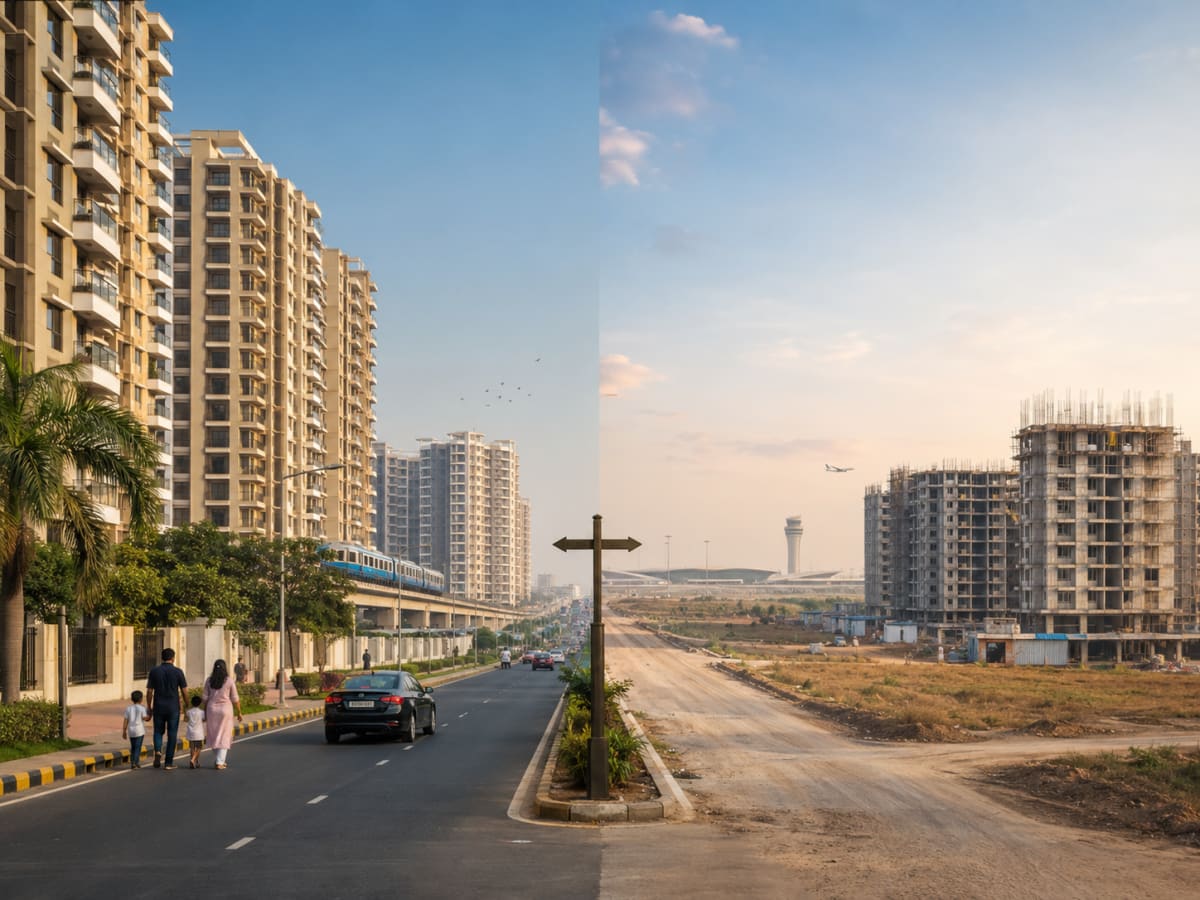
Ulwe vs Pushpak Nagar: Quick Comparison
| Buyer factor | Ulwe | Pushpak Nagar | Practical takeaway |
| Immediate family living | More practical in occupied and established pockets | Livability can vary considerably by project and access road | Visit the exact pocket during morning, evening and monsoon conditions |
| Railway access | Some sectors benefit from access to the Nerul-Uran suburban corridor | More dependent on the exact road and last-mile connection | Test the actual route instead of relying on map distance |
| Ready and resale options | Buyers may find a mix of ready, resale and under-construction stock | Many shortlists are likely to involve newer construction | Resale buyers and under-construction buyers need different document checks |
| Legal risk | OC, society, title and CIDCO-related papers may still require verification | Planning authority, land rights, CC, project execution and future development require close attention | The project documents matter more than the locality name |
| Rental demand | Easier to examine in occupied sectors using current rental evidence | Rental demand may be more dependent on future occupation and connectivity | Do not accept a guaranteed rental yield |
| Investment profile | May suit buyers seeking a balance between current use and future growth | May suit buyers accepting a longer holding period and higher uncertainty | Compare entry price with realistic exit demand |
| Main buyer risk | Paying a premium without checking the building and sector | Buying mainly on airport or infrastructure promises | Separate present facts from future expectations |
This table is a general decision framework. It is not a verdict on every project in Ulwe or Pushpak Nagar.
Why Pushpak Nagar Property Risks Matter
Pushpak Nagar is often marketed using words such as:
- Airport proximity
- Future connectivity
- Affordable entry price
- Upcoming infrastructure
- High appreciation potential
- Next major growth location
These factors can make the area worth studying. But they do not prove that a particular flat has clear title, valid approvals or good resale potential. For a homebuyer, there are two separate questions:
- Can this location develop over time?
- Is this exact property legally, financially and practically suitable for me?
The first question is about location potential. The second is about project-level verification. A buyer should never replace the second question with the first.
What Does “Property Risk” Mean?
Property risk does not mean that every flat in the locality is unsafe. It means there may be issues that must be checked before committing money. These risks normally fall into five categories:
| Risk category | What it means |
| Title risk | The seller or promoter may not have complete or transferable rights |
| Approval risk | The sanctioned plan, CC, OC or other permission may be incomplete or unclear |
| Construction risk | The project may be delayed, changed or developed differently from what was promised |
| Financial risk | The entry price may be high compared with actual resale or rental demand |
| Livability risk | Roads, water, shops, transport and social infrastructure may not yet support comfortable living |
A property may have a good title but poor livability. Another property may be in a good location but have an incomplete OC. That is why buyers need both legal verification and a practical site inspection.
Main Pushpak Nagar Property Risks to Check
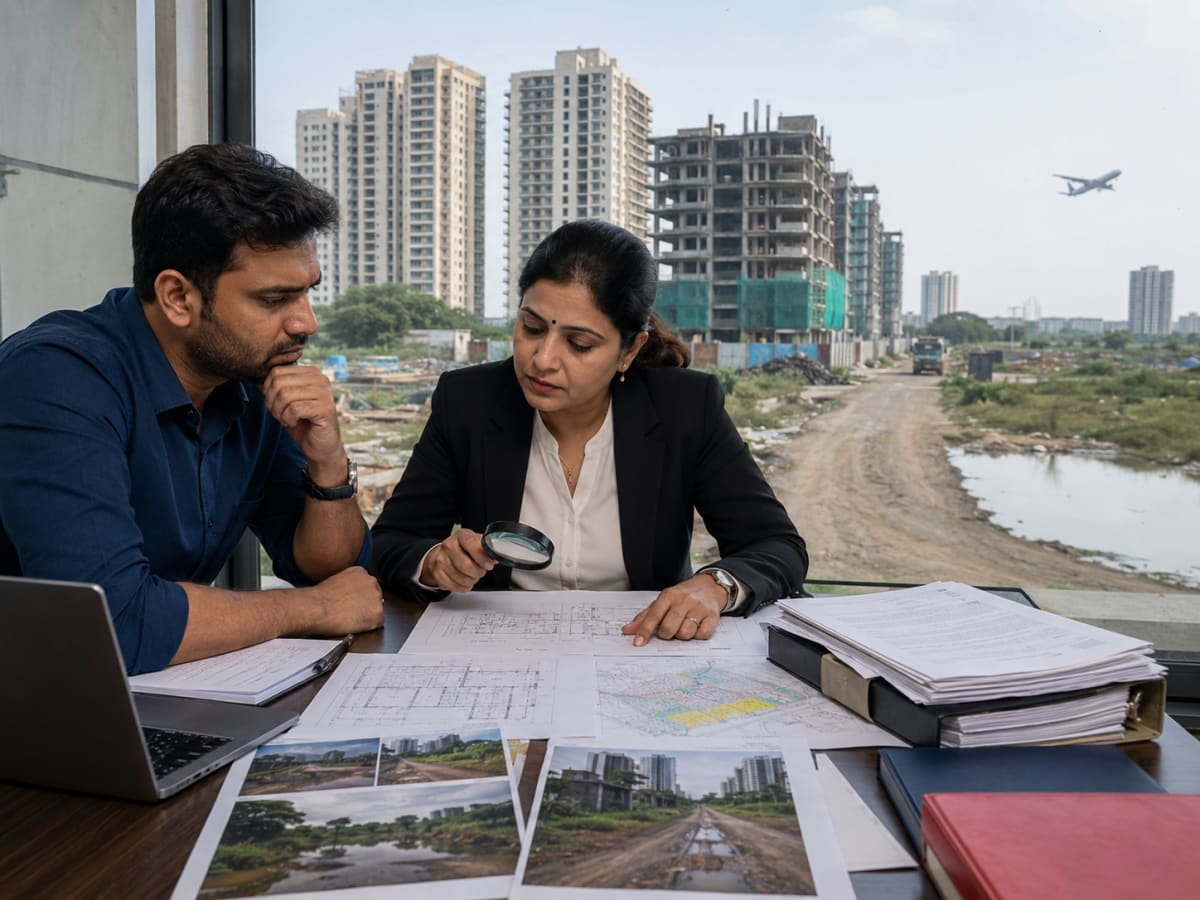
1. The Marketing Location May Not Match the Legal Property Identity
“Pushpak Nagar” may be used as a broad marketing label. Your legal documents should identify the exact:
- Village
- Sector
- Plot number
- Survey or gat number
- Project boundary
- Building and wing
- Planning authority
- Landowner
- Promoter
Do not accept descriptions such as “airport road,” “Pushpak Nagar side” or “near Ulwe” as the legal identity of the property. The project name, land details and promoter name should match across the agreement, MahaRERA record, sanctioned plan, CC and title documents.
2. Confusion About the Correct Planning Authority
Different parts of Navi Mumbai and the Panvel region can involve CIDCO, a municipal corporation, a special planning authority or another competent authority. Do not assume that every property marketed in Pushpak Nagar is approved by the same authority. Under the Real Estate (Regulation and Development) Act, the “competent authority” is the authority legally empowered to permit development on that land. The authority named on the sanctioned plan, CC and OC should therefore be checked against the property’s land and title documents.[1] Ask for:
- Sanctioned-plan approval number
- Commencement Certificate number
- Development-permission letter
- Name of the issuing authority
- Approval date
- Plot and survey number covered by the permission
CIDCO provides official nodal-plan and building-permission resources for Navi Mumbai. Buyers should use these resources where CIDCO is stated to be the approving authority.[2][3]
3. MahaRERA Registration May Be Treated as a Complete Safety Certificate
MahaRERA registration is important, but it is only one part of due diligence. The official project search allows buyers to review registered and revoked projects. MahaRERA also publishes lists relating to lapsed, deregistered and abeyance projects, along with complaints and orders.[4][5] When checking a Pushpak Nagar project, review:
- Project registration number
- Promoter’s legal name
- Landowner details
- Original completion date
- Revised completion date
- Extension certificate
- Quarterly progress updates
- Approved plans
- Commencement Certificate
- Encumbrance declaration
- Complaints and orders
- Project phase covered by the registration
A project appearing on MahaRERA does not mean you should skip an independent title search. The RERA Act requires the promoter to submit approvals, sanctioned plans, title-related declarations and encumbrance information. These are promoter disclosures that buyers should examine rather than treating the registration number as a guarantee.[1] For a detailed walkthrough, use our guide on how to search a project on MahaRERA.
4. The Commencement Certificate May Not Cover the Entire Project
A Commencement Certificate, commonly called a CC, permits the promoter to start development according to an approved plan. However, buyers must check its scope. A CC may cover:
- Only one building
- Only one project phase
- Only certain floors
- Development up to a stated level
- A plan that was later revised
Do not ask only, “Does the project have a CC?” Ask:
“Does this CC cover my building, wing, phase and the floor on which I am buying?” The RERA Act defines a Commencement Certificate as permission issued by the competent authority to begin development according to the sanctioned plan.[1] Read our detailed guide on OC vs CC vs Possession Letter before purchasing an under-construction or recently completed flat.
5. Possession May Be Offered Without a Clear Full OC
A possession letter and an Occupancy Certificate are not the same document. A possession letter is generally issued by the promoter to communicate that the flat is being offered for possession. An Occupancy Certificate is issued by the competent authority and permits occupation of the building or approved portion under applicable local laws. The RERA Act connects an OC with occupation and civic infrastructure such as water, sanitation and electricity.[1] Before accepting a ready flat, check:
- Who issued the OC?
- What is the certificate number?
- Does it cover the entire building or only part of it?
- Does it cover your wing?
- Does it cover your floor?
- Does the approved use match the property being sold?
- Does the building on site match the sanctioned plan?
Never assume that an occupied building automatically has a valid full OC.
6. Land Ownership and Development Rights May Be Different
The promoter selling the flat may not be the original landowner. The project may be developed through:
- A development agreement
- A registered power of attorney
- CIDCO allotment or lease rights
- Joint development
- Private land acquisition
- Landowner and promoter partnership
- Rehabilitation or project-affected-person allotment
This is not automatically a problem. But the complete chain must be verified. Ask a property lawyer to examine:
- How the landowner acquired the land
- Whether the development agreement is registered
- Whether the power of attorney is valid
- Whether the promoter has the right to construct and sell
- Whether the land is mortgaged
- Whether lender permission is required
- Whether CIDCO transfer conditions apply
- Whether any litigation or third-party claim exists
For a broader explanation, read how to verify property ownership.
7. Airport-Based Appreciation May Be Overstated
Airport proximity can influence demand, connectivity and commercial activity. But it does not guarantee a specific return. Property prices can also be affected by:
- Purchase price
- Quality of the building
- Current occupation
- Rental demand
- Future project supply
- Road access
- Maintenance
- Loan rates
- Builder reputation
- Resale competition
- Infrastructure completion
Avoid statements such as:
- “Prices will double.”
- “This is guaranteed to appreciate.”
- “The airport makes every project safe.”
- “You will definitely receive a fixed rent.”
- “This is the last chance to buy at this price.”
A future infrastructure project should be treated as one factor, not the entire investment case.
8. Surrounding Land Use May Change the Buyer Experience
A project brochure normally focuses on nearby roads, the airport and future commercial development. It may not clearly explain what is proposed on surrounding land. CIDCO publishes development plans, nodal plans and development-permission resources. Its official portal also contains a logistics-park land-acquisition proposal listing survey areas in villages including Chirle, Dhutum, Jasai and others.[2][6] This does not mean every Pushpak Nagar residential project is affected by logistics activity. It means buyers should verify:
- The project’s exact survey number
- Nearby reservations
- Road-widening lines
- Proposed commercial or logistics use
- Natural drains
- High-tension lines
- Access roads
- Future public-purpose reservations
Do not make a decision from the broader “Pushpak node” name alone.
9. Current Livability May Be Different From Future Livability
A good investment presentation may show what the location could become. A homebuyer must also examine what exists today. During your site visit, check:
- Condition of the access road
- Street lighting
- Public transport frequency
- Walking route
- Grocery and medical shops
- School access
- Hospital access
- Water supply
- Drainage
- Mobile network
- Construction dust
- Heavy-vehicle movement
- Night-time activity
- Monsoon waterlogging
Visit once during the day and once after dark. A weekend visit alone may not show the normal traffic situation.
10. Resale and Rental Exit May Take Time
A lower entry price does not automatically mean a better investment. You also need someone willing to buy or rent the property later. Before investing, ask local brokers and residents:
- How many comparable flats are currently available?
- How long do they take to sell?
- What rent is actually achieved?
- Are tenants families, airport workers, students or temporary workers?
- Are flats remaining vacant?
- What maintenance does the society charge?
- How much negotiation happens during resale?
Do not calculate rental yield using the highest advertised rent. Use the rent that similar occupied flats are genuinely receiving.
Ulwe Property Risks Buyers Should Not Ignore
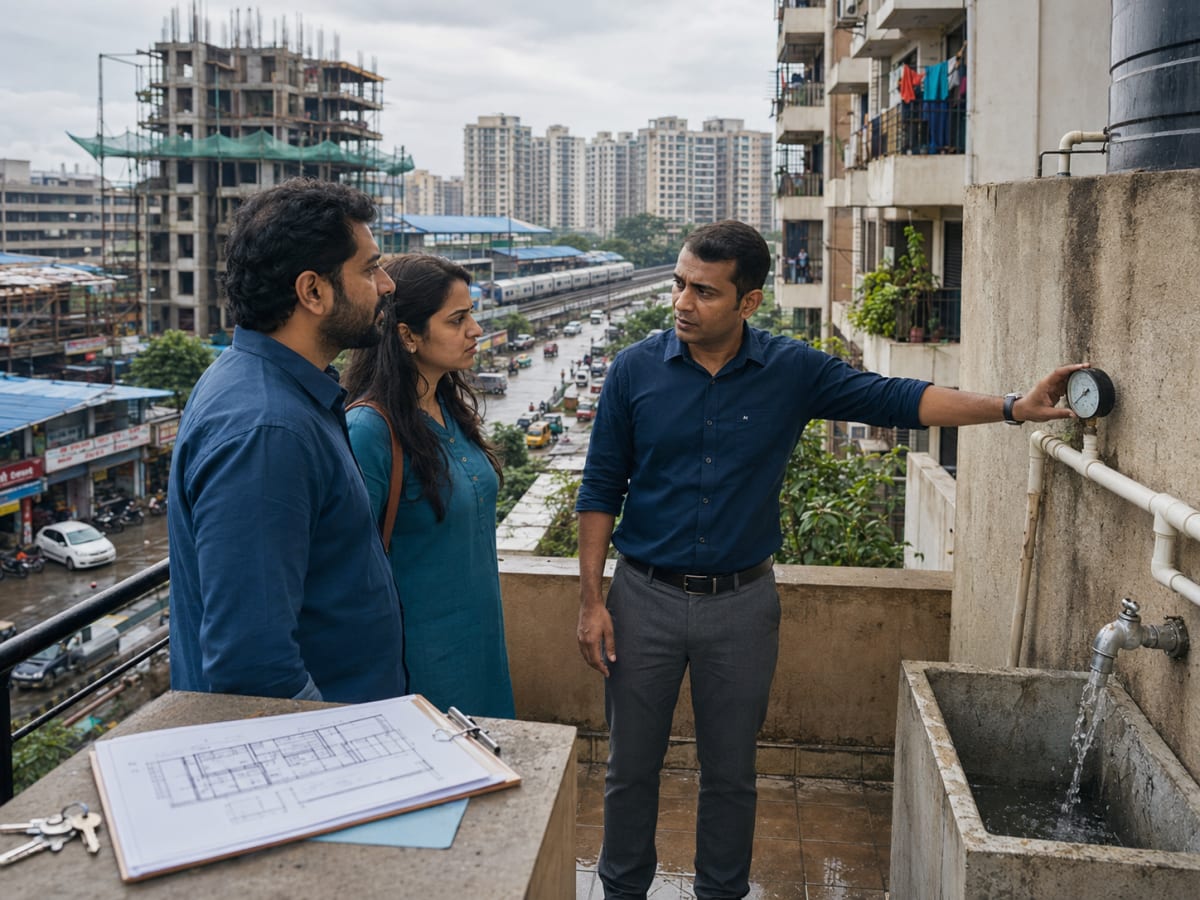
Ulwe may appear more established than Pushpak Nagar in several buyer shortlists, but Ulwe also requires project-level verification.
OC and Society Documentation
An older or occupied building can still have:
- Partial OC
- Missing OC for added floors
- Society formation issues
- Incomplete conveyance
- Unpaid municipal or authority dues
- An active mortgage
- Parking disputes
- Water or maintenance issues
A resale buyer should use a complete resale flat documents checklist rather than relying only on the seller’s registered agreement.
Sector-Level Differences
Ulwe should not be treated as one uniform market. The buyer experience can differ based on:
- Distance from the station
- Actual walking route
- Road width
- Occupancy of nearby buildings
- Water pressure
- Local shops
- Construction activity
- Access to schools and healthcare
Always compare the exact sector and building.
Water-Supply Verification
Water conditions can differ between buildings and sectors. In 2025, residents and activists raised concerns about supply and water pressure in parts of Ulwe. This should not be treated as proof that all Ulwe buildings face the same problem. It should prompt buyers to check the society’s actual source, pressure, storage and tanker dependence.[7] Ask the society:
- How many hours of water are supplied?
- Is tanker water used?
- What is the monthly tanker expense?
- Is the overhead tank sufficient?
- Are upper floors facing low pressure?
- Has there been a major shortage during summer?
Paying a Premium for the Locality Name
A buyer may pay more for a flat simply because it is described as “near station,” “airport-facing” or “prime Ulwe.” Check the real route and the actual building condition. A flat that looks close on a map may involve:
- A longer walking route
- An incomplete road
- A difficult crossing
- Poor night-time access
- Construction obstruction
- Limited last-mile transport
Ulwe vs Pushpak Nagar: Which Is Better?
Best for Families and Immediate Living
Ulwe may be the better starting shortlist, especially where the buyer finds:
- A properly occupied building
- Full OC for the relevant wing and floor
- Reliable water supply
- Daily-use shops
- Practical station or road access
- A functioning society
- Clean resale documents
This is not a blanket recommendation for every Ulwe project.
Best for Patient Investors
Pushpak Nagar may suit a patient investor when:
- The purchase price is reasonable
- The project has clear title and approvals
- MahaRERA progress is satisfactory
- Access roads are practical
- The investor can hold for several years
- The investment does not depend on guaranteed appreciation
- The investor understands the resale and rental risk
Best for Budget Buyers
Do not choose Pushpak Nagar only because the price is lower. Compare the total cost, including:
- Stamp duty and registration
- GST, where applicable
- Floor-rise charges
- Parking
- Maintenance deposit
- Corpus fund
- Fit-out cost
- Loan interest during construction
- Rent paid while waiting for possession
- Daily travel cost
A more expensive ready flat may sometimes be financially safer than a cheaper delayed project.
Best for Short-Term Investors
Neither locality should be treated as a guaranteed short-term trading opportunity. Short-term resale depends on market conditions, competing supply, loan rates, project progress and the price at which you entered.
Who Issues and Verifies the Main Property Documents?
| Document or record | Main source or issuing authority | What the buyer should verify |
| MahaRERA registration | Maharashtra Real Estate Regulatory Authority | Status, promoter, dates, updates, complaints and uploaded documents |
| Sanctioned building plan | Competent planning authority | Project, plot, building, floors, use and approval number |
| Commencement Certificate | Competent planning authority | Building, phase and floors covered |
| Occupancy Certificate | Competent planning authority | Full or partial coverage and exact wing/floor |
| Registered agreement or deed | Sub-Registrar under IGR Maharashtra | Parties, property identity, consideration and registration |
| Index II | IGR Maharashtra | Summary details matching the full registered document |
| Property Card, 7/12 or 8A | Maharashtra Land Records | Owner entry, area, survey number and mutations |
| CIDCO allotment or lease papers | CIDCO | Allotment, lease conditions, transfers and dues |
| Society documents | Co-operative housing society | Membership, shares, dues, disputes and records |
| Loan release documents | Bank or financial institution | Mortgage status, outstanding loan and release |
Step-by-Step Pushpak Nagar Property Verification
Step 1: Fix the Exact Property Identity
Collect:
- Project name
- MahaRERA number
- Promoter’s legal name
- Landowner’s name
- Village
- Survey or gat number
- Sector and plot number
- Building and wing
- Floor and flat number
- Carpet area
All major documents should describe the same property.
Step 2: Search the Project on MahaRERA
Use the official MahaRERA project search. Check the project as well as the promoter. Review:
- Registration certificate
- Original application
- Current completion date
- Extension history
- Quarterly progress
- Uploaded approvals
- Encumbrance details
- Complaints and orders
- Lapsed, revoked, deregistered or abeyance status
Do not rely on a screenshot supplied by the sales office. Search independently.[4][5]
Step 3: Identify the Competent Authority
Ask for the sanctioned-plan approval and development-permission letter. Match:
- Authority name
- Plot number
- Survey number
- Project name
- Promoter
- Approval date
The authority responsible for municipal services may not always be the same authority that sanctioned the project. Verify the exact position from the documents.
Step 4: Get an Independent Title Search
The lawyer should examine the land and development-right chain, not only the flat agreement. The review should cover:
- Ownership documents
- Development agreement
- Power of attorney
- Lease or allotment
- Mortgage
- Encumbrance
- Litigation
- Succession
- Transfer restrictions
- Promoter’s authority to sell
Step 5: Compare the Sanctioned Plan With the Actual Project
Check:
- Number of approved buildings
- Approved floors
- Your wing
- Flat layout
- Carpet area
- Parking
- Amenities
- Open spaces
- Fire access
- Entry and exit
- Revised plans
Use our guide on how to verify building plan approval before accepting a brochure layout as final.
Step 6: Verify the CC
Confirm that the CC covers the construction being sold to you. For an under-construction flat, ask for the latest certificate and compare it with the current work on site.
Step 7: Verify the OC for Ready Property
Obtain the complete OC document. Confirm:
- Certificate number
- Issuing authority
- Building or wing
- Approved floors
- Date
- Full or partial status
- Any conditions mentioned
Where possible, cross-check it with the issuing authority.
Step 8: Search Registered Documents
The IGR Maharashtra portal provides e-Search, e-ASR and other registration and valuation services.[8] Use registered-document research to examine:
- Seller’s earlier purchase
- Index II
- Development agreement
- Power of attorney
- Mortgage documents
- Release deed
- Comparable registered transactions
An Index II is a summary. It should be read with the full registered document.
Step 9: Check Land Records
Mahabhulekh allows searches for records such as 7/12, 8A and Property Card using district, taluka, village and survey details.[9] Check for mismatches in:
- Owner name
- Survey number
- Area
- Mutation entry
- Land description
The Mahabhulekh portal itself states that the displayed information should not be used for governmental or legal purposes. Obtain appropriate certified or digitally signed records and have them professionally reviewed.[9]
Step 10: Check Resale and Society Papers
For a resale flat, check:
- Seller’s agreement or sale deed
- Complete ownership chain
- Share certificate
- Society registration
- Maintenance dues
- Society disputes
- Loan status
- Property tax
- Utility bills
- Parking record
- Conveyance status
- Major repair plans
Read when a Society NOC is required for a detailed explanation.
Step 11: Inspect the Location Practically
Visit:
- During office hours
- During evening peak hours
- At night
- On a weekend
- During heavy rain, where practical
Test the actual travel time to the station, highway, school and workplace.
Step 12: Compare the Price With Real Evidence
Compare:
- Recent registered transactions
- Similar carpet areas
- Same building or nearby buildings
- Floor and view
- OC status
- Parking
- Society condition
- Actual rent
- Maintenance
Do not compare only builder quotes with property-portal asking prices.
Documents Checklist
Under-Construction Flat
- [ ] MahaRERA registration certificate
- [ ] Current MahaRERA project status
- [ ] Original and revised completion date
- [ ] Extension certificate, if applicable
- [ ] Sanctioned building and layout plan
- [ ] Commencement Certificate
- [ ] Development-permission letter
- [ ] Title report
- [ ] Encumbrance disclosure
- [ ] Landowner-promoter development agreement
- [ ] Registered power of attorney
- [ ] CIDCO allotment or lease documents, where applicable
- [ ] Environmental permission, where applicable
- [ ] Fire-related approval, where applicable
- [ ] Draft agreement for sale
- [ ] Carpet-area statement
- [ ] Payment schedule
- [ ] Amenity and specification schedule
- [ ] Parking terms
- [ ] Cancellation and refund terms
For the complete list, use our Flat Buying Documents Checklist.
Ready-to-Move or Resale Flat
- [ ] Seller’s registered agreement or sale deed
- [ ] Complete title chain
- [ ] Index II
- [ ] Full or applicable partial OC
- [ ] Completion Certificate, where applicable
- [ ] Sanctioned plan
- [ ] Society registration certificate
- [ ] Share certificate
- [ ] Society NOC, where required
- [ ] Maintenance no-dues statement
- [ ] Property tax receipt
- [ ] Electricity and water bills
- [ ] Existing-loan statement
- [ ] Bank release or foreclosure documents
- [ ] Parking document
- [ ] CIDCO transfer papers, where applicable
- [ ] Succession papers for inherited property
- [ ] Conveyance or deemed-conveyance documents, where relevant
New Flat vs Resale Flat: What Changes?
| Verification point | New or under-construction flat | Resale flat |
| Main party | Promoter or developer | Existing owner |
| Main risk | Delay, plan changes and incomplete approvals | Ownership chain, mortgage, dues and society records |
| MahaRERA | Detailed project review is essential | Check original project where applicable |
| Title | Verify promoter’s development and sale rights | Verify every transfer up to the current seller |
| CC | Confirm scope and construction stage | Useful for checking whether construction was authorised |
| OC | May not yet be issued | Must be checked for ready occupation |
| Agreement | Agreement for sale with promoter | Registered resale agreement or sale deed |
| Society papers | Society may not yet exist | Share certificate and no-dues checks are important |
| Loan | Project and buyer loan conditions | Seller’s mortgage must be cleared |
| Possession | Depends on construction and OC | Confirm vacant possession and handover terms |
Red Flags
Pause the transaction if:
- The seller refuses to share complete documents.
- The project name differs across documents.
- Survey or plot numbers do not match.
- The planning authority cannot be clearly identified.
- Only a MahaRERA number is shown as proof of legal safety.
- The CC covers fewer floors than the building being sold.
- A possession letter is shown instead of an OC.
- A partial OC is described as a full OC.
- The promoter will not provide the sanctioned plan.
- Development rights between landowner and promoter are unclear.
- A mortgage is visible but lender clearance is missing.
- The seller insists on a cash token.
- The receipt does not identify the exact flat.
- The price is justified only through future airport appreciation.
- Fixed appreciation or rent is guaranteed.
- You are pressured to pay before legal review.
- The asking price is unusually low without a clear reason.
One red flag does not always mean fraud. It means you need a satisfactory written explanation and supporting documents before proceeding.
Common Mistakes Buyers Make
Mistake 1: Choosing the Locality Before Checking the Project
A popular locality can still contain a poorly documented building. A developing locality can also contain a properly approved project. Compare project against project, not only Ulwe against Pushpak Nagar.
Mistake 2: Checking Only MahaRERA
MahaRERA is a starting point. It does not replace title verification, authority confirmation, sanctioned-plan review, OC verification or a site inspection.
Mistake 3: Treating Bank Approval as Legal Approval
A bank may conduct its own checks for lending. However, its approval does not remove the buyer’s responsibility to conduct independent due diligence.
Mistake 4: Paying Token Money to “Block the Price”
A verbal promise is difficult to enforce. Complete at least a preliminary document review before paying.
Mistake 5: Comparing Super Built-Up Area
Compare the price using RERA carpet area. Also include parking, taxes, maintenance deposits and other charges when calculating the effective cost.
Mistake 6: Visiting Only the Sample Flat
The sample flat does not show:
- Actual access
- Water supply
- Noise
- Traffic
- Drainage
- Neighbourhood occupation
- Resale demand
Visit the real site and surrounding roads.
What to Check Before Paying Token Money
Confirm:
- [ ] Seller or promoter identity
- [ ] Exact flat and carpet area
- [ ] Ownership or development rights
- [ ] MahaRERA status
- [ ] Competent planning authority
- [ ] Sanctioned plan
- [ ] CC coverage
- [ ] OC coverage for ready property
- [ ] Loan and encumbrance position
- [ ] CIDCO transfer position, where applicable
- [ ] Society dues for resale property
- [ ] Written token receipt
- [ ] Refund condition
- [ ] Payment through a traceable banking channel
- [ ] Lawyer’s preliminary approval
Under Section 13 of the RERA Act, a promoter cannot accept more than 10% of the property cost as an advance or application fee without first entering into a written and registered agreement for sale.[1] This rule does not make a smaller informal token automatically safe. Do not pay token money only because the price looks attractive.
Final Buyer Checklist
Before selecting Ulwe or Pushpak Nagar, answer these questions:
- Can I identify the exact plot, survey number and authority?
- Does the promoter or seller have valid transferable rights?
- Is the project correctly reflected on MahaRERA?
- Does the CC cover my building and floor?
- Does the OC cover my exact wing and floor?
- Does the actual construction match the sanctioned plan?
- Are there mortgages, claims or litigation?
- Are CIDCO lease or transfer conditions relevant?
- Is the society properly functioning?
- Is water supply reliable?
- Is the actual commute acceptable?
- Am I paying a fair price based on registered evidence?
- Can I hold the investment if resale takes longer?
- Is the decision still sensible without guaranteed airport appreciation?
- Has an independent property lawyer reviewed the documents?
Final Verdict
Ulwe may be better for a family or end-user who wants a more immediately usable location and finds a properly documented, occupied building. Pushpak Nagar may be considered by a patient investor or budget buyer who is willing to verify the exact project carefully and accept greater dependence on future development. The safer choice is not automatically Ulwe or Pushpak Nagar. The safer choice is the property with:
- Clear title
- Correct authority approval
- Valid sanctioned plan
- Adequate CC coverage
- Applicable OC
- Fair entry price
- Practical access
- Realistic rental or resale demand
Need Help Shortlisting a Property in Navi Mumbai?
Navi Mumbai Property Deals follows a buyer-first approach. Before arranging a serious property visit or helping you compare options, we focus on practical questions such as project status, location suitability, document availability, current livability and realistic buyer requirements. Use this guide as your starting checklist. Before paying token money or signing an agreement, verify the documents with the relevant authority and an independent property lawyer.
Disclaimer
This article provides general buyer education and is not legal, financial or investment advice. Planning boundaries, project status, approvals, land records, infrastructure plans and authority procedures can change. Verify the latest position with MahaRERA, CIDCO, IGR Maharashtra, the relevant planning or municipal authority and an independent property lawyer before making a transaction.