Property Near Creek Risk in Navi Mumbai: What Buyers Must Check Before Paying Token Money

Buying property near a creek in Navi Mumbai is not automatically risky. But it needs stricter verification than a normal city property. Before paying token money, check CRZ/CZMP status, mangrove proximity, flood history, land records, IGR transaction history, MahaRERA details, CIDCO/NAINA approvals, and Occupancy Certificate status. If any document is unclear, verify it with the relevant authority or a property lawyer.Disclaimer:This is an educational guide. Verify the latest position with the relevant authority or a property lawyer before making a transaction.
What Is Creek-Side Property in Navi Mumbai?
Creek-side property means any flat, plot, building, or land parcel located close to a creek, tidal water body, mangrove belt, wetland, mudflat, or low-lying drainage zone. In Navi Mumbai, this can be relevant around parts of Vashi, Nerul, Seawoods, Belapur, Palm Beach Road, Kharghar, Panvel, Ulwe, Dronagiri, Uran, and some NAINA-side villages. A creek view can look premium. But a good view does not mean the land is legally clear. A flat may be in an approved building near a creek. A plot nearby may still have CRZ, mangrove, wetland, flood, access road, or planning restrictions. So the real question is not, “Is it near a creek?” The real question is, “Has the property been properly approved, verified, and documented?”
Why Property Near Creek in Navi Mumbai Needs Extra Due Diligence
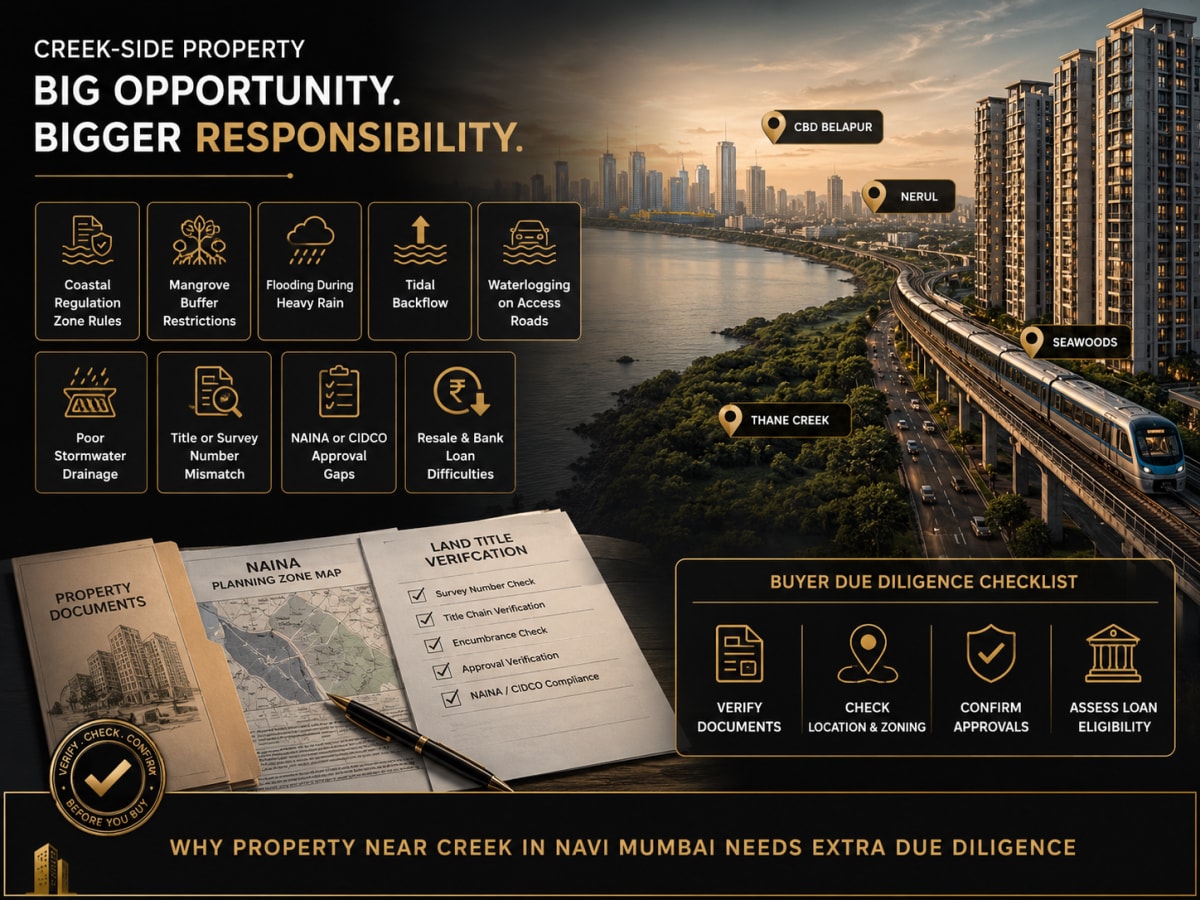
Navi Mumbai has many planned nodes, but it also has coastal belts, mangrove areas, creeklines, wetlands, low-lying pockets, old gaothan settlements, CIDCO leasehold areas, and NAINA planning zones. That combination creates opportunity. It also creates risk. Creek-side property may face issues related to:
- Coastal Regulation Zone rules
- Mangrove buffer restrictions
- Flooding during heavy rain
- Tidal backflow
- Waterlogging on access roads
- Poor stormwater drainage
- Title or survey number mismatch
- NAINA or CIDCO approval gaps
- Resale and bank loan difficulties
This is why buyers should not depend only on the broker’s statement, project brochure, Google Maps location, or “sea-facing/creek-facing” marketing.
Main Risks of Property Near Creek in Navi Mumbai
1. CRZ and CZMP Risk
CRZ means Coastal Regulation Zone. In simple words, it is a regulatory framework for development near coastal areas, tidal water bodies, creeks, and ecologically sensitive zones. CZMP means Coastal Zone Management Plan. It is the map-based document used to understand CRZ classification in a particular area. For creek-side property in Navi Mumbai, CRZ verification is important because some land parcels may fall under regulated zones. In such cases, construction, expansion, redevelopment, or land use may need specific permissions.Buyer takeaway:Never assume a property is outside CRZ just because nearby buildings exist.
2. Mangrove and Buffer Risk
Mangroves are environmentally sensitive. If a project or plot is close to mangroves, the buyer should be more careful. This does not mean every property near mangroves is illegal. It means verification becomes essential. A buyer should check whether the property is near a mangrove belt, whether any buffer condition applies, whether the project has required permissions, and whether there are any environmental objections or litigation.Important warning:If the seller says, “Mangrove ka issue nahi hai,” ask for written proof, not verbal confidence.
3. Flooding and Tidal Backflow Risk
Creek-side areas may face water-related problems during heavy monsoon periods. Common issues include:
- Road waterlogging
- Basement parking flooding
- Tidal backflow
- Stormwater drain overflow
- Dampness in lower floors
- Mosquito problems
- Bad smell from stagnant water
- Higher maintenance cost
A building can be legally approved and still have poor livability during monsoon. That is why practical local checking matters. Speak to residents, shopkeepers, security guards, and nearby societies. They often know the real monsoon condition better than a sales brochure.
4. Title and Land Record Risk
This risk is bigger for plots, land parcels, gaothan properties, and NAINA-side purchases. Important Marathi / land-record terms:
- 7/12 extract:A land record showing basic agricultural land details, survey number, area, occupant name, and crop/land-use related entries.
- 8A extract:A record showing landholding details of a person in a village.
- Ferfar / mutation entry:A record of change in ownership or rights after sale, inheritance, partition, or other transaction.
- Gut number / survey number:Identification number of a land parcel in village records.
- Property card:Record commonly used for urban properties, showing property details and rights-related entries.
These records support verification. They should not be treated as a complete guarantee of ownership by themselves. For creek-side or low-lying land, the buyer should also check zoning, reservation, access road, CRZ/CZMP status, and development permission.
5. Approval and OC Risk
For flats and buildings, documents matter. A buyer should check:
- MahaRERA registration, if applicable
- Commencement Certificate
- Approved building plan
- Occupancy Certificate
- Environmental clearance, if applicable
- Fire NOC for high-rise buildings
- CIDCO, NMMC, PCMC, NAINA, or relevant planning authority approval
Do not rely only on “RERA registered” as a complete safety certificate. MahaRERA registration is important, but buyers still need to check title, approvals, OC, CRZ risk, and actual site conditions.
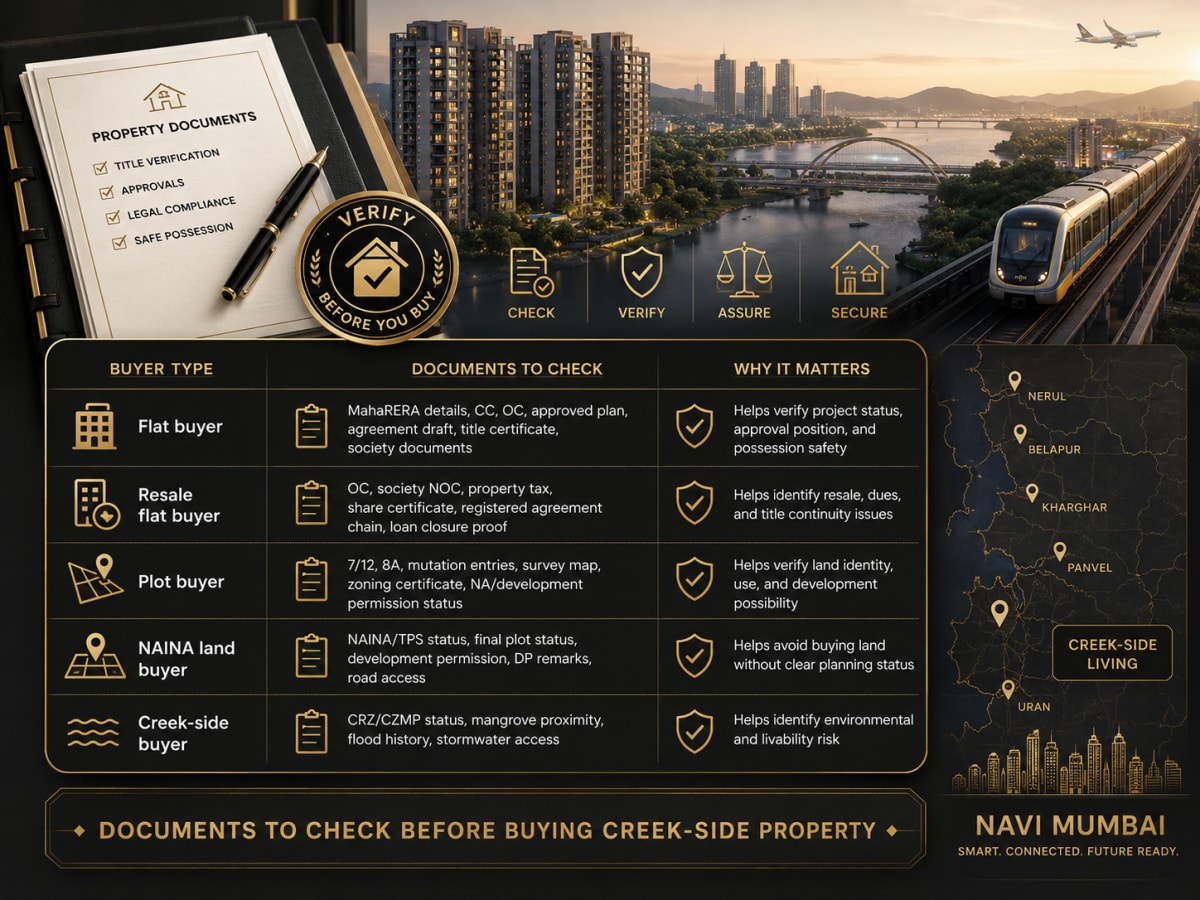
Documents to Check Before Buying Creek-Side Property
| Buyer TypeDocuments to CheckWhy It Matters | ||
| Flat buyer | MahaRERA details, CC, OC, approved plan, agreement draft, title certificate, society documents | Helps verify project status, approval position, and possession safety |
| Resale flat buyer | OC, society NOC, property tax, share certificate, registered agreement chain, loan closure proof | Helps identify resale, dues, and title continuity issues |
| Plot buyer | 7/12, 8A, mutation entries, survey map, zoning certificate, NA/development permission status | Helps verify land identity, use, and development possibility |
| NAINA land buyer | NAINA/TPS status, final plot status, development permission, DP remarks, road access | Helps avoid buying land without clear planning status |
| Creek-side buyer | CRZ/CZMP status, mangrove proximity, flood history, stormwater access | Helps identify environmental and livability risk |
How to Verify Property Near Creek in Navi Mumbai
Step 1: Get the Exact Property Identity
Ask for the exact:
- Survey number
- Gut number
- CTS number, if applicable
- Village name
- Plot number
- Building name and phase
- MahaRERA number, if applicable
Do not verify only by project name. Many mistakes happen because buyers check the wrong land parcel.
Step 2: Check Land Records
Use Maharashtra land-record portals to check 7/12, 8A, and property card details. Check:
- Name on record
- Survey/gut number
- Area
- Mutation entries
- Land classification
- Remarks or restrictions
- Whether details match the seller’s documents
If there is a mismatch, do not proceed without legal review.
Step 3: Check IGR Maharashtra Records
IGR Maharashtra e-Search can help check registered transaction history. For buyers, this is useful because it helps identify past sale deeds, registered agreements, mortgages, and document history where available. Do not treat IGR search alone as full title clearance. It is one part of due diligence.
Step 4: Check MahaRERA
For eligible projects, search the project on MahaRERA. Check:
- Project registration status
- Promoter name
- Project address
- Completion timeline
- Uploaded approvals
- Extension details
- Complaints or orders, if visible
- Whether the project is lapsed, revoked, or under any issue
If the broker gives a MahaRERA number, verify it yourself.
Step 5: Check CRZ/CZMP
For creek-side property, CRZ/CZMP checking is important. The buyer or professional should check whether the land falls near a regulated coastal area, mangrove belt, creekline, or sensitive zone. Use official MCZMA/CZMP resources or consult a qualified architect, planning consultant, or environmental/legal professional.Do not depend on Google Maps distance alone for CRZ decisions.
Step 6: Check CIDCO / NAINA / Local Authority Approval
Different parts of Navi Mumbai fall under different authorities. Depending on location, check with:
- CIDCO
- NAINA / NIAMS
- NMMC
- PCMC
- Raigad district / revenue office
- Other applicable planning authority
For NAINA areas, buyers must be extra careful. NAINA land may involve town planning schemes, interim development plans, final plots, road reservations, and development control regulations. A random “future residential plot” is not enough. Ask for planning status in writing.
Step 7: Check Monsoon and Site Conditions
Visit the site during or after heavy rain if possible. Ask:
- Does the access road flood?
- Does basement parking flood?
- Does water enter the compound?
- Is there a bad smell from creek/nullah water?
- Are mosquitoes a major issue?
- Are stormwater drains functional?
- Do residents complain every monsoon?
This one step can save a buyer from years of frustration.
Example Scenario: Creek-Side Plot Near Panvel / NAINA Belt
A buyer is offered a plot near a creek-influenced village in the Panvel-NAINA belt. The broker says: “Airport ke baad rate double ho jayega. Token de do. Baad mein papers ho jayenge.” The buyer receives a 7/12 extract, but there is no clear zoning certificate, no development permission, no CRZ/CZMP check, and no written NAINA status. This is risky. The buyer should first:
- Confirm the exact gut number and village name. 2. Check 7/12 and mutation entries. 3. Verify whether the land falls under NAINA planning or TPS. 4. Check zoning and reservation. 5. Check CRZ/CZMP and mangrove proximity. 6. Confirm legal access road. 7. Get a title search from a property lawyer. 8. Pay token only after basic verification is complete.
Airport growth is not a substitute for legal due diligence.
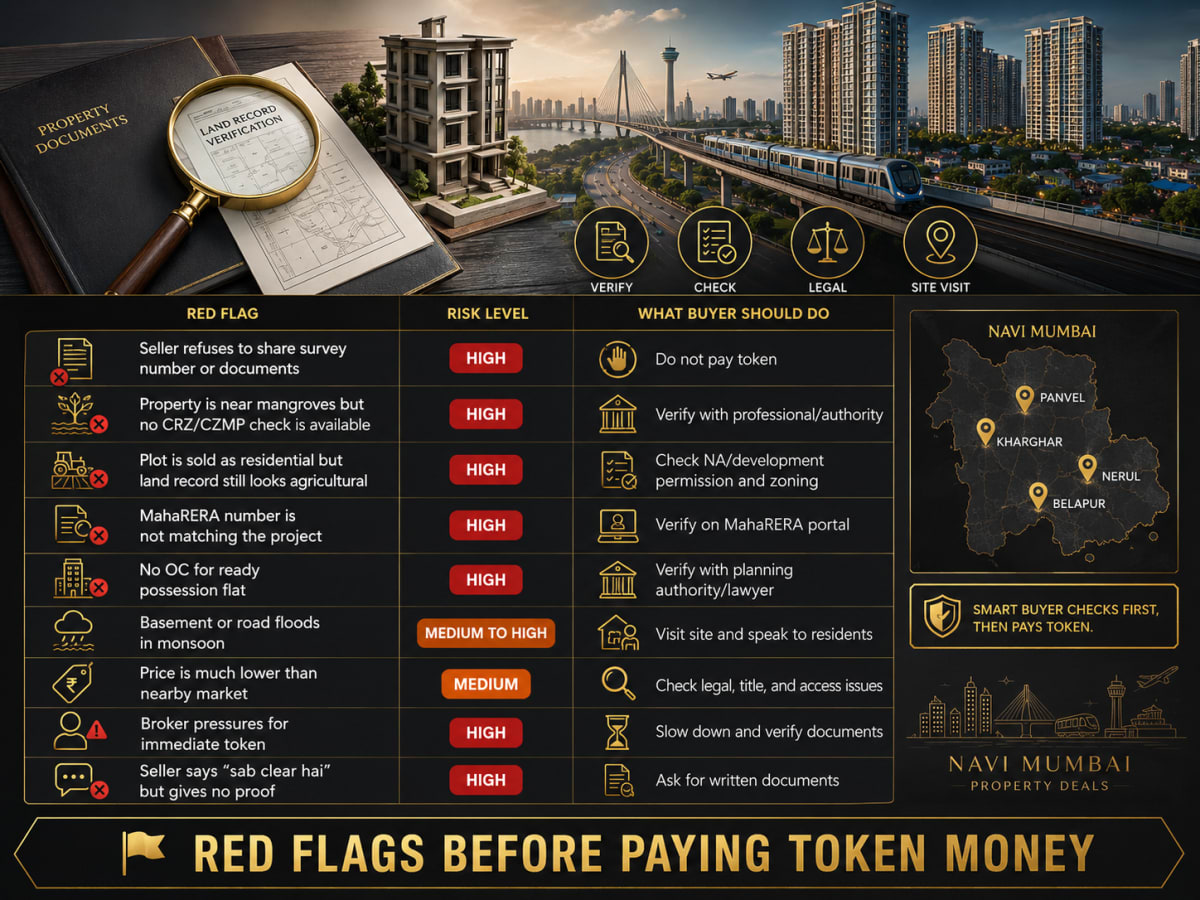
Red Flags Before Paying Token Money
| Red FlagRisk LevelWhat Buyer Should Do | ||
| Seller refuses to share survey number or documents | High | Do not pay token |
| Property is near mangroves but no CRZ/CZMP check is available | High | Verify with professional/authority |
| Plot is sold as residential but land record still looks agricultural | High | Check NA/development permission and zoning |
| MahaRERA number is not matching the project | High | Verify on MahaRERA portal |
| No OC for ready possession flat | High | Verify with planning authority/lawyer |
| Basement or road floods in monsoon | Medium to High | Visit site and speak to residents |
| Price is much lower than nearby market | Medium | Check legal, title, and access issues |
| Broker pressures for immediate token | High | Slow down and verify documents |
| Seller says “sab clear hai” but gives no proof | High | Ask for written documents |
Common Mistakes Buyers Make
Mistake 1: Trusting Creek View More Than Documents
A creek view can increase emotional value. But banks, lawyers, and future buyers will look at documents. Views do not clear title. Views do not remove CRZ risk. Views do not solve flooding.
Mistake 2: Checking Only MahaRERA
MahaRERA is important, but it is not the only check. A buyer should also check OC, CC, title, IGR records, planning approval, and local environmental risk.
Mistake 3: Paying Token Too Early
Many buyers pay token money after a site visit. That is dangerous for creek-side, NAINA, gaothan, or plot purchases. First ask for documents. Then verify. Then negotiate token terms.
Mistake 4: Ignoring Monsoon Reality
A project may look excellent in December. Visit during monsoon or ask residents about monsoon issues. Creek-side risk is not visible in a dry season brochure.
Mistake 5: Believing “Future Approval” Claims
“Future CIDCO approved,” “future NAINA approved,” or “future residential zone” are not enough. Ask for current written status. If it is not approved today, price it as risk.
What to Check Before Paying Token Money
Use this checklist before paying token money for property near creek in Navi Mumbai.
- Exact survey number / CTS number / gut number
- Village name and plot identity
- 7/12 extract or property card
- Mutation entries / Ferfar
- IGR transaction history
- MahaRERA registration, if applicable
- Commencement Certificate
- Occupancy Certificate
- Approved building plan
- CRZ/CZMP status
- Mangrove or wetland proximity
- Flood and waterlogging history
- Stormwater drainage condition
- Access road legality
- CIDCO / NAINA / NMMC / PCMC approval
- Environmental clearance, if applicable
- Legal title report
- Written token refund conditions
Best rule:If the seller cannot share documents before token, do not pay token.
FAQs
Is property near creek in Navi Mumbai always risky?
No. Property near a creek is not automatically risky. The risk depends on CRZ status, mangrove proximity, flooding, approvals, title clarity, OC status, and local site conditions.
Can I buy a creek-facing flat in Navi Mumbai?
Yes, if the building has proper approvals, MahaRERA compliance where applicable, OC, clear title, and no unresolved environmental or legal issue. Always verify documents before payment.
Is CRZ applicable to all creek-side properties?
Not always. CRZ applicability depends on location, coastal maps, tidal influence, CRZ category, and official CZMP interpretation. Verify with official maps or a qualified professional.
What is the biggest risk in creek-side land?
For land and plots, the biggest risks are CRZ restriction, unclear zoning, NAINA/TPS uncertainty, weak access road, agricultural land status, and title mismatch.
Should I pay token money before document verification?
No. For creek-side property, token money should be paid only after basic document screening. Token terms should also be written clearly.