Panvel Real Estate Guide: Best Areas, Property Prices and Buying Tips
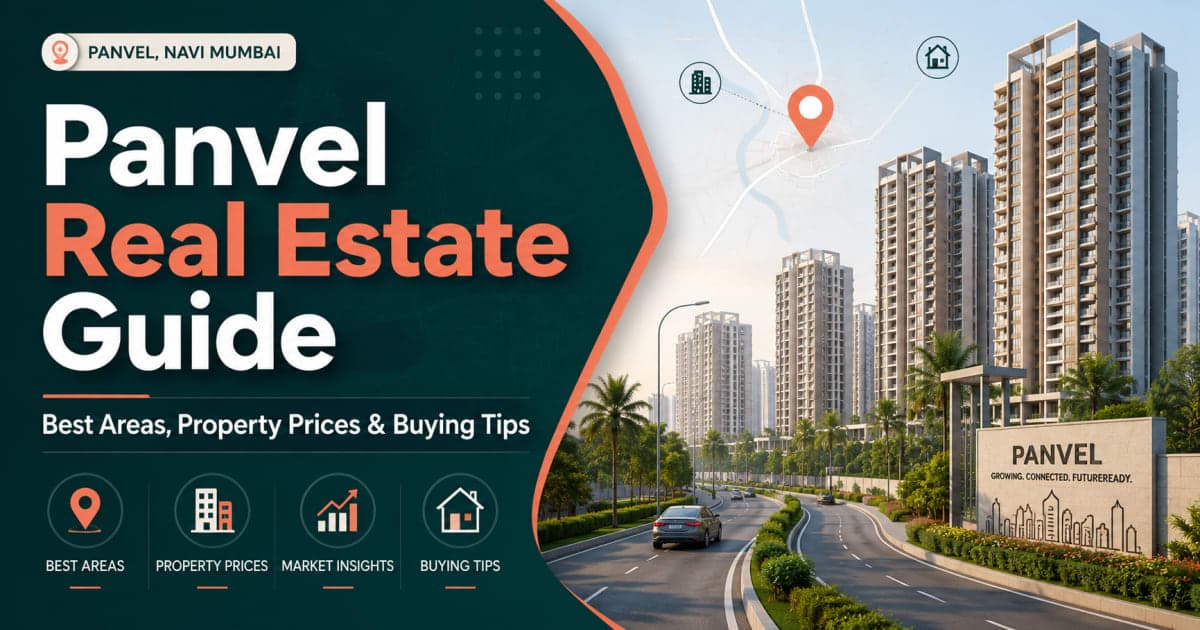
Quick Answer
Panvel can be a practical property-buying location for families, first-time buyers and long-term investors. It offers established residential areas, railway connectivity, road access and a wider choice of homes compared with many costlier parts of Navi Mumbai. But there is one important point: Panvel is not one uniform property market. A resale flat near Panvel station, a home in New Panvel, an apartment near Palaspe and a plot inside a NAINA-influenced village can have completely different prices, authorities, documents and risks. Before comparing properties, identify:
- The exact locality and survey details.
- Whether the property is new, resale or under construction.
- The relevant planning and civic authority.
- The MahaRERA status, where applicable.
- The approved carpet area and building plan.
- The Occupancy Certificate status.
- The seller’s ownership documents.
- The total price, including taxes and other charges.
This guide explains how to compare Panvel areas, understand property prices and verify a property before paying token money.
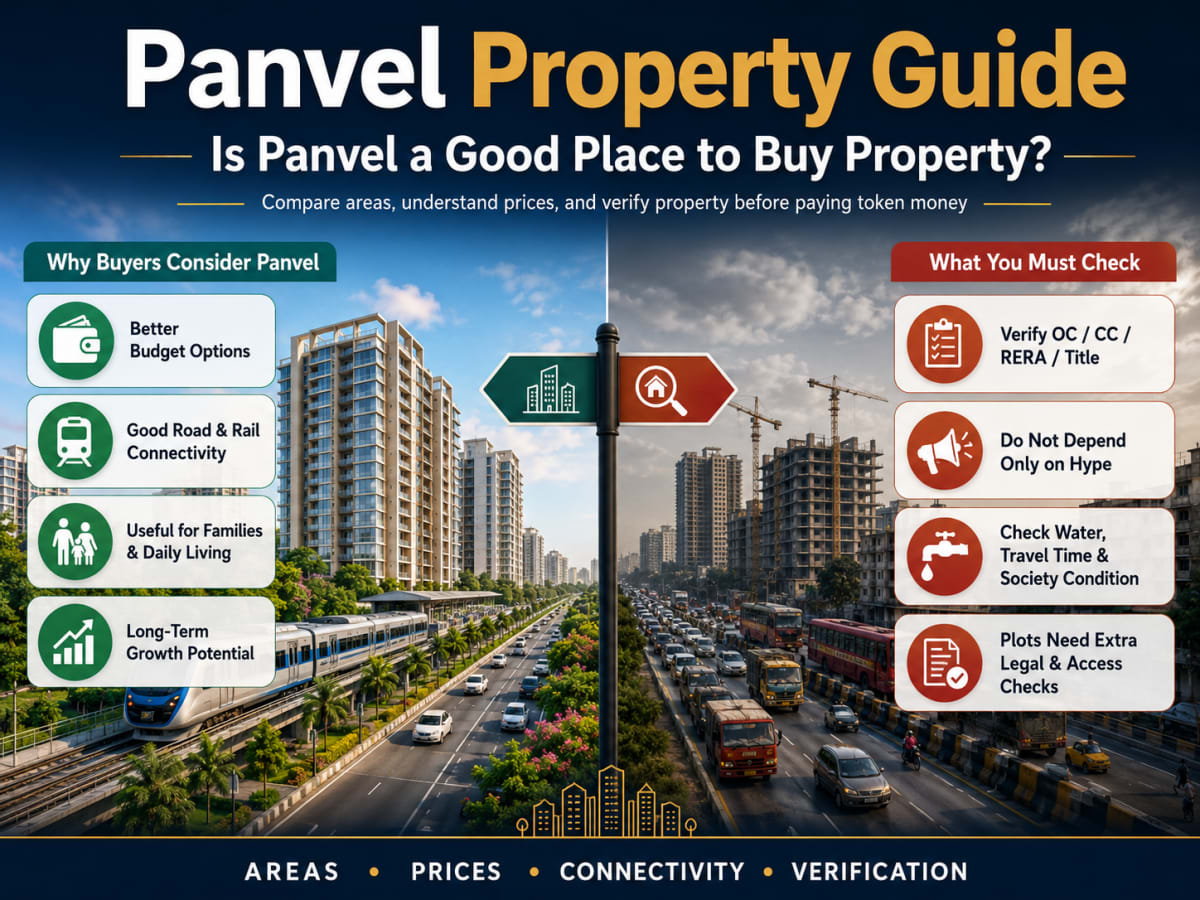
Is Panvel a Good Place to Buy Property?
Panvel may suit buyers who want a balance between price, connectivity, daily convenience and long-term regional development. It can be particularly useful for:
- Families looking for a home within a controlled budget.
- Buyers working around Navi Mumbai, Taloja, Khopoli, Rasayani or nearby industrial belts.
- People who regularly travel towards Pune or the Konkan region.
- First-time buyers comparing Panvel with Kharghar, Kamothe, Kalamboli or Taloja.
- Long-term investors who understand that infrastructure-driven returns are not guaranteed.
Panvel is part of Raigad district and the wider Mumbai Metropolitan Region. Its property market includes old city areas, planned residential sectors, large townships, highway-side developments and peripheral village land. That variety creates opportunities, but it also makes property verification more important.
Simple verdict
| Buyer type | Is Panvel suitable? | Main condition |
| First-time homebuyer | Often suitable | Choose an established area and verify all approvals |
| Family buying for self-use | Often suitable | Check schools, hospitals, water, travel time and society condition |
| Railway commuter | Suitable in selected pockets | Test the real station route during peak hours |
| Long-term investor | Potentially suitable | Do not depend only on airport or infrastructure marketing |
| Resale buyer | Suitable with proper checks | Verify title chain, society records, OC and pending dues |
| Plot buyer | Higher-risk category | Complete land, zoning, access-road and title verification |
| Short-term speculator | Uncertain | Liquidity and price growth are not guaranteed |
Why Panvel Attracts Property Buyers
Panvel functions as an important transport and residential gateway in the eastern part of the Mumbai Metropolitan Region. Its appeal comes from several factors.
1. Railway connectivity
Panvel is connected to Mumbai’s suburban railway network and also serves important long-distance and Konkan Railway routes. However, being “near Panvel station” can mean different things in property advertisements. A project may look close on a map but still require a long auto-rickshaw ride, a difficult crossing or travel through congested roads. Always test the actual route.
2. Road access
Panvel provides access towards:
- Mumbai and central Navi Mumbai.
- Pune.
- Khopoli.
- Karjat.
- The Konkan region.
- Taloja and nearby industrial areas.
- Uran and the airport-influence belt.
Road connectivity can be valuable, but buyers should check peak-hour congestion and last-mile access instead of relying only on distance shown in brochures.
3. Wider housing choice
Panvel offers:
- Older resale buildings.
- Cooperative housing societies.
- New apartment projects.
- Integrated townships.
- Budget housing.
- Premium towers.
- Plotted developments.
- Village and peripheral land.
The wide choice means that two properties located only a few kilometres apart may not be directly comparable.
4. Regional infrastructure
Panvel is frequently marketed using airport, railway, expressway and NAINA-related development. These projects may influence future demand, but buyers should not assume that every nearby property will appreciate equally. The benefit depends on:
- Actual road access.
- Project quality.
- Legal approvals.
- Available social infrastructure.
- Water and drainage.
- Distance from employment.
- Future housing supply.
- Resale demand.
Infrastructure is an important factor. It is not a substitute for property verification.
Understanding the Different Parts of Panvel
Buyers often search for “property in Panvel” without first deciding which Panvel micro-market they are considering. This can lead to poor comparisons.
Panvel Areas at a Glance
| Area | General character | Suitable for | Important checks |
| Old Panvel | Established and commercially active | Buyers who want daily convenience | Parking, congestion, building age and title documents |
| New Panvel East | Planned residential sectors | Families, commuters and resale buyers | OC, society condition, water and actual station distance |
| New Panvel West | Residential sectors on the western side | Families and end-users | Road access, maintenance and neighbourhood infrastructure |
| Khanda Colony | Established residential pocket near Khandeshwar | Families and regular commuters | Building age, parking, society records and noise |
| Panvel station belt | Transport-focused and busy | Railway users and rental buyers | Crowding, access road, old-building documents and parking |
| Palaspe and highway belt | Road-focused development and larger projects | Car users and long-term buyers | Daily convenience, project access and approval status |
| Vichumbe and nearby pockets | Budget-oriented peripheral housing | Buyers seeking lower entry prices | Water, roads, OC, authority and transport |
| Akurli and surrounding areas | Developing residential market | Budget-conscious buyers | Project approvals, civic services and last-mile access |
| NAINA-influenced villages | Future-planning and land market | Experienced plot investors | Zoning, title, NA status, layout approval and road access |
| Large townships | Amenity-led planned developments | Families seeking organised living | Phase approvals, possession, maintenance and exit demand |
These are broad market descriptions. The authority and approval position must be checked for the exact plot, building and project.
1. Old Panvel
Old Panvel is an established city market with shops, transport, schools, hospitals and everyday services. It may work well for buyers who prioritise convenience over wide roads or modern township amenities.
Advantages
- Established markets and commercial activity.
- Access to buses and railway connectivity.
- Existing social infrastructure.
- A large resale-property market.
- Greater day-to-day convenience in many pockets.
Points to check
Older buildings may have:
- Limited parking.
- Narrow approach roads.
- Lift or structural-maintenance issues.
- Incomplete society records.
- Redevelopment discussions.
- Unapproved internal changes.
- Older title documents that require careful review.
A lower price does not automatically make an older resale flat a better deal. Renovation, major repairs and society liabilities should be included in the calculation.
2. New Panvel East
New Panvel East is one of the better-known residential parts of the Panvel market. It includes planned sectors, educational institutions, local shopping and access towards Panvel railway station. It may suit families who want an established neighbourhood without paying the prices seen in some central Navi Mumbai nodes.
Advantages
- Planned residential layout in many sectors.
- Mix of old and new housing.
- Schools, colleges and local markets.
- Access to Panvel station.
- Suitable for end-use buyers.
Points to check
Do not buy only based on the sector name. Check:
- Walking and driving time to the station.
- Water source and pressure.
- Society maintenance.
- Lift condition.
- Parking allocation.
- Occupancy Certificate.
- Leakage during the monsoon.
- Noise from roads or railway activity.
- Building age and repair history.
3. New Panvel West and Khanda Colony
New Panvel West, including the Khanda Colony side, is popular among families and commuters. Khandeshwar railway station can be useful for selected pockets, but actual convenience differs from sector to sector.
Advantages
- Established residential buildings.
- Access to schools and daily services.
- Khandeshwar and Panvel connectivity.
- Mix of compact and larger apartments.
- Active resale market.
Points to check
Visit the property during working-day peak hours. Also verify:
- The real route to Khandeshwar station.
- Traffic near important junctions.
- Parking availability.
- Society transfer requirements.
- Maintenance arrears.
- Water and drainage.
- Any unauthorised extension inside the flat.
4. Palaspe and Highway-Side Panvel
Palaspe and other highway-side areas may attract buyers because of road connectivity and large residential projects. These locations can be useful for households that depend more on private vehicles than daily railway travel.
Advantages
- Road connectivity.
- Larger development parcels.
- Newer apartment projects.
- Township-style amenities in selected projects.
- Potential suitability for Pune- or highway-oriented travel.
Points to check
A project beside a highway may still have poor internal access. Verify:
- The legal approach road.
- Distance from groceries, schools and hospitals.
- Public transport availability.
- Noise and air quality.
- Water supply.
- Project completion status.
- MahaRERA phase and possession date.
- Future maintenance charges.
- Whether amenities belong to the same registered phase.
5. Vichumbe, Akurli and Peripheral Pockets
Peripheral locations may offer lower quoted prices than established parts of New Panvel. This does not necessarily mean they offer better value. The price difference may reflect:
- Weaker roads.
- Greater dependence on autos or private vehicles.
- Incomplete drainage.
- Tanker-water dependence.
- Limited nearby retail.
- Slower resale demand.
- Project-level approval differences.
These areas may suit buyers with limited budgets, but the decision should be based on present liveability, not only future promises.
6. NAINA and Peripheral Plot Locations
NAINA stands for the Navi Mumbai Airport Influence Notified Area. CIDCO has acted as the Special Planning Authority for notified NAINA areas across parts of Panvel, Uran and Pen talukas. Being located inside or near NAINA does not automatically mean:
- The plot is approved for residential use.
- Construction can start immediately.
- The layout is sanctioned.
- The land has clear title.
- The property will appreciate.
- The road shown in the brochure exists legally.
For a NAINA-area property, verify the exact:
- Village.
- Survey or Gat number.
- Land-use zone.
- Town Planning Scheme status.
- Development Plan reservation.
- NA status.
- Layout approval.
- Development permission.
- Access road.
- Title chain.
- Acquisition or reservation risk.
A marketing statement such as “NAINA approved plot” should always be supported by official documents.
Panvel Property Prices: 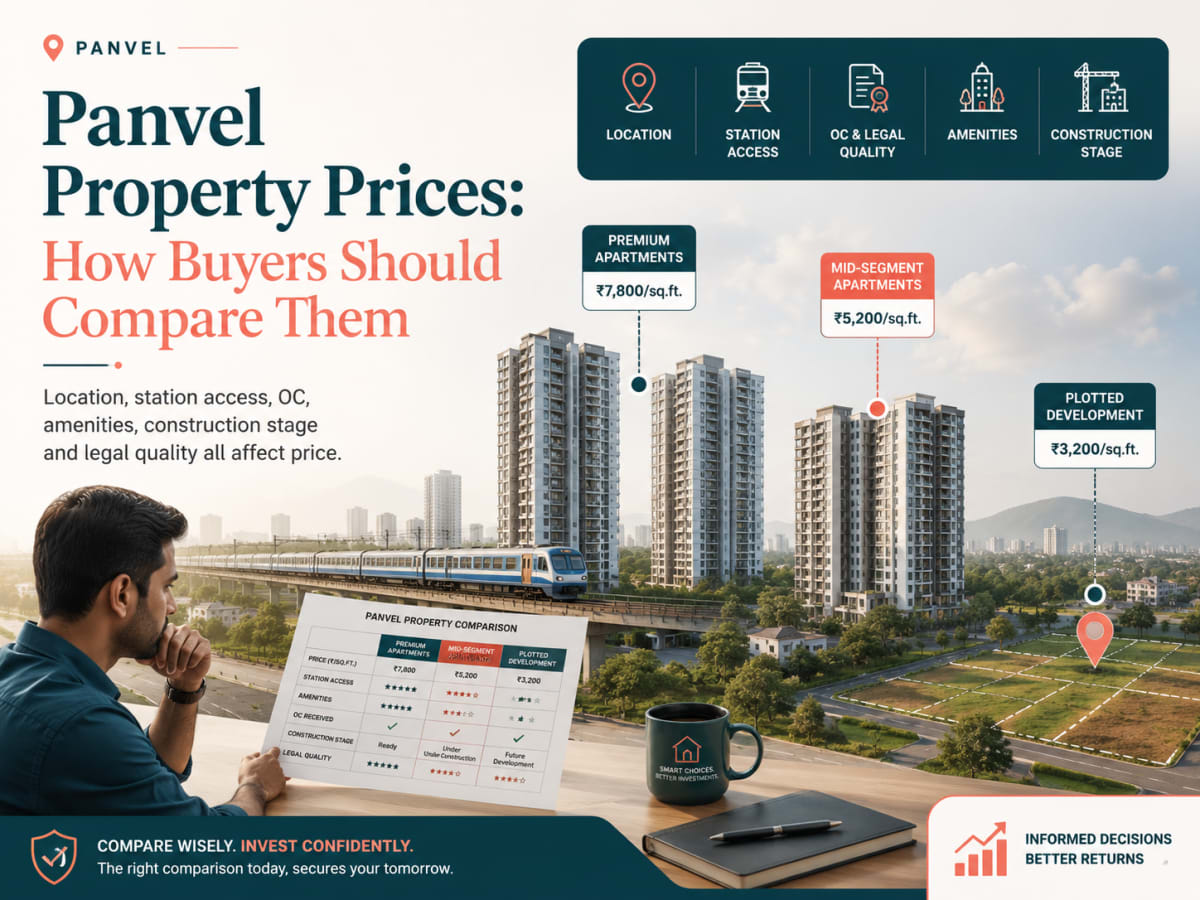
How Buyers Should Compare Them
How Buyers Should Compare Theme is no single correct “Panvel property rate.” Prices change based on:
- Exact location.
- Distance from a functional railway station.
- Building age.
- Project reputation.
- Carpet area.
- Floor and view.
- Parking.
- Occupancy Certificate.
- Society condition.
- Amenities.
- Road access.
- Water supply.
- Construction stage.
- Seller urgency.
- Legal and documentation quality.
Relative Price Positioning
| Property category | General price position | Why it varies |
| Old-building resale flat | Lower to medium | Age, parking, repairs, society condition |
| Established New Panvel society | Medium | Sector, station access, OC and maintenance |
| New branded project | Medium to premium | Amenities, brand, construction stage and location |
| Highway-side township | Project-specific | Scale, connectivity and daily-service availability |
| Peripheral apartment | Lower to medium | Infrastructure and transport limitations |
| Approved plotted development | Highly variable | Title, zone, NA status, layout and access |
| Unclear or unapproved land | May appear unusually cheap | High documentation and development risk |
This table gives only relative positioning. It is not a current rate card.
Asking Price vs Actual Property Value
A seller may quote ₹10,000 per square foot. But that number is meaningless unless you know which area measurement has been used. Ask whether the price is based on:
- Carpet area.
- Built-up area.
- Saleable area.
- Super built-up area.
- Plot area.
Example
Suppose two Panvel flats are advertised at the same total price. Flat A has 650 sq. ft. RERA carpet area. Flat B is described as 1,000 sq. ft., but that figure is the saleable area and its carpet area is only 610 sq. ft. Flat B may appear larger in the advertisement even though its actual usable space is smaller. Always compare the price using the same carpet-area basis.
Four Prices Every Panvel Buyer Should Understand
| Price type | What it means |
| Asking price | The seller’s or developer’s quoted price |
| Negotiated price | The amount finally agreed between buyer and seller |
| Registered consideration | The value recorded in the registered agreement |
| Ready reckoner value | Government valuation benchmark used for stamp-duty purposes |
The ready reckoner value is not automatically the market value. Check the applicable Annual Statement of Rates through the Maharashtra Department of Registration and Stamps for the exact location and property category. Maharashtra retained the previous ready reckoner rates for FY 2026–27, but buyers must still verify the applicable rate for their exact property and transaction date.1
How to Calculate the Real Cost of a Panvel Property
Do not compare properties using only the agreement price. Calculate the total acquisition cost.
| Cost | New or under-construction flat | Resale flat |
| Property consideration | Yes | Yes |
| Stamp duty | Yes | Yes |
| Registration fee | Yes | Yes |
| GST | May apply depending on property status | Normally not on a completed resale transaction |
| Parking or amenity charges | May apply | Depends on transaction and records |
| Maintenance deposit | Common | Possible |
| Floor-rise or preference charges | Possible | Usually included in seller’s expectation |
| Society transfer charges | Usually later | May apply |
| Brokerage | Possible | Common |
| Loan-processing charges | Possible | Possible |
| Legal verification | Recommended | Recommended |
| Interior or renovation | Likely | Often significant |
| Pending dues | Usually not applicable | Must be checked |
Tax treatment and charges can change. Confirm current amounts with the relevant authority and a qualified tax or property professional.
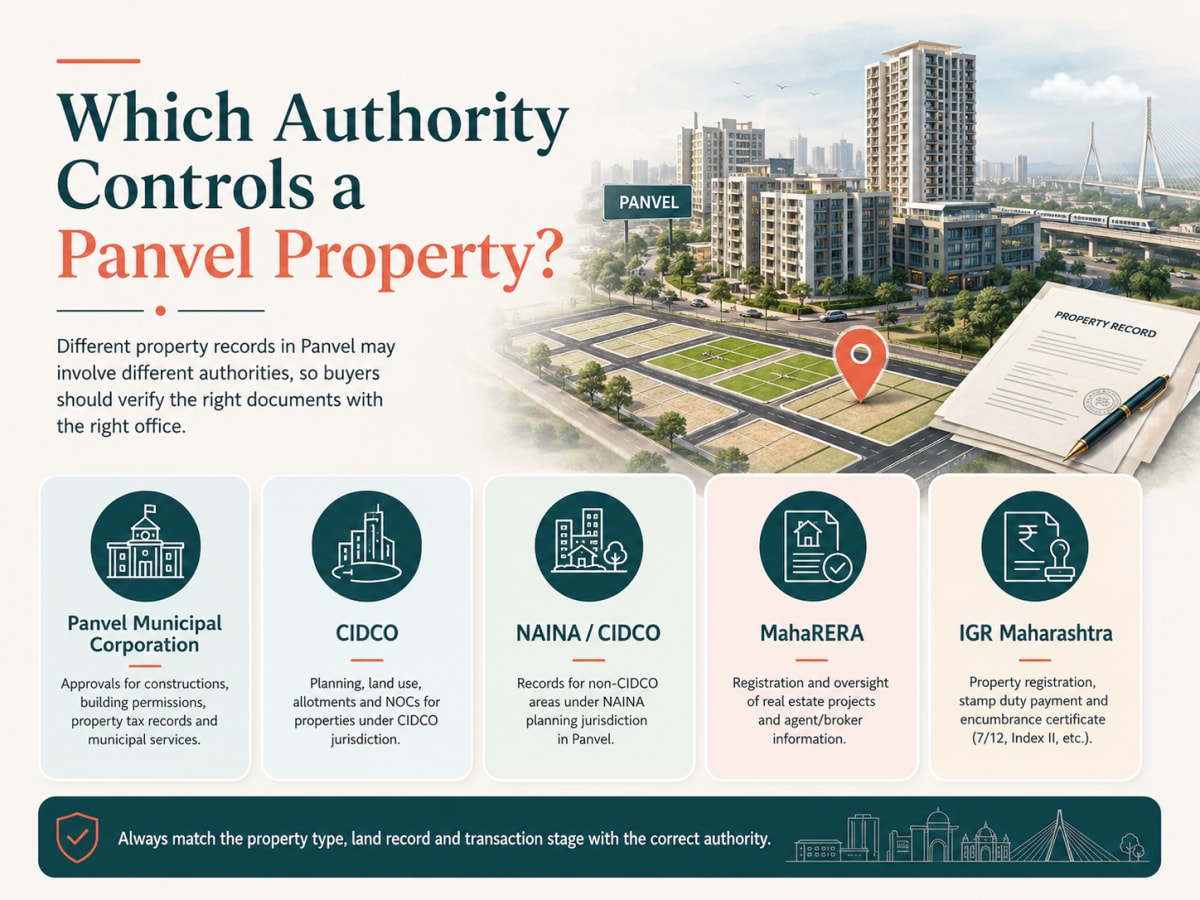
Which Authority Controls a Panvel Property?
This is one of the most confusing parts of buying property in Panvel. Different records may involve different authorities.
Authority Guide
| Authority | What buyers may need to verify |
| Panvel Municipal Corporation | Property tax, civic records and applicable municipal permissions |
| CIDCO | Lease, allotment, transfer, plot conditions and planning records where relevant |
| NAINA/CIDCO | Zoning and development permissions in notified areas |
| MahaRERA | Project registration, disclosures, completion date and complaints |
| IGR Maharashtra | Registration, Index II, ready reckoner and stamp-duty information |
| Mahabhumi/Mahabhulekh | 7/12 extract, property card and other land records |
| Cooperative housing society | Share certificate, dues, transfer records and society documents |
| Developer or landowner | Title chain, approvals and contractual documents |
Panvel Municipal Corporation was formed in 2016 and covers Panvel city and various surrounding urban areas. However, the planning history and exact approval authority can still differ between properties.2 Never assume the authority only from the postal address.
How to Verify a Panvel Property Step by Step
Step 1: Identify the Exact Property
Collect:
- Full address.
- Flat and wing number.
- Building name.
- Project name.
- Sector.
- Plot number.
- Village name.
- Survey or Gat number.
- CTS or property-card number, where applicable.
A project’s marketing name is not enough for legal verification.
Step 2: Identify the Property Type
Confirm whether it is:
- Under construction.
- Ready but unsold.
- Resale.
- Society flat.
- CIDCO-linked property.
- Leasehold property.
- Freehold property.
- Plot.
- Village property.
- NA land.
- Agricultural land.
Different property types need different documents.
Step 3: Confirm the Relevant Authority
Ask for copies of the approvals and see which authority issued them. Do not rely only on an agent’s statement that the property is:
- “CIDCO approved.”
- “NAINA approved.”
- “PMC approved.”
- “Collector approved.”
- “Bank approved.”
Ask to see the actual document, approval number and approved plan.
Step 4: Check the MahaRERA Project Page
For a project required to be registered, use the official MahaRERA project search. Compare:
- Project name.
- Registration number.
- Promoter name.
- Project address.
- Registered phase.
- Declared completion date.
- Approved plans.
- Encumbrance disclosure.
- Quarterly updates.
- Litigation and complaint information where shown.
Read our MahaRERA Project Search guide before relying on a registration number. MahaRERA registration improves access to project information. It does not independently guarantee title, construction quality or timely possession.
Step 5: Verify Property Ownership
For a resale property, match the seller’s name with the registered agreement and other ownership records. Check:
- Current registered agreement.
- Previous agreements.
- Index II.
- Share certificate.
- Property card or land record where applicable.
- Inheritance documents, if the original owner has died.
- Power of attorney, if someone else is signing.
- Existing housing loan.
- Court dispute or family claim.
Use our guide on How to Verify Property Ownership for a more detailed process. A property lawyer should review the complete title chain before the transaction.
Step 6: Check the Sanctioned Building Plan
A sanctioned plan is the building plan approved by the competent planning authority. Compare the approved plan with:
- Building wing.
- Floor.
- Flat number.
- Carpet area.
- Balcony.
- Terrace.
- Parking.
- Actual construction.
Read our Building Plan Approval guide to understand what an approved plan should show. An attractive flat can still have an unauthorised extension or layout change.
Step 7: Check the Commencement Certificate
In Maharashtra, “CC” commonly refers to the Commencement Certificate. This document permits construction according to the approved stage and conditions. A Commencement Certificate may be limited to certain floors or stages. Therefore, check whether the certificate covers:
- The building.
- The wing.
- The floor being sold.
- The relevant project phase.
Do not rely on the statement “CC received” without reading the document.
Step 8: Check the Occupancy Certificate
An Occupancy Certificate, commonly called OC, is an important document for a completed building. It generally confirms that the competent authority has permitted occupation of the completed building or the covered portion, subject to its terms. Check whether the OC covers:
- The correct building.
- The correct wing.
- The relevant floors.
- The flat being purchased.
- Full or partial occupation.
A possession letter is not the same as an OC. Read OC vs CC vs Possession Letter before buying a ready or resale property.
Step 9: Check Society Records
For a resale flat, ask the housing society for:
- Share certificate.
- Maintenance statement.
- No-dues confirmation.
- Transfer requirements.
- Parking information.
- Major repair history.
- Pending disputes.
- Conveyance or deemed-conveyance status.
- Notices affecting the flat or building.
A Society NOC can be useful, but it does not replace title verification.
Step 10: Check Property-Tax and Utility Dues
Ask for:
- Latest property-tax bill.
- Paid receipt.
- Electricity bill.
- Water charges.
- Society maintenance statement.
- Any penalty or arrears notice.
Confirm that the property details and owner information match the transaction records.
Step 11: Inspect the Property Physically
Visit more than once. A good inspection should cover:
- Water pressure.
- Tanker dependence.
- Leakage.
- Cracks.
- Lift condition.
- Staircase and fire access.
- Parking.
- Drainage.
- Garbage collection.
- Road condition.
- Noise.
- Mobile connectivity.
- Actual sunlight and ventilation.
Try to visit during heavy rain when possible. Panvel receives strong monsoon rainfall, and drainage or leakage problems may not be visible during a dry-season visit.
Step 12: Test the Daily Travel Route
Do not rely only on Google Maps or the broker’s travel time. Test:
- Home to railway station.
- Home to workplace.
- School route.
- Hospital route.
- Grocery access.
- Highway entry.
- Evening return journey.
A project advertised as “10 minutes from Panvel station” may take longer during peak traffic.
Step 13: Review the Agreement Before Signing
The draft agreement should clearly state:
- Correct property description.
- Carpet area.
- Total consideration.
- Payment schedule.
- Possession terms.
- Parking terms.
- Common areas.
- Maintenance obligations.
- Delay provisions.
- Cancellation terms.
- Existing mortgage.
- Tax responsibility.
- Seller’s declarations.
- Indemnity clauses.
Do not sign a booking form or agreement that contains blank spaces or terms you do not understand.
What to Check Before Paying Token Money
Do not pay token money only because the price looks attractive. Complete at least these minimum checks:
- Verify the seller’s identity.
- See the current ownership document.
- Check the project’s MahaRERA status, if applicable.
- Confirm the correct property and survey details.
- Ask for the sanctioned plan.
- Check CC and OC status where relevant.
- Check the society share certificate for resale.
- Verify outstanding housing loans.
- Check maintenance and property-tax dues.
- Confirm authority and land-use status for plots.
- Record the token terms in writing.
- Clearly state when the token is refundable.
A WhatsApp promise is weaker than a properly written and signed token document.
Documents Checklist for a Panvel Property
Under-Construction Flat Checklist
- [ ] MahaRERA registration details.
- [ ] Project and phase details.
- [ ] Promoter name.
- [ ] Title report.
- [ ] Development agreement.
- [ ] Landowner–developer arrangement.
- [ ] Sanctioned plan.
- [ ] Commencement Certificate.
- [ ] Carpet-area statement.
- [ ] Draft Agreement for Sale.
- [ ] Payment schedule.
- [ ] Possession date.
- [ ] Encumbrance or lender disclosure.
- [ ] Parking terms.
- [ ] Complete cost sheet.
- [ ] Amenity and maintenance terms.
Ready-to-Move Flat Checklist
- [ ] Registered agreement or sale deed.
- [ ] Occupancy Certificate.
- [ ] Sanctioned plan.
- [ ] Possession document.
- [ ] Property-tax record.
- [ ] Electricity and water bills.
- [ ] Builder no-dues confirmation.
- [ ] Parking document.
- [ ] Society formation records.
- [ ] Loan-release document, where applicable.
Resale Flat Checklist
- [ ] Seller’s registered agreement.
- [ ] Previous ownership documents.
- [ ] Relevant Index II records.
- [ ] Share certificate.
- [ ] Society no-dues letter.
- [ ] Society transfer requirements.
- [ ] Property-tax receipt.
- [ ] Electricity bill.
- [ ] Occupancy Certificate.
- [ ] Sanctioned building plan.
- [ ] Existing-loan details.
- [ ] Loan closure and lender NOC process.
- [ ] Succession records, where relevant.
- [ ] Power of attorney, where applicable.
- [ ] Parking confirmation.
- [ ] Major repair or redevelopment information.
Use our complete Resale Flat Documents Checklist before finalising a resale transaction.
Plot and Land Checklist
- [ ] Latest digitally signed 7/12 extract.
- [ ] 8A extract, where relevant.
- [ ] Mutation entries.
- [ ] Village map.
- [ ] Survey or measurement plan.
- [ ] Seller’s ownership chain.
- [ ] Title-search report.
- [ ] NA permission or valid land-use record.
- [ ] Zoning confirmation.
- [ ] Development Plan remarks.
- [ ] Town Planning Scheme status.
- [ ] Sanctioned layout.
- [ ] Development permission.
- [ ] Legal access-road proof.
- [ ] Acquisition or reservation check.
- [ ] Encumbrance and litigation search.
- [ ] Physical boundary demarcation.
A 7/12 extract is an important land record, but it is not by itself proof that a residential plot or construction is legally approved.
New Flat vs Resale Flat in Panvel
| Factor | New or under-construction flat | Resale flat |
| Main risk | Delay, phase approval and delivery | Title chain, dues and building condition |
| MahaRERA check | Usually important | May not apply to an older individual resale |
| OC | Not available until eligible completion | Should be checked for completed building |
| Carpet-area clarity | Compare agreement and RERA records | Measure and compare with documents |
| Society records | Society may not yet exist | Share certificate and dues are important |
| Immediate use | Depends on construction stage | Usually possible after transfer |
| GST | May apply depending on status | Normally not charged on completed resale |
| Maintenance | New estimates may change | Existing maintenance history is visible |
| Renovation | Usually lower initially | May require substantial spending |
| Price negotiation | Depends on developer and inventory | Often depends on seller urgency |
| Possession certainty | Must be verified | Physical possession is usually visible |
| Building history | Limited | Repairs, leakage and management can be checked |
Neither category is automatically safer. A properly documented resale flat may be safer than an unclear new project. A well-approved new project may be more suitable than an old building with weak society records.
Practical Red Flags
A red flag does not always mean that the property must be rejected. It means you should pause and verify further.
1. The Authority Is Unclear
The seller cannot explain whether the property is approved by PCMC, CIDCO, NAINA or another planning authority.
2. The Seller Avoids Sharing Documents
You receive only brochures, floor plans or WhatsApp images instead of readable approvals and ownership records.
3. The RERA Number Belongs to Another Phase
The registration shown covers a different tower, phase or completion date.
4. The Approved Floors Do Not Match
The project is selling a floor not covered by the available Commencement Certificate or sanctioned plan.
5. The Building Is Occupied Without a Clear OC
Families may already be living there, but occupation does not automatically prove that the relevant OC exists.
6. “NAINA Approved” Is Used Without Proof
No sanctioned layout, zoning confirmation or development permission is provided.
7. The Plot Has No Clear Legal Access
A mud road or informal village route is shown, but legal access is not recorded in the title or approved layout.
8. The Carpet Area Changes Across Documents
The brochure, cost sheet, RERA page and agreement show different numbers.
9. The Price Is Justified Only by the Airport
There is no clear explanation of present road access, water, social infrastructure or rental demand.
10. Immediate Token Pressure
You are told that the price will increase within hours unless you transfer money immediately.
11. Large Cash Component
An unrecorded cash payment creates legal, tax, financing and proof-related risks.
12. “Bank Approved” Is Treated as Complete Verification
A bank’s willingness to finance a property does not replace independent title and approval checks.
Common Mistakes Panvel Buyers Make
Mistake 1: Comparing Panvel as One Locality
Old Panvel, New Panvel, Palaspe and peripheral villages have different markets. Compare micro-location with micro-location.
Mistake 2: Comparing Saleable Area With Carpet Area
This can make an expensive property look cheaper per square foot. Use carpet area for a fair comparison.
Mistake 3: Buying Only for Future Infrastructure
Infrastructure may help the wider market, but individual projects can still face poor access, weak maintenance or documentation issues.
Mistake 4: Ignoring the Return Journey
A smooth Sunday site visit does not show weekday traffic. Visit during your real commuting hours.
Mistake 5: Assuming All Panvel Properties Are CIDCO Properties
The planning and ownership structure can differ between localities and plots. Check the exact documents.
Mistake 6: Treating MahaRERA Registration as a Legal Guarantee
MahaRERA is an important regulatory verification point, but buyers still need title, approval and agreement review.
Mistake 7: Paying Token Before Seeing Documents
A discount is not useful if the property cannot pass basic verification.
Mistake 8: Ignoring Water and Monsoon Conditions
Check water source, tanker costs, drainage, basement condition and past leakage.
Mistake 9: Forgetting Resale Expenses
Painting, plumbing, electrical work, society transfer, loan closure and unpaid dues can increase the real purchase cost.
Mistake 10: Not Checking Resale Demand
A large project with many similar unsold or resale units may take longer to exit. Ask how many genuine transactions have happened, not only how many listings are online.
Example Scenario: Buying a Budget Flat Near Panvel
Situation
A buyer finds a two-bedroom flat in a developing pocket outside central Panvel. The price is lower than a similar flat in New Panvel. The agent says:
- It is close to the airport.
- The area will soon be fully developed.
- The building is “authority approved.”
- Many families have already moved in.
Possible risk
The lower price may reflect:
- Weak station connectivity.
- Tanker-water dependence.
- Partial approval.
- Missing OC.
- Limited public transport.
- Poor monsoon access.
- Low resale demand.
What the buyer should verify
- Exact authority.
- MahaRERA project and phase.
- Sanctioned plan.
- Commencement Certificate.
- OC status.
- Water source.
- Property-tax record.
- Actual travel time.
- Society maintenance.
- Available resale transactions.
Safer decision
Compare the lower purchase price with the additional transport cost, maintenance, documentation risk and future resale difficulty. The cheapest flat is not always the most affordable flat over ten years.
Final Panvel Homebuyer Checklist
Before selecting the area:
- [ ] Decide whether the property is for self-use, rental income or long-term investment.
- [ ] Set a total budget, not just a base-price budget.
- [ ] Test your daily travel route.
- [ ] Compare at least three Panvel micro-markets.
- [ ] Check schools, healthcare and shopping.
- [ ] Visit during the monsoon or ask residents about drainage and leakage.
Before selecting the property:
- [ ] Confirm the carpet area.
- [ ] Identify the planning authority.
- [ ] Verify MahaRERA, where applicable.
- [ ] Review title and ownership documents.
- [ ] Check the sanctioned plan.
- [ ] Check CC and OC status.
- [ ] Verify property-tax and society dues.
- [ ] Check water, parking and building condition.
- [ ] Compare recent similar properties.
- [ ] Calculate the complete acquisition cost.
Before paying token:
- [ ] Obtain readable document copies.
- [ ] Verify seller identity.
- [ ] Check outstanding loans.
- [ ] Record refund conditions.
- [ ] Avoid unrecorded cash.
- [ ] Get an independent legal review.
- [ ] Do not depend only on verbal promises.
Final Verdict: Should You Buy Property in Panvel?
Panvel can be a sensible choice for buyers who select the right micro-location and complete proper verification. Established areas such as New Panvel and Khanda Colony may offer greater day-to-day convenience. Highway-side projects may suit car-dependent families. Peripheral areas may offer lower entry prices but require stronger checks for roads, water, approvals and resale demand. For investors, the airport and regional infrastructure can support the broader growth story. But they should not be treated as guaranteed-return tools. The safest approach is simple: Choose the area based on your present needs. Choose the property based on its documents, liveability and total cost.
Need Help Buying Property in Panvel?
Navi Mumbai Property Deals follows a buyer-first approach. We can help you compare Panvel properties based on:
- Location.
- Budget.
- Carpet area.
- Daily connectivity.
- Project status.
- Resale condition.
- Basic document availability.
- Practical advantages and limitations.
The goal is not to push the first available property. It is to help you ask better questions before you make a major financial commitment.
Disclaimer
This article is for general property education and does not constitute legal, tax, financial or investment advice. Property rules, authority boundaries, prices, charges, project status, planning records and approval processes can change. Verify the exact property through the relevant authority and obtain an independent review from a qualified property lawyer before paying token money or signing an agreement.
Frequently Asked Questions
Is Panvel a good place to buy property in 2026?
Panvel may be suitable for families, commuters and long-term buyers because it offers multiple residential markets and regional connectivity. Suitability depends on the exact area, property documents, daily travel needs and total purchase cost.
Which part of Panvel is best for families?
New Panvel East, New Panvel West and Khanda Colony are commonly considered by families because of their established residential character and access to daily services. The best area depends on school, workplace, station route and budget.
Is Old Panvel better than New Panvel?
Old Panvel may offer stronger traditional markets and city convenience. New Panvel may offer a more planned residential environment in selected sectors. Buyers should compare congestion, building age, parking, travel route and society quality.
What is the property rate in Panvel?
Panvel does not have one standard property rate. Prices differ by micro-location, carpet area, project age, construction stage, station access, OC status, amenities and building condition. Compare similar properties using the same carpet-area basis.
How can I check a Panvel project on MahaRERA?
Search using the project name or registration number on the official MahaRERA portal. Match the promoter, project address, phase, completion date, approvals and progress disclosures.
Does every Panvel project come under CIDCO?
No. The relevant authority can differ by locality, plot and planning history. Check the sanctioned plan, title documents and approval letters for the exact property.
Does every Panvel property come under Panvel Municipal Corporation?
No assumption should be made using only the postal address. Confirm the civic and planning jurisdiction through the property documents and relevant authority.
What does NAINA mean for a property buyer?
NAINA is the Navi Mumbai Airport Influence Notified Area. Properties in notified areas may be subject to NAINA planning provisions. Inclusion in NAINA does not automatically mean that a plot or project is approved.
Is a MahaRERA-registered project completely safe?
Registration is an important regulatory check, but it does not guarantee clear title, construction quality, possession or investment return. Buyers should independently verify approvals, title and agreement terms.
Is a 7/12 extract enough for buying a plot?
No. A 7/12 extract is a land-revenue record. Plot buyers must also verify title, mutation entries, land use, NA status, zoning, layout approval, access road, reservations and development permission.
Should I buy a property only because it is near the airport?
Airport proximity may support demand, but the purchase should also make sense based on present access, price, approvals, water, social infrastructure and resale potential.
Is an Occupancy Certificate required for a resale flat?
The applicable OC should be checked for a completed building. Confirm whether it covers the correct wing, floor and flat. Occupation or a possession letter should not be treated as a substitute.
What should I check before paying token money?
Check seller identity, ownership documents, project status, MahaRERA details, building approvals, OC or CC status, outstanding loans, society dues and written token-refund conditions.
Is a bank-approved property legally clear?
Bank finance can be a useful indicator, but it is not a complete legal guarantee. Obtain an independent title and agreement review.