Panvel CIDCO vs PCMC: What Property Buyers Must Verify
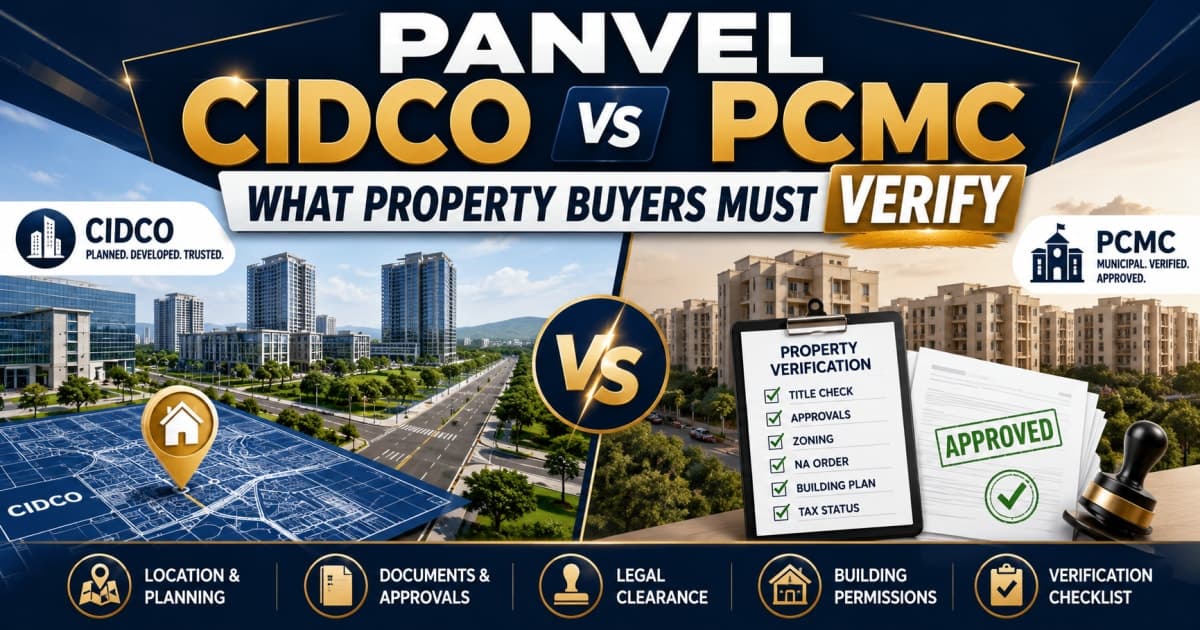
- “This is a CIDCO property.”
- “The building comes under PCMC.”
- “The project is CIDCO approved.”
- “PCMC property tax is available, so everything is legal.”
These statements can be confusing because CIDCO and PCMC do not always perform the same job. A property can be situated within Panvel Municipal Corporation limits, stand on land originally allotted by CIDCO, have an older building approval from one authority and receive civic services or property-tax bills from another authority. That is why the correct question is not simply:
Is CIDCO better than PCMC? The more useful question is: Which authority controls the land, planning approval, construction permission, property tax and transfer process for this specific property? This guide explains how to find that answer before you pay token money.
Quick Answer: CIDCO vs PCMC in Panvel
CIDCO and PCMC may both be relevant to the same Panvel property, but their roles can be different.
| Point | CIDCO | PCMC |
| Full name | City and Industrial Development Corporation of Maharashtra | Panvel Municipal Corporation |
| Main role | Planned development, land allotment, lease administration, infrastructure and planning functions in applicable areas | Municipal administration and civic services within its notified limits |
| May deal with | CIDCO plots, lease documents, allotment records, estate transfer and planning approvals in applicable areas | Property tax, municipal services, civic notices and town-planning functions in applicable areas |
| Does it prove ownership? | No. CIDCO records must be checked with the full title chain | No. A municipal tax bill does not by itself prove title |
| Does it prove legal construction? | Not by name alone. Check the actual sanctioned plan, CC and OC | Not by tax assessment alone. Check the actual approval documents |
| Where buyers get confused | “CIDCO developed” is treated as “fully legally verified” | “PCMC tax paid” is treated as “building is approved” |
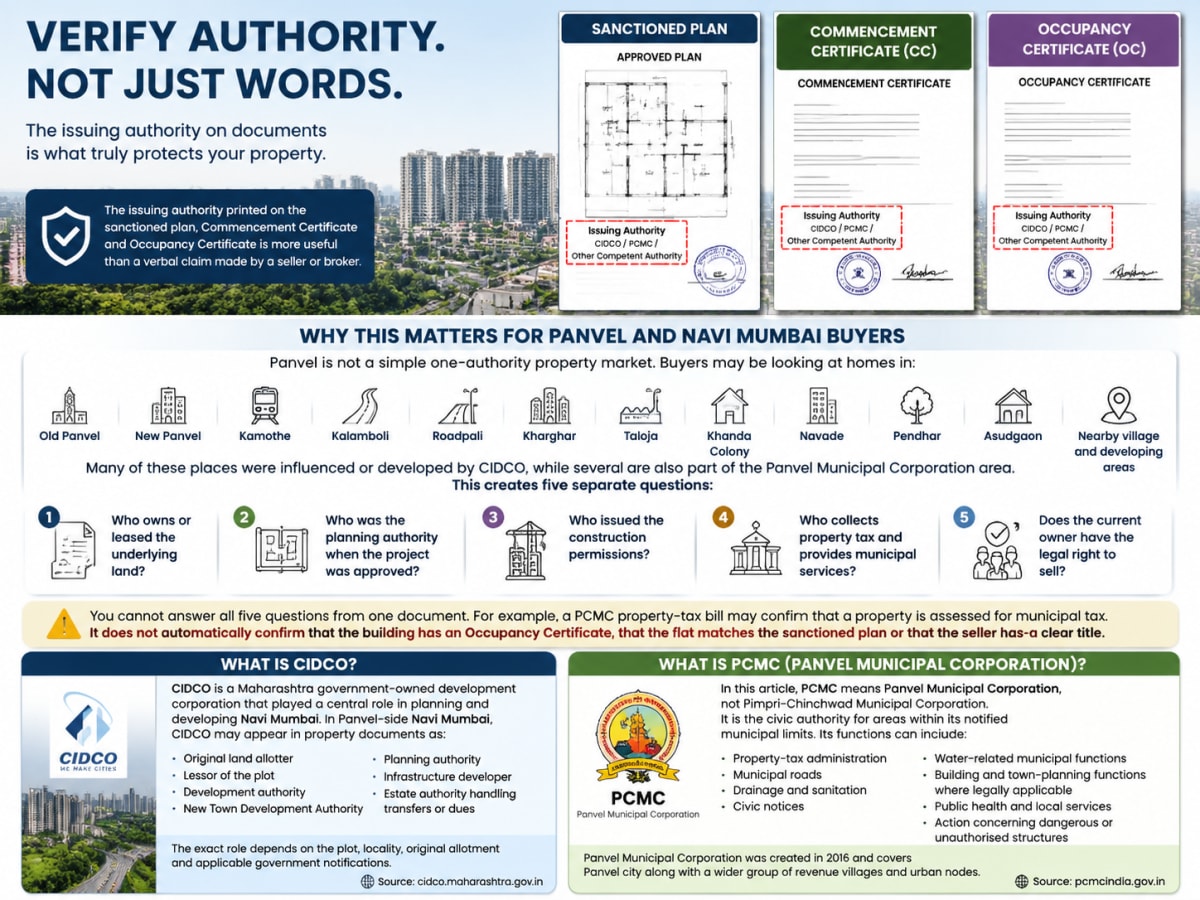
The issuing authority printed on the sanctioned plan, Commencement Certificate and Occupancy Certificate is more useful than a verbal claim made by a seller or broker.
Why This Matters for Panvel and Navi Mumbai Buyers
Panvel is not a simple one-authority property market. Buyers may be looking at homes in:
- Old Panvel
- New Panvel
- Kamothe
- Kalamboli
- Roadpali
- Kharghar
- Taloja
- Khanda Colony
- Navade
- Pendhar
- Asudgaon
- Nearby village and developing areas
Many of these places were influenced or developed by CIDCO, while several are also part of the Panvel Municipal Corporation area. This creates five separate questions:
- Who owns or leased the underlying land?
- Who was the planning authority when the project was approved?
- Who issued the construction permissions?
- Who collects property tax and provides municipal services?
- Does the current owner have the legal right to sell?
You cannot answer all five questions from one document. For example, a PCMC property-tax bill may confirm that a property is assessed for municipal tax. It does not automatically confirm that the building has an Occupancy Certificate, that the flat matches the sanctioned plan or that the seller has a clear title.
What Is CIDCO?
CIDCO is a Maharashtra government-owned development corporation that played a central role in planning and developing Navi Mumbai. In Panvel-side Navi Mumbai, CIDCO may appear in property documents as:
- Original land allotter
- Lessor of the plot
- Development authority
- New Town Development Authority
- Planning authority
- Infrastructure developer
- Estate authority handling transfers or dues
The exact role depends on the plot, locality, original allotment and applicable government notifications.
What “CIDCO property” may mean
When an agent says “CIDCO property,” it could mean:
- The land was allotted by CIDCO.
- The plot is held under a CIDCO lease.
- The node was planned by CIDCO.
- The building was approved by CIDCO.
- CIDCO transfer conditions apply.
- The property is located in a CIDCO-developed sector.
These meanings are not identical. Ask the agent to show you the actual document supporting the claim. Official source: CIDCO Maharashtra
What Is PCMC?
In this article, PCMC means Panvel Municipal Corporation, not Pimpri-Chinchwad Municipal Corporation. Panvel Municipal Corporation is the civic authority for areas within its notified municipal limits. Its functions can include:
- Property-tax administration
- Municipal roads
- Drainage and sanitation
- Civic notices
- Water-related municipal functions
- Building and town-planning functions where legally applicable
- Public health and local services
- Action concerning dangerous or unauthorised structures
Panvel Municipal Corporation was created in 2016 and covers Panvel city along with a wider group of revenue villages and urban nodes. However, civic inclusion and planning-authority jurisdiction should not be treated as automatically identical for every parcel. Official source: Panvel Municipal Corporation
Is CIDCO or PCMC the Main Authority?
There may not be one single answer. A property can involve different authorities for different purposes.
| Buyer’s question | Record or authority to check |
| Who collects property tax? | PCMC property-tax records or the applicable local body |
| Who owns or leased the plot? | Title deed, lease deed, allotment letter and land records |
| Who approved the building plan? | Sanctioned plan and approval letter |
| Who allowed construction to start? | Commencement Certificate |
| Who permitted occupation? | Occupancy Certificate |
| Is the project registered? | MahaRERA |
| Who registered the sale agreement? | Maharashtra Registration and Stamps Department |
| Is the broker registered for a RERA-covered transaction? | MahaRERA agent search |
| Are CIDCO transfer conditions applicable? | CIDCO lease, allotment and estate records |
This is why the article is called “CIDCO vs PCMC,” but the practical answer is often “CIDCO and PCMC, for different purposes.”
Civic Authority, Planning Authority and Landowner: The Difference
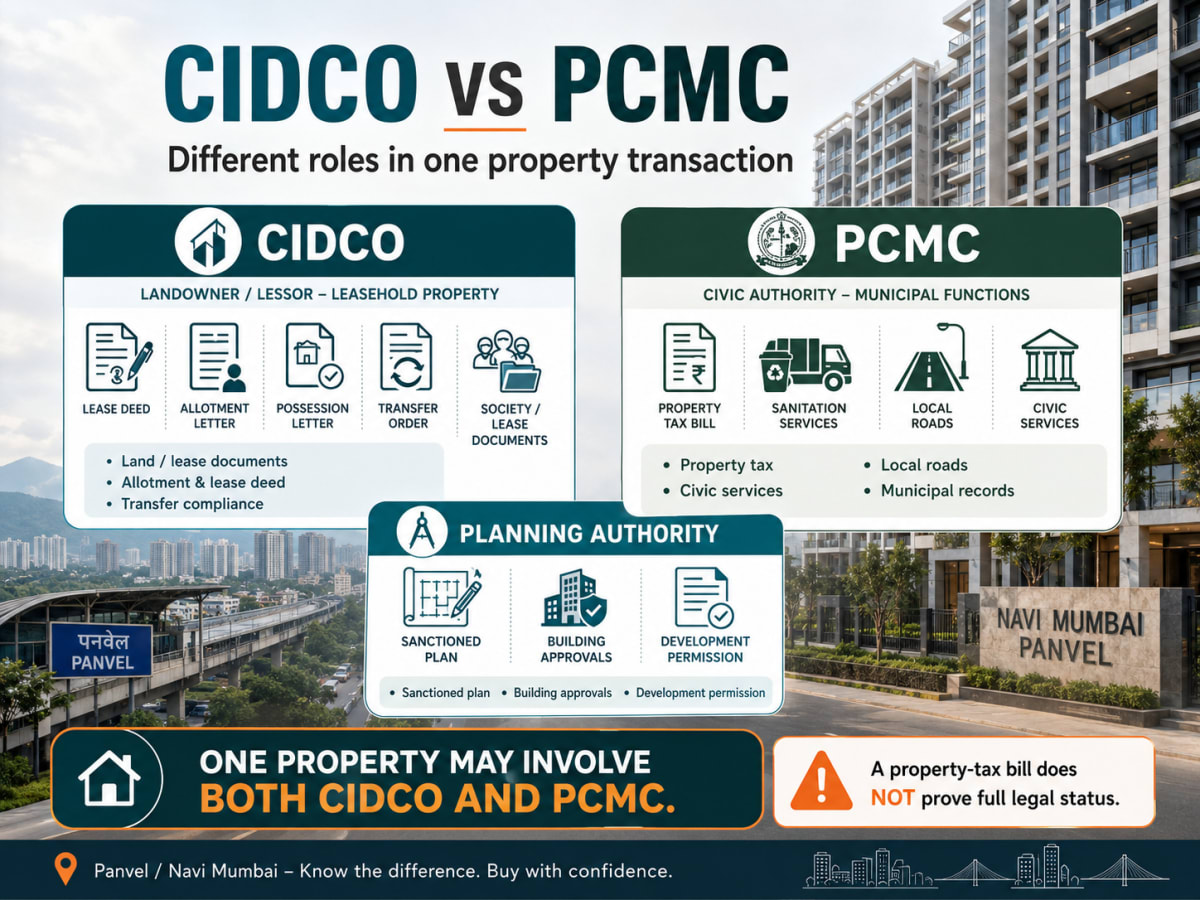
These three terms are often mixed together.
Civic authority
The civic authority manages municipal functions such as property tax, sanitation, local roads and civic notices. For many Panvel-side areas, this may be Panvel Municipal Corporation.
Planning authority
The planning authority approves development and building plans under the applicable planning law. The planning authority may depend on:
- The exact plot
- Village or sector
- Government notification
- Approval date
- Whether the area is part of a special planning area
- Whether authority functions were transferred
Landowner or lessor
The landowner holds title to the land. In some Navi Mumbai properties, CIDCO may be the lessor and the buyer or society may hold leasehold rights under a CIDCO lease. A property can therefore have:
- PCMC as civic authority
- CIDCO in the land or lease documents
- A specific authority named on the sanctioned plan
- MahaRERA as the project regulator
- IGR Maharashtra as the registration authority
What Is a CIDCO Leasehold Property?
A leasehold property is held under a lease for a stated period and is subject to the conditions written in that lease. In a CIDCO-originated property, important documents may include:
- Allotment letter
- Agreement to lease
- Lease deed
- Possession letter
- Transfer order
- CIDCO no-dues records
- Society lease documents
- Permission for mortgage or transfer, where applicable
Do not assume a property is freehold simply because the seller has a registered Agreement for Sale. The title lawyer must read the original land and lease documents to identify the exact ownership structure.
Does a PCMC Property-Tax Bill Prove the Property Is Legal?
No. A property-tax bill mainly shows that the property is entered in the municipal tax system and that tax has been assessed. It does not automatically prove:
- Clear ownership
- Valid sanctioned plan
- Legal construction
- Full Occupancy Certificate
- Correct flat layout
- Absence of litigation
- Absence of a bank charge
- CIDCO transfer compliance
- Legal use of the premises
Property tax is still an important document. Buyers should verify the account number, owner name, property description and outstanding dues. But it should be checked together with title and approval documents. Read: How to Verify Property Ownership
Does MahaRERA Registration Mean the Property Is Fully Safe?
MahaRERA registration is an important verification point, but it does not replace independent due diligence. The MahaRERA project record can help you check:
- Promoter’s legal name
- Project registration status
- Landowner details
- Survey or plot information
- Sanctioned-plan disclosures
- Completion date
- Project extensions
- Quarterly updates
- Complaints and orders
- Lapsed, revoked or other status information
MahaRERA moved its online services to the MahaCRITI platform in 2026, so buyers should use the current official system rather than relying on old saved portal links. Official source: MahaRERA Read: MahaRERA Project Search
Step-by-Step: How to Verify a Panvel Property
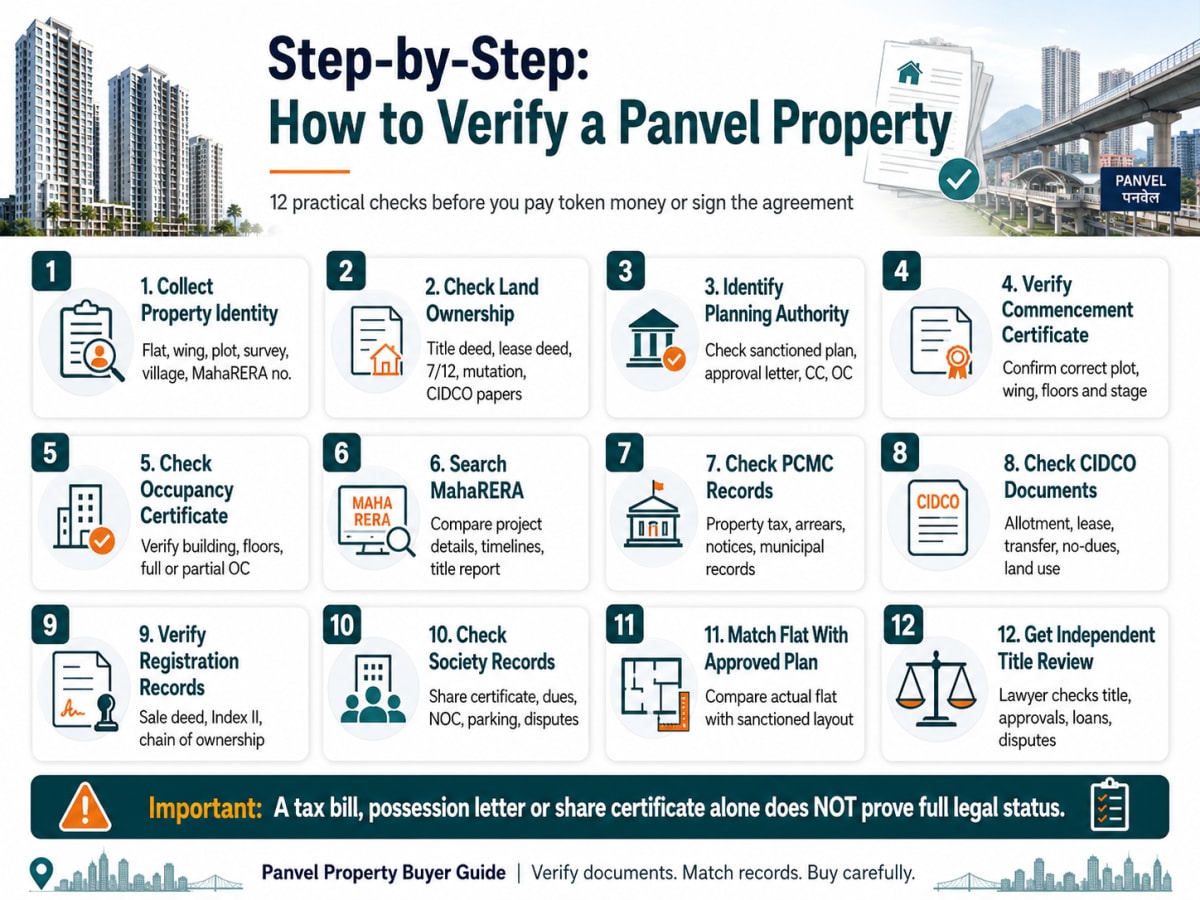
Step 1: Collect the Exact Property Identity
Do not begin with only the project name. Collect:
- Flat number
- Wing and building number
- Sector
- Plot number
- Survey number
- Gat number
- CTS or City Survey number
- Village
- Taluka
- Project MahaRERA number
- Full postal address
Project marketing names can change. Land and approval records usually rely on plot, survey or CTS details.
Step 2: Check Who Owns the Land
Ask for:
- Registered title deed
- Development agreement
- Power of Attorney, where applicable
- CIDCO allotment letter
- Agreement to lease or lease deed
- Property Card or 7/12 extract, where applicable
- Mutation entries
- Landowner-promoter agreement
Match the names and land numbers across every document. A mismatch in the survey number, plot number or owner name should be clarified before you proceed. Read: Flat Buying Documents Checklist
Step 3: Identify the Planning Authority
Look at the actual:
- Sanctioned building plan
- Approval letter
- Commencement Certificate
- Revised plan approval
- Completion Certificate
- Occupancy Certificate
Check:
- Authority name
- Approval number
- Date
- Plot number
- Building or wing
- Number of approved floors
- Conditions attached to the approval
Do not accept “CIDCO approved” or “PCMC approved” unless the document is shown. Read: Building Plan Approval
Step 4: Verify the Commencement Certificate
A Commencement Certificate, commonly called a CC, permits construction to begin or proceed according to the stages mentioned in it. Check whether the CC covers:
- The correct plot
- Your building
- Your wing
- The approved number of floors
- The construction stage represented by the developer
A CC for one wing cannot automatically be treated as approval for every building in a large project. Read: OC vs CC vs Possession Letter
Step 5: Check the Occupancy Certificate
An Occupancy Certificate, commonly called an OC, permits occupation of the completed building or approved part. Check:
- Authority name
- Certificate number
- Building and wing
- Floors covered
- Whether it is full or partial
- Conditions mentioned
- Whether your flat is included
A possession letter issued by a developer is not the same as an OC issued by the competent authority.
Step 6: Search the Project on MahaRERA
Compare the MahaRERA page with the documents supplied by the developer or agent. Verify:
- Project and promoter name
- Registration status
- Survey and plot details
- Number of buildings and wings
- Approved plans
- Completion timeline
- Extensions
- Uploaded title report
- Encumbrance disclosure
- Complaints and orders
- Agent registration
Save or print the relevant pages on the date of verification because project records may later be updated.
Step 7: Check PCMC Records
Where applicable, verify:
- Property-tax account
- Current owner name
- Outstanding tax
- Penalty or arrears
- Property description
- Municipal notices
- Town-planning information
- Development-plan reservations
- Dangerous or unauthorised-building notices
A clean tax account is useful, but it must be read with the title and building approvals. Official source: Panvel Municipal Corporation
Step 8: Check CIDCO Documents
Where the property has a CIDCO connection, obtain:
- Original allotment letter
- Lease or agreement-to-lease
- Transfer order
- Estate-service records
- No-dues confirmation
- Permitted land use
- Mortgage permission, where applicable
- Society or apartment transfer records
- Applicable transfer conditions
- Confirmation of the current authority role
Charges and procedures can change. Verify the latest requirement directly with CIDCO before the transaction.
Step 9: Verify Registration Records
For a resale purchase, check:
- Seller’s registered agreement or sale deed
- Index II
- Prior agreements
- Stamp-duty payment
- Registration receipt
- Property description
- Seller’s name
- Chain of ownership
Use the official Maharashtra Registration and Stamps portal for current services and registration information. Official source: IGR Maharashtra Read: Resale Flat Documents Checklist
Step 10: Check Society Records
For a cooperative housing society flat, ask for:
- Share Certificate
- Society registration details
- Membership records
- Maintenance no-dues statement
- Society NOC, where required
- Nomination or succession papers, where relevant
- Conveyance or lease records
- Approved parking record
- Alteration approvals
- Pending society disputes
A Share Certificate is important, but it does not replace the registered title documents. Read: Society NOC
Step 11: Match the Flat With the Approved Plan
Inspect the actual flat and compare it with the sanctioned plan. Look for:
- Enclosed balconies
- Merged rooms or flats
- Converted terraces
- Unapproved lofts
- Changed entrance
- Commercial use of residential space
- Altered plumbing areas
- Unauthorised mezzanine floors
- Parking changes
Minor-looking alterations can create loan, resale, insurance or regularisation problems later.
Step 12: Obtain an Independent Title Review
Before paying a large token or signing the agreement, ask an independent property lawyer to examine:
- Ownership chain
- CIDCO lease conditions
- Encumbrances
- Existing loans
- Court cases
- MahaRERA complaints
- Authority approvals
- Sale rights of the seller
- Society documents
- Registration structure
The builder’s lawyer, seller’s lawyer or broker should not be treated as your independent legal reviewer.
Documents Checklist for an Under-Construction Flat
| Document | What to check |
| MahaRERA registration | Project status, promoter and completion date |
| Title report | Landowner, title history and disclosed encumbrances |
| Development agreement | Promoter’s right to develop and sell |
| Sanctioned plan | Plot, building, wing, floors and authority |
| Commencement Certificate | Construction permission and stages |
| Revised approvals | Changes made after original sanction |
| Agreement for Sale | Carpet area, possession, payment and cancellation terms |
| Project specifications | What is legally promised |
| Agent registration | MahaRERA registration of the broker, where applicable |
Documents Checklist for a Ready-to-Move Flat
| Document | Why it matters |
| Occupancy Certificate | Confirms permitted occupation for the covered portion |
| Sanctioned plan | Helps compare the approved and actual structure |
| Completion-related documents | Shows completion process, where applicable |
| Property-tax record | Checks tax account and dues |
| Society records | Confirms membership and outstanding charges |
| CIDCO lease documents | Required where the plot has CIDCO lease conditions |
| Registered agreement | Establishes the buyer’s recorded transaction |
| Utility dues | Avoids inherited arrears |
Documents Checklist for a Resale Flat
- Registered purchase agreement or sale deed
- Index II
- Previous ownership documents
- Share Certificate
- Society maintenance statement
- Society NOC or no-dues confirmation, where applicable
- PCMC property-tax bill
- Electricity and water dues
- Occupancy Certificate
- Sanctioned plan
- CIDCO transfer and lease papers, where applicable
- Bank loan closure papers
- Release of mortgage or charge
- Succession or inheritance papers, where relevant
- Approved alteration records
- Seller’s identity and PAN details
Read: Resale Flat Documents Checklist
New Flat vs Resale Flat: What Changes?
| Verification point | New or under-construction flat | Resale flat |
| Main party to verify | Promoter and landowner | Current seller and prior owners |
| MahaRERA | Usually central to verification for a covered project | Check original project status and complaints where relevant |
| Title check | Land title and promoter development rights | Full ownership chain up to the current seller |
| Building approvals | Sanctioned plan, CC and revisions | Sanctioned plan, OC and later alterations |
| CIDCO issue | Plot allotment, lease and promoter rights | Lease compliance and transfer history |
| Society documents | Society may not yet be formed | Share Certificate, dues and membership records |
| Possession risk | Delay, plan change and incomplete approval | Unauthorised alteration and incomplete title chain |
| Tax check | Initial assessment may be pending | Existing PCMC tax account and arrears |
How to Choose the Right Real Estate Agent in Panvel
A good Panvel agent should understand more than prices and site visits. The agent should be able to identify whether the property may involve:
- CIDCO lease records
- PCMC property tax
- MahaRERA
- Society documentation
- IGR registration records
- OC and sanctioned-plan checks
- Village or revenue land records
- NAINA or another planning authority in relevant outskirts
Questions to ask the agent
- What is your MahaRERA agent registration number?
- Are you representing the seller, buyer or both?
- Who will pay your brokerage?
- Which authority approved this building?
- Can you share the sanctioned plan, CC and OC?
- Is the land CIDCO leasehold?
- Does any CIDCO transfer process apply?
- Is PCMC property tax fully paid?
- Does the flat match the approved plan?
- Are there any project complaints, court cases or bank charges?
- Can I verify all documents before paying token money?
- Will the token terms be recorded in writing?
A trustworthy agent will not object to document verification. The agent does not have to give legal advice, but should be transparent about documents, commissions and the parties represented.
What to Check Before Paying Token Money
Do not pay token money only because the price looks attractive or another buyer is allegedly waiting. Verify:
- Seller’s identity
- Seller’s ownership rights
- Registered title documents
- Authority shown on the sanctioned plan
- CC and OC status
- MahaRERA status
- CIDCO lease or transfer conditions
- PCMC tax dues
- Society dues
- Existing home loan
- Encumbrances and litigation
- Flat-plan mismatch
- Written refund terms
- Token recipient’s bank account
- Brokerage terms
- Time allowed for legal verification
Safer token wording
The token receipt should state that the payment is subject to:
- Satisfactory title verification
- Verification of approvals
- Confirmation of outstanding dues
- Loan eligibility, if applicable
- Mutually agreed Agreement for Sale terms
Ask your lawyer to review the token terms before payment.
Local Example: A Resale Flat in New Panvel
Situation
A buyer is considering a resale flat in a society in New Panvel. The seller shows:
- A PCMC property-tax bill
- A society Share Certificate
- An electricity bill
- A registered purchase agreement
The broker says it is a “CIDCO property” and therefore safe.
What is still missing?
The buyer may still need to verify:
- Original CIDCO allotment or lease structure
- Current transfer conditions
- Full ownership chain
- Occupancy Certificate
- Sanctioned plan
- Whether the flat has alterations
- Society dues
- Existing bank charge
- Seller’s right to transfer
- Any authority or court notice
Safer decision
The buyer should not reject the property only because multiple authorities are involved. Instead, the buyer should identify each authority’s role and make sure the title, lease, approvals, tax and society records all match.
Red Flags Buyers Should Not Ignore
Be careful when:
- The seller refuses to share the sanctioned plan.
- The agent repeatedly says “CIDCO approved” but shows no approval.
- Only a property-tax bill is shown as proof of legality.
- The OC belongs to a different building or wing.
- The flat number does not match the agreement.
- The MahaRERA plot number differs from the title document.
- The building has more floors than the approved plan.
- The seller cannot provide previous agreements.
- CIDCO lease or transfer papers are missing.
- Society dues are described verbally but not confirmed in writing.
- The broker’s commission arrangement is hidden.
- Token money is requested in cash.
- Payment is requested in a third party’s name.
- The seller promises guaranteed airport appreciation.
- The buyer is discouraged from consulting a lawyer.
- The agent says bank-loan approval is equal to a title certificate.
A red flag does not always mean the transaction must be abandoned. It means further written verification is required.
Common Mistakes Panvel Buyers Make
Mistake 1: Treating CIDCO and PCMC as competitors
They may perform different functions. One can be relevant to land or planning, while the other handles civic administration.
Mistake 2: Relying on the locality name
Two properties in the same locality may have different plot histories or approval records.
Mistake 3: Believing a tax bill proves approval
A tax assessment is not the same as a sanctioned plan or OC.
Mistake 4: Checking MahaRERA but ignoring title
MahaRERA is important, but the title chain and sale rights still need independent review.
Mistake 5: Checking the OC but not the covered wing
A project may have a partial OC. Confirm that your building, floor and flat are covered.
Mistake 6: Ignoring CIDCO lease terms
Lease restrictions may affect transfer, mortgage, use or future redevelopment.
Mistake 7: Paying token before document review
Once money is paid, the buyer may have less negotiating power.
Mistake 8: Choosing an agent only by inventory
A Panvel agent should understand local authority and document issues, not only show flats.
Final Panvel Buyer Checklist
Before purchasing, confirm all of the following:
- [ ] Exact plot, survey, gat or CTS number collected
- [ ] Seller or promoter identity verified
- [ ] Ownership chain checked
- [ ] CIDCO allotment or lease checked, where applicable
- [ ] Planning authority identified from actual approval
- [ ] Sanctioned plan verified
- [ ] Commencement Certificate checked
- [ ] Occupancy Certificate checked
- [ ] MahaRERA record reviewed
- [ ] PCMC tax dues verified
- [ ] CIDCO dues and transfer conditions verified
- [ ] Society documents checked
- [ ] Existing bank charge identified
- [ ] Flat compared with sanctioned plan
- [ ] Token terms put in writing
- [ ] Agent registration and commission disclosed
- [ ] Independent lawyer completed title review
Final Verdict: CIDCO or PCMC, Which Is Better?
Neither authority name makes a property automatically safe or unsafe. A safer property is one where:
- The seller has the legal right to sell.
- The title chain is clear.
- The land and lease records match.
- The sanctioned plan covers the building.
- The CC and OC are valid for the relevant portion.
- MahaRERA details match the project documents.
- Municipal and society dues are clear.
- The actual flat matches the approved plan.
- Transfer conditions have been followed.
For Panvel buyers, document consistency matters more than labels such as “CIDCO property” or “PCMC property.”
Need Help Buying Property in Navi Mumbai?
Navi Mumbai Property Deals follows a buyer-first approach. We help buyers shortlist suitable properties, ask the right document questions and coordinate practical checks before site visits, negotiations and closure. Whether you are buying in Panvel, Kharghar, Kamothe, Kalamboli, Taloja or another Navi Mumbai location, do not rely only on advertisements or verbal promises. Verify first. Decide calmly. Buy with clarity.
Disclaimer
This article is for general buyer education and is not legal advice. Authority boundaries, planning powers, charges, project status, lease conditions, land records and transfer procedures can change. Verify the latest position for the exact plot and property with CIDCO, Panvel Municipal Corporation, MahaRERA, IGR Maharashtra and other applicable authorities. Obtain an independent title report from a qualified property lawyer before paying token money or signing an agreement.