Nerul Redevelopment Guide: Documents, RERA, OC & Buyer Checks
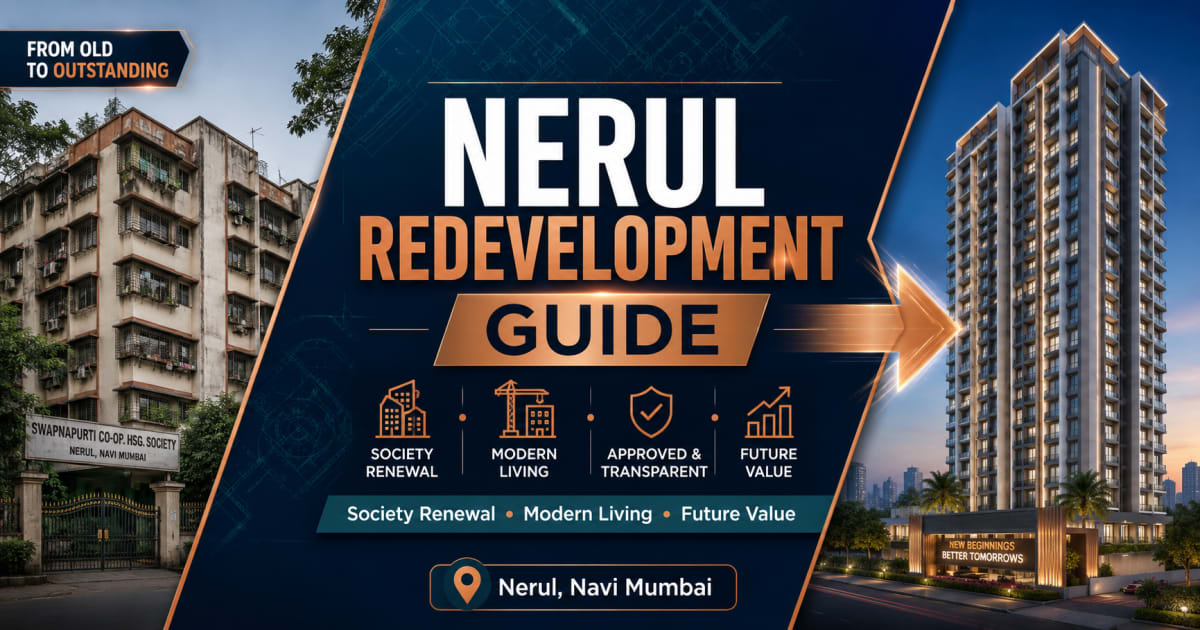
Quick Answer
If you are buying a flat, shop, office, or resale property in a redevelopment project in Nerul, do not depend only on the brochure, sample flat, or builder promise. Check four things before paying token money:
- The land and society documents
- The builder and MahaRERA status
- The sanctioned plan, CC, and OC status
- The exact flat/shop/office documents before agreement
Redevelopment can be good for old societies in Nerul. It can improve building safety, parking, lifts, amenities, and long-term usability. But for a buyer, the main question is simple:Is this property legally clear, properly approved, and safe to buy?This guide explains that in simple English.
Why Redevelopment Matters in Nerul
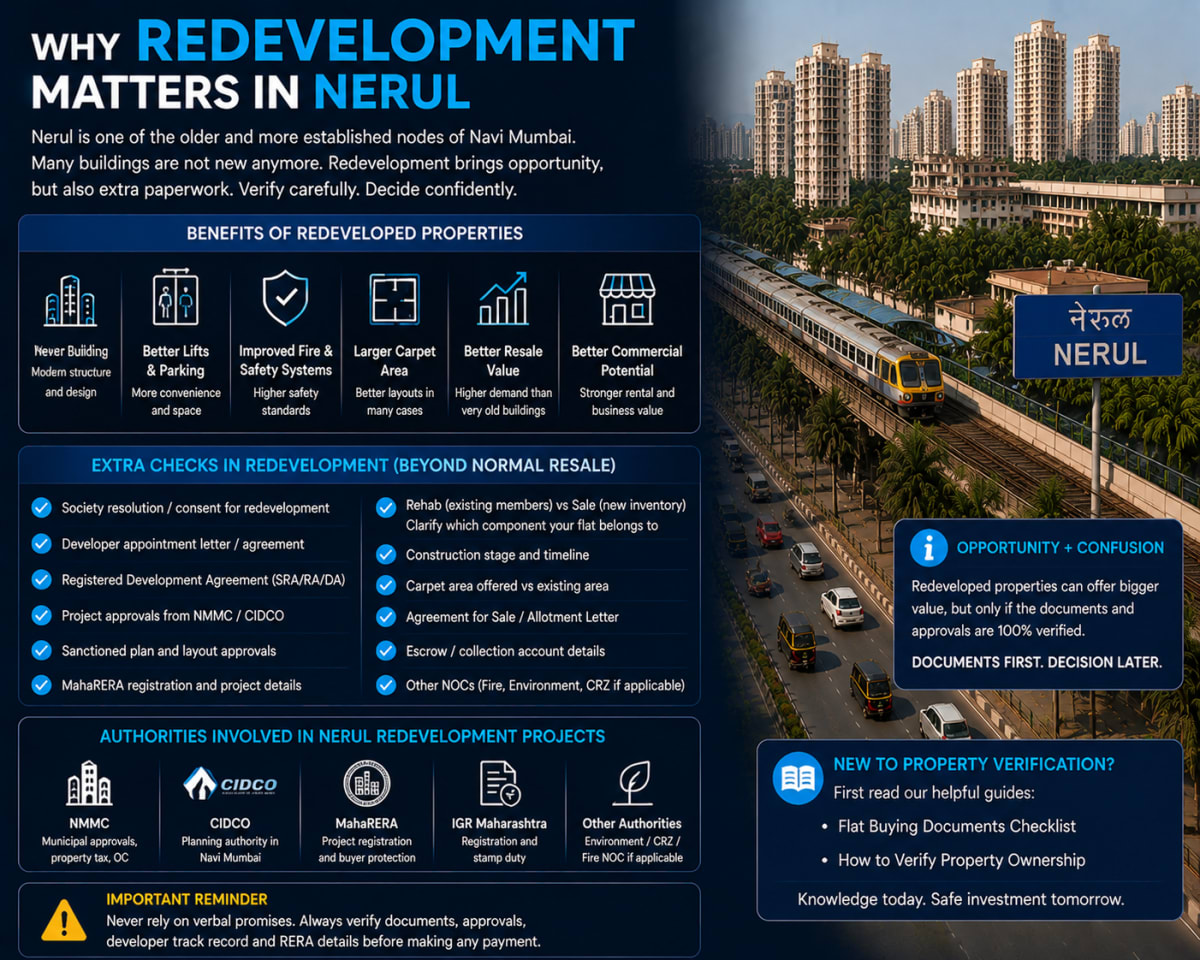
Nerul is one of the older and more established nodes of Navi Mumbai. Many buildings are not new anymore. Some societies are already discussing redevelopment. Some are at planning stage. Some have appointed developers. Some projects may be selling new flats, shops, or offices after redevelopment. For a homebuyer, this creates opportunity and confusion at the same time. A redeveloped property may offer:
- A newer building
- Better lifts and parking
- Improved fire and safety systems
- Larger carpet area in some cases
- Better resale value compared to very old buildings
- Better commercial potential in selected pockets
But redevelopment also adds extra paperwork. In a normal resale flat, you mainly check the seller, title chain, society documents, OC, dues, and registration history. In redevelopment, you also need to check the society decision, developer agreement, approvals, MahaRERA status, construction stage, and whether the flat you are buying is part of the rehab component or sale component. For Navi Mumbai buyers, this is even more important because Nerul properties may involve authorities such asNMMC, CIDCO, MahaRERA, IGR Maharashtra, and sometimes environmental or CRZ-related authoritiesdepending on the location and project. If you are new to property verification, first read ourFlat Buying Documents ChecklistandHow to Verify Property Ownershipguides before using this redevelopment checklist.
What Is Redevelopment in Simple English?
Redevelopment means an old building or society is demolished and rebuilt. Usually, the existing society members get new flats in the new building. The developer may also get permission to construct additional flats, shops, or offices for sale, depending on the approved plan and applicable rules. Here is a simple example. An old Nerul society has 40 flats. The building is old and needs major repairs. The society appoints a developer. The developer agrees to give new flats to existing members, pay transit rent while construction is going on, and build additional flats for sale. The developer earns by selling those extra flats. That sounds simple. But legally, many documents must match each other. The society agreement, sanctioned plan, MahaRERA details, flat agreement, carpet area, parking, OC, and building approvals should all tell the same story. If they do not match, the buyer should slow down and verify.
Key Terms Every Nerul Buyer Should Know
| Term | Simple Meaning |
| Redevelopment | Rebuilding an old building or society into a new building. |
| Society redevelopment | A cooperative housing society appoints a developer to rebuild the property. |
| Cluster redevelopment | Multiple buildings or plots are redeveloped together as a larger project. |
| Development Agreement | Main agreement between society/landowner and developer. |
| PAAA | Permanent Alternate Accommodation Agreement given to existing members for their new flat. |
| Transit rent | Rent paid to existing members while the old building is demolished and rebuilt. |
| Corpus | Lump sum amount offered to existing society members, if agreed. |
| Bank guarantee | Financial security given by developer to protect society members if the developer fails to perform. |
| Sanctioned plan | Building plan approved by the competent authority. |
| CC | Commencement Certificate. It allows construction to start up to approved stages. |
| OC | Occupation Certificate. It means the completed building or part of the building is approved for occupation. |
| MahaRERA registration | Registration of an eligible real estate project with MahaRERA. It helps buyers check project details, but it is not the same as title clearance or OC. |
| Index II | Summary of a registered document available through registration records. |
| Society NOC | Society confirmation that there is no objection or no dues for transfer, depending on context. |
| CIDCO leasehold property | Property originally allotted or governed through CIDCO lease/allotment conditions. |
| Commercial use permission | Approval that a shop, office, showroom, clinic, or other commercial use is legally permitted. |
Which Authorities Matter in Nerul Redevelopment?
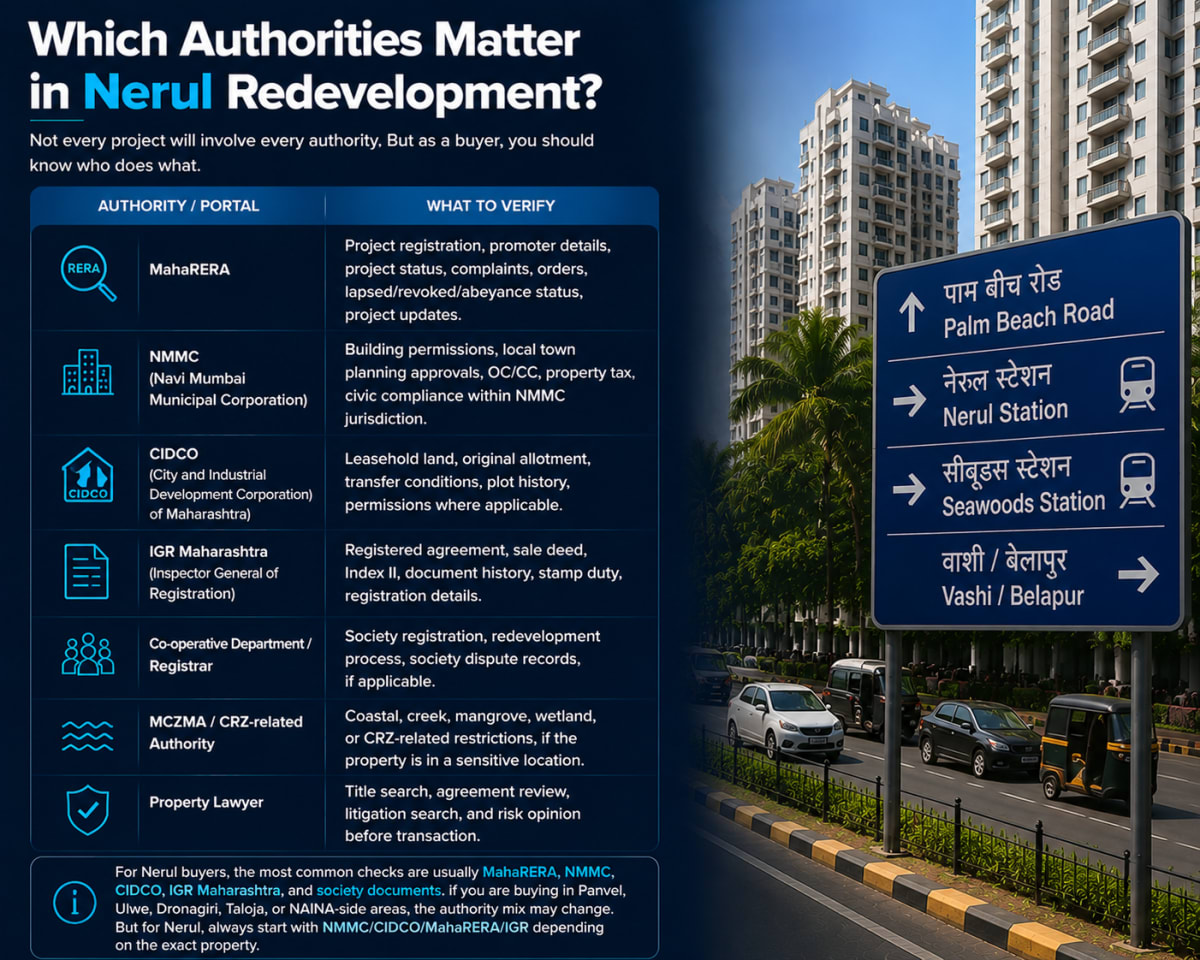
Not every project will involve every authority. But as a buyer, you should know who does what.
| Authority / Portal | What to Verify |
| MahaRERA | Project registration, promoter details, project status, complaints, orders, lapsed/revoked/abeyance status, project updates. |
| NMMC | Building permissions, local town planning approvals, OC/CC, property tax, civic compliance within NMMC jurisdiction. |
| CIDCO | Leasehold land, original allotment, transfer conditions, plot history, permissions where applicable. |
| IGR Maharashtra | Registered agreement, sale deed, Index II, document history, stamp duty, registration details. |
| Co-operative Department / Registrar | Society registration, redevelopment process, society dispute records, if applicable. |
| MCZMA / CRZ-related authority | Coastal, creek, mangrove, wetland, or CRZ-related restrictions, if the property is in a sensitive location. |
| Property lawyer | Title search, agreement review, litigation search, and risk opinion before transaction. |
For Nerul buyers, the most common checks are usuallyMahaRERA, NMMC, CIDCO, IGR Maharashtra, and society documents. If you are buying in Panvel, Ulwe, Dronagiri, Taloja, or NAINA-side areas, the authority mix may change. But for Nerul, always start with NMMC/CIDCO/MahaRERA/IGR depending on the exact property.
MahaRERA Check: Important, But Not Enough
MahaRERA is one of the first checks for an under-construction or redevelopment project where RERA registration is applicable. A buyer should search the project and promoter on the MahaRERA portal. Do not only ask the sales team for the RERA number. Search it yourself. Check:
- Project name
- Promoter name
- Registered address
- Project location
- Project status
- Proposed completion date
- Extension details, if any
- Complaints or orders, if visible
- Lapsed, revoked, abeyance, or non-compliance status
- Uploaded approvals and project updates
But remember one important point:MahaRERA registration does not automatically mean the title is clear, OC is received, or every local approval is complete.It is a transparency and regulatory check. It is not a full legal title report. For a deeper process, internally link toMahaRERA Project Search.
OC and CC: Why They Matter in Redevelopment
Many buyers hear these two words but do not fully understand them.
What is CC?
CC meansCommencement Certificate. It allows the developer to start construction as per the approved plan and conditions. Sometimes a CC may be given in stages. For example, the authority may allow construction up to a certain floor first and later approve further stages. So do not only ask, “CC hai kya?” Ask:
- CC is approved up to which floor?
- Is my flat/shop/office included in that approval?
- Are there revised CCs?
- Does the approved plan match the unit being sold?
What is OC?
OC meansOccupation Certificate. It is issued after the building, or a part of the building, is completed as per approved plans and conditions. For a buyer, OC is very important because it affects legal occupation, utilities, resale, loan comfort, and long-term peace of mind. In Navi Mumbai, OC is not a small issue. NMMC had publicly identified many buildings within its jurisdiction that had commencement approvals but did not have occupancy certificates. This shows why buyers should not treat OC as a formality. For a detailed explanation, internally link toOC vs CC vs Possession Letter.
Nerul Redevelopment Verification Process: Step by Step
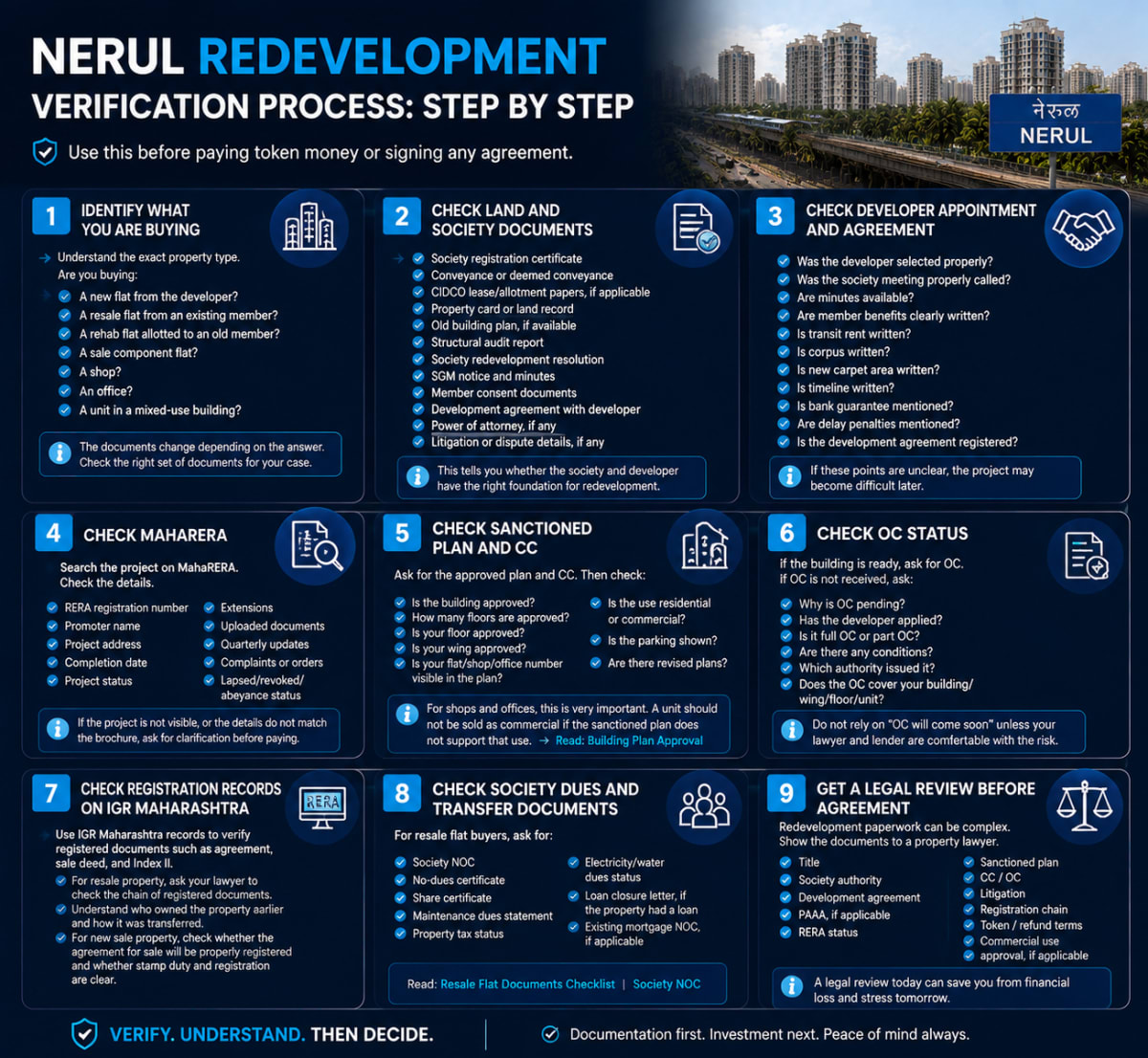
Use this before paying token money or signing any agreement.
Step 1: Identify What You Are Buying
First, understand the exact property type. Are you buying:
- A new flat from the developer?
- A resale flat from an existing member?
- A rehab flat allotted to an old member?
- A sale component flat?
- A shop?
- An office?
- A unit in a mixed-use building?
The documents change depending on the answer. For example, a resale flat from an old society member may need share certificate, old agreements, society NOC, PAAA, and allotment details. A new sale flat from the developer needs MahaRERA, agreement for sale, approved plan, CC, and payment schedule.
Step 2: Check Land and Society Documents
Before checking interiors and amenities, check the base documents. Ask for:
- Society registration certificate
- Conveyance or deemed conveyance documents
- CIDCO lease/allotment papers, if applicable
- Property card or land record
- Old building plan, if available
- Structural audit report
- Society redevelopment resolution
- SGM notice and minutes
- Member consent documents
- Development agreement with developer
- Power of attorney, if any
- Litigation or dispute details, if any
This tells you whether the society and developer have the right foundation for redevelopment.
Step 3: Check Developer Appointment and Agreement
Society redevelopment should not be based only on verbal understanding. Check:
- Was the developer selected properly?
- Was the society meeting properly called?
- Are minutes available?
- Are member benefits clearly written?
- Is transit rent written?
- Is corpus written?
- Is new carpet area written?
- Is timeline written?
- Is bank guarantee mentioned?
- Are delay penalties mentioned?
- Is the development agreement registered?
If these points are unclear, the project may become difficult later.
Step 4: Check MahaRERA
Search the project on MahaRERA. Do not only check whether the project exists. Check the details. Look for:
- RERA registration number
- Promoter name
- Project address
- Completion date
- Project status
- Extensions
- Uploaded documents
- Quarterly updates
- Complaints or orders
- Lapsed/revoked/abeyance status
If the project is not visible, or the details do not match the brochure, ask for clarification before paying.
Step 5: Check Sanctioned Plan and CC
Ask for the approved plan and CC. Then check:
- Is the building approved?
- How many floors are approved?
- Is your floor approved?
- Is your wing approved?
- Is your flat/shop/office number visible in the plan?
- Is the use residential or commercial?
- Is the parking shown?
- Are there revised plans?
For shops and offices, this is very important. A unit should not be sold as commercial if the sanctioned plan does not support that use. Internally link here toBuilding Plan Approval.
Step 6: Check OC Status
If the building is ready, ask for OC. If OC is not received, ask:
- Why is OC pending?
- Has the developer applied?
- Is it full OC or part OC?
- Are there any conditions?
- Which authority issued it?
- Does the OC cover your building/wing/floor/unit?
Do not rely on “OC will come soon” unless your lawyer and lender are comfortable with the risk.
Step 7: Check Registration Records on IGR Maharashtra
Use IGR Maharashtra records to verify registered documents such as agreement, sale deed, and Index II. For resale property, ask your lawyer to check the chain of registered documents. A buyer should understand who owned the property earlier and how it was transferred. For new sale property, check whether the agreement for sale will be properly registered and whether stamp duty and registration are clear.
Step 8: Check Society Dues and Transfer Documents
For resale flat buyers, ask for:
- Society NOC
- No-dues certificate
- Share certificate
- Maintenance dues statement
- Property tax status
- Electricity/water dues status
- Loan closure letter, if the property had a loan
- Existing mortgage NOC, if applicable
Internally link toResale Flat Documents ChecklistandSociety NOC.
Step 9: Get a Legal Review Before Agreement
Redevelopment paperwork can be complex. Before signing or paying a large amount, show the documents to a property lawyer. The lawyer should check:
- Title
- Society authority
- Development agreement
- PAAA, if applicable
- RERA status
- Sanctioned plan
- CC/OC
- Litigation
- Registration chain
- Token/refund terms
- Commercial use approval, if applicable
This is not an extra cost. It is basic transaction safety.
Documents Checklist for Nerul Redevelopment Buyers
A. Society and Land Documents
| Document | Why It Matters |
| Society registration certificate | Confirms society identity. |
| Share certificate records | Important for resale and member rights. |
| Conveyance / deemed conveyance | Shows land/building transfer status to society. |
| CIDCO allotment / lease documents | Important for many Navi Mumbai properties. |
| Property card / land record | Helps check land identity and ownership trail. |
| Structural audit report | Explains why redevelopment was considered. |
| SGM notice and minutes | Shows society decision process. |
| Member consent records | Shows support for redevelopment. |
| Development agreement | Main legal document between society and developer. |
| Power of attorney | Shows who can act on behalf of society/developer. |
| Litigation search | Helps identify disputes. |
B. Project and Approval Documents
| Document | Why It Matters |
| MahaRERA registration | Helps verify registered project and promoter details. |
| MahaRERA project updates | Shows progress and compliance. |
| Sanctioned building plan | Shows what is officially approved. |
| CC | Shows construction approval stage. |
| Revised CC / revised plan | Important if changes were made. |
| Fire NOC | Important for larger buildings/commercial use, where applicable. |
| Environmental/CRZ permission | Important near sensitive coastal/creek/mangrove areas. |
| OC | Confirms approved occupation after completion. |
C. Buyer-Side Documents
| Document | Why It Matters |
| Allotment letter | Initial booking details. |
| Agreement for sale | Main buyer-builder agreement. |
| Sale deed | Final ownership transfer document, where applicable. |
| Index II | Registration summary. |
| Stamp duty receipt | Proof of stamp duty payment. |
| Registration receipt | Proof of registration. |
| Carpet area statement | Confirms usable area as agreed. |
| Parking allotment | Avoids parking disputes later. |
| Payment schedule | Helps avoid unclear demands. |
| Possession letter | Builder’s possession handover record. |
| OC copy | Important before possession/resale. |
D. Extra Checklist for Shops and Offices
Nerul also has commercial demand because of connectivity, station access, nearby business pockets, and movement between Vashi, Seawoods, Belapur, and Palm Beach Road. If you are buying or leasing a shop/office in a redevelopment project, check:
- Is commercial use approved?
- Is the shop/office shown in the sanctioned plan?
- Is the exact unit number approved?
- Is the floor approved for commercial use?
- Is there proper access?
- Is parking/loading allowed?
- Are fire norms applicable?
- Is signage allowed?
- Does the society allow that business activity?
- Does the OC cover the commercial portion?
This is where theNavi Mumbai Commercial Real Estate Guideangle becomes important. A commercial unit should be checked not only for price and location, but also for legal use.
New Flat vs Resale Flat in Nerul Redevelopment
| Point | New Flat from Developer | Resale Flat from Existing Owner |
| Main seller | Developer/promoter | Individual owner/member |
| Key check | MahaRERA, sanctioned plan, CC, agreement | Title chain, society NOC, share certificate, old agreements |
| OC risk | Important if under construction | Important if ready or old building |
| Society role | May come after project completion | Already important |
| Payment risk | Construction-linked payments | Seller payment and loan closure risk |
| Main document | Agreement for sale | Sale deed/agreement chain |
| Extra redevelopment check | Sale component approval | PAAA/member rights, if related to redevelopment |
If you are buying a resale flat in an old Nerul building that is likely to go into redevelopment, also check whether there are ongoing society discussions, notices, disputes, or developer proposals. This can affect future timelines, maintenance, rent, and buyer expectations.
Red Flags Buyers Should Not Ignore
Do not panic if one issue appears. But do not ignore it either. Ask for documents and professional review.
Major red flags
- Project is marketed but not traceable on MahaRERA where registration is applicable.
- RERA details do not match the brochure or sales pitch.
- Project status is lapsed, revoked, in abeyance, or poorly updated.
- Builder refuses to share sanctioned plan.
- CC is available only for lower floors but your flat is on a higher floor.
- OC is promised verbally but not issued.
- The commercial unit is not shown as commercial in the approved plan.
- Society redevelopment agreement is not shared.
- Existing society members are in dispute.
- CIDCO lease/allotment or transfer documents are unclear.
- Seller asks for token before showing papers.
- Carpet area, parking, floor, or wing details keep changing.
- “Guaranteed appreciation” is used to pressure you.
- You are told, “RERA number hai, so everything is safe.”
The last line is very important. RERA is a good check. But it is not the only check.
Common Mistakes Nerul Buyers Make
Mistake 1: Checking only the sample flat
A sample flat can show design. It cannot prove title, approvals, OC, or RERA compliance.
Mistake 2: Believing WhatsApp brochures
Many property details move through WhatsApp. Use them only as starting information. Always verify with documents.
Mistake 3: Paying token without refund terms
Before paying token, write clear refund conditions. For example, token should be refundable if title, RERA, OC, CC, society, or bank/legal verification fails.
Mistake 4: Not checking exact floor approval
A CC may exist, but your exact floor may not be approved yet. Always check the stage.
Mistake 5: Ignoring CIDCO angle
Many Navi Mumbai properties have a CIDCO-origin history. Lease, transfer, and allotment conditions should be checked where applicable.
Mistake 6: Treating commercial property like residential property
Shop and office checks are different. Use permission, fire norms, access, parking, and society restrictions matter.
Mistake 7: Not checking old society disputes
In redevelopment, society disputes can delay the project. Check notices, meeting minutes, and pending cases where possible.
Practical Buyer Checklist Before Token Payment
Use this final checklist before paying any booking amount.
| Check | Done? |
| I know whether this is new sale, resale, rehab, or sale component property. | |
| I have checked the project/promoter on MahaRERA, if applicable. | |
| I have checked lapsed/revoked/abeyance/non-compliance status. | |
| I have asked for sanctioned plan. | |
| I have checked whether my unit/floor/wing is approved. | |
| I have asked for CC and understood the approved stage. | |
| I have asked for OC if the building is ready. | |
| I have checked society documents and redevelopment agreement, where applicable. | |
| I have checked CIDCO documents, if applicable. | |
| I have checked IGR registration records or asked a lawyer to do it. | |
| I have checked society NOC/no-dues/share certificate for resale. | |
| I have checked commercial use approval for shop/office. | |
| I have written token refund conditions. | |
| A property lawyer has reviewed the documents before agreement. |
Simple Rule for Nerul Redevelopment Buyers
If you remember only one thing from this guide, remember this:Do not buy redevelopment property only because the location is Nerul or the builder sounds reputed. Buy only after the documents match the promise.Nerul is a strong Navi Mumbai location. It has established social infrastructure, railway connectivity, access to Seawoods, Belapur, Vashi, Palm Beach Road, and many old housing pockets where redevelopment may continue to be discussed. But location alone cannot replace verification. Good property buying means checking:
- Location
- Price
- Builder
- Society
- Title
- RERA
- Plan approval
- CC
- OC
- Registration
- Resale documents
- Commercial use, if applicable
When these are checked properly, you can take a calmer and more confident decision.
Soft CTA: Need Help Checking a Nerul Property?
Navi Mumbai Property Deals is building a buyer-first property verification platform for Navi Mumbai. If you are planning to buy a flat, shop, office, or resale property in Nerul redevelopment, our team can help you understand which documents to ask for before you move ahead. We do not replace a property lawyer or government authority verification. But we help you ask better questions, organize the paperwork, and avoid basic due diligence mistakes before you commit. For document-focused guidance, start with:
- Flat Buying Documents Checklist
- OC vs CC vs Possession Letter
- MahaRERA Project Search
- Resale Flat Documents Checklist
- How to Verify Property Ownership
- Building Plan Approval
- Society NOC
FAQs
1. Is every Nerul redevelopment project required to be MahaRERA registered?
1. Is every Nerul redevelopment project required to be MahaRERA registered?
Not every property situation is the same. If RERA registration is applicable to the project, the buyer should verify the project on the MahaRERA portal before paying any money. If you are unsure whether registration is required, verify with MahaRERA, the developer, and a property lawyer.
2. Does MahaRERA registration mean the project is fully safe?
2. Does MahaRERA registration mean the project is fully safe?
No. MahaRERA registration is important, but it does not automatically prove clear title, full OC, final approval, or absence of disputes. You still need title, society, sanctioned plan, CC, OC, and registration checks.
3. What is the most important document in redevelopment?
3. What is the most important document in redevelopment?
There is no single document. For society redevelopment, the development agreement, society resolutions, member consent, sanctioned plan, CC, MahaRERA details, and title documents are all important.
4. Should I buy a flat before OC?
4. Should I buy a flat before OC?
Many buyers buy under-construction flats before OC, but the risk should be understood. Check MahaRERA, CC stage, approved plan, builder track record, payment schedule, and agreement terms. For ready properties, OC becomes a very important document.
5. What should I check before buying a resale flat in an old Nerul society?
5. What should I check before buying a resale flat in an old Nerul society?
Check title chain, Index II, previous agreements, share certificate, society NOC, no-dues certificate, OC, property tax, maintenance dues, loan closure documents, and whether redevelopment discussions or disputes are going on.
6. What is the difference between CC and OC?
6. What is the difference between CC and OC?
CC allows construction to start as per approved stages. OC confirms the completed building or part of the building is approved for occupation. Both are important, but they are used at different stages.
7. Can a shop or office in redevelopment be unsafe even if the building is approved?
7. Can a shop or office in redevelopment be unsafe even if the building is approved?
Yes. The building may be approved, but the specific unit must also be approved for the use being sold. If you are buying a shop or office, check sanctioned commercial use, floor approval, fire norms, parking, access, and OC coverage.
8. Is CIDCO verification needed in Nerul?
8. Is CIDCO verification needed in Nerul?
Many Navi Mumbai properties have CIDCO-origin history. Depending on the property, CIDCO lease, allotment, transfer, or permission documents may matter. A lawyer should check this before transaction.
9. Should I pay token before document verification?
9. Should I pay token before document verification?
Ideally, avoid paying token before basic document sharing. If token is unavoidable, keep written refund conditions if legal, RERA, title, OC/CC, society, loan, or authority verification fails.
10. Who should verify redevelopment documents?
10. Who should verify redevelopment documents?
A buyer can do basic checks using portals like MahaRERA and IGR Maharashtra. But final title, agreement, redevelopment, and dispute checks should be done by a qualified property lawyer.