Navi Mumbai Solid Waste Management: A Practical Guide for Residents and Property Buyers
Quick Answer
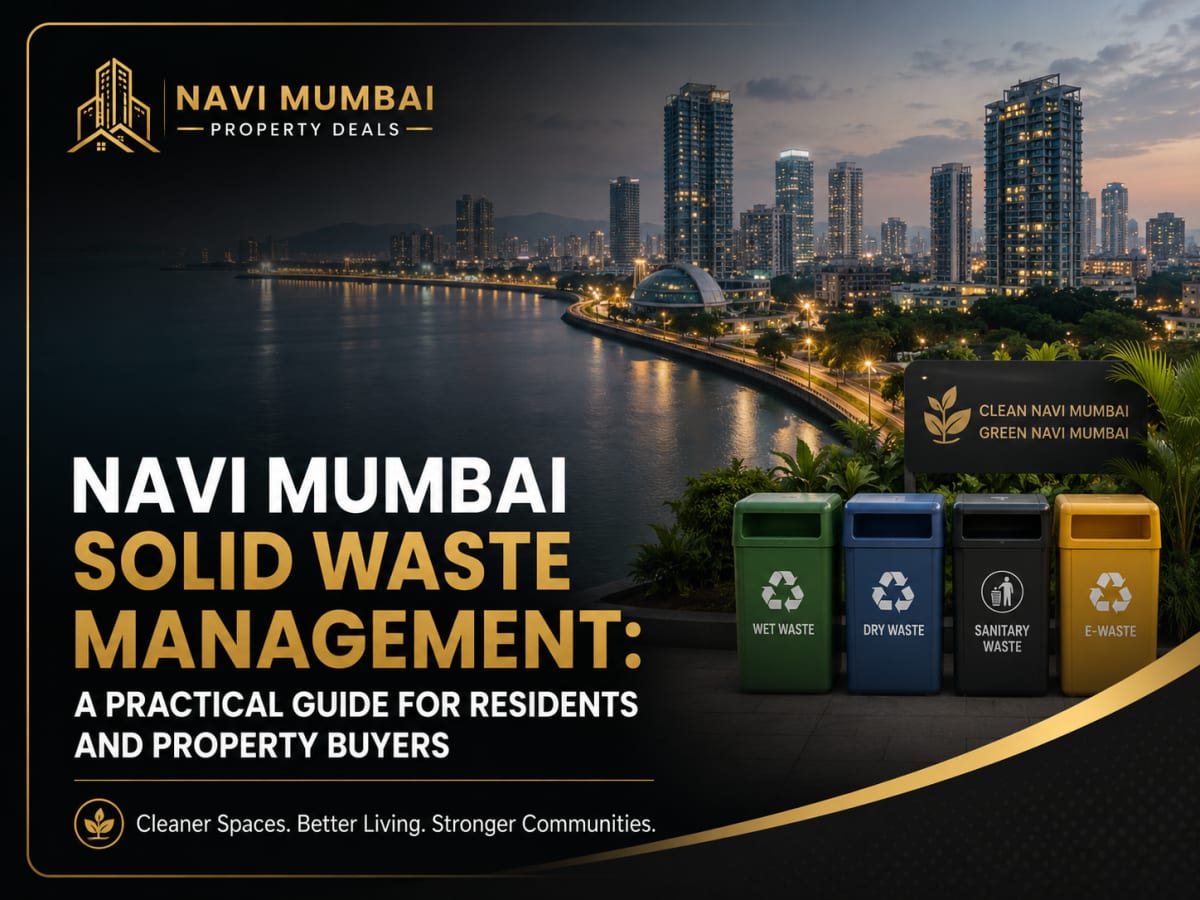
Navi Mumbai Solid Waste Management is generally stronger than many Indian cities, with NMMC reporting daily doorstep garbage collection, road sweeping, gutter cleaning and centralized waste handling. But buyers should still check the exact society, lane and locality for waste segregation, odour, open dumping, waste burning, nullah-side garbage, Turbhe/MIDC impact and authority responsibility before paying token money or finalizing a rental deal.
Why Navi Mumbai Solid Waste Management Matters for Property Buyers
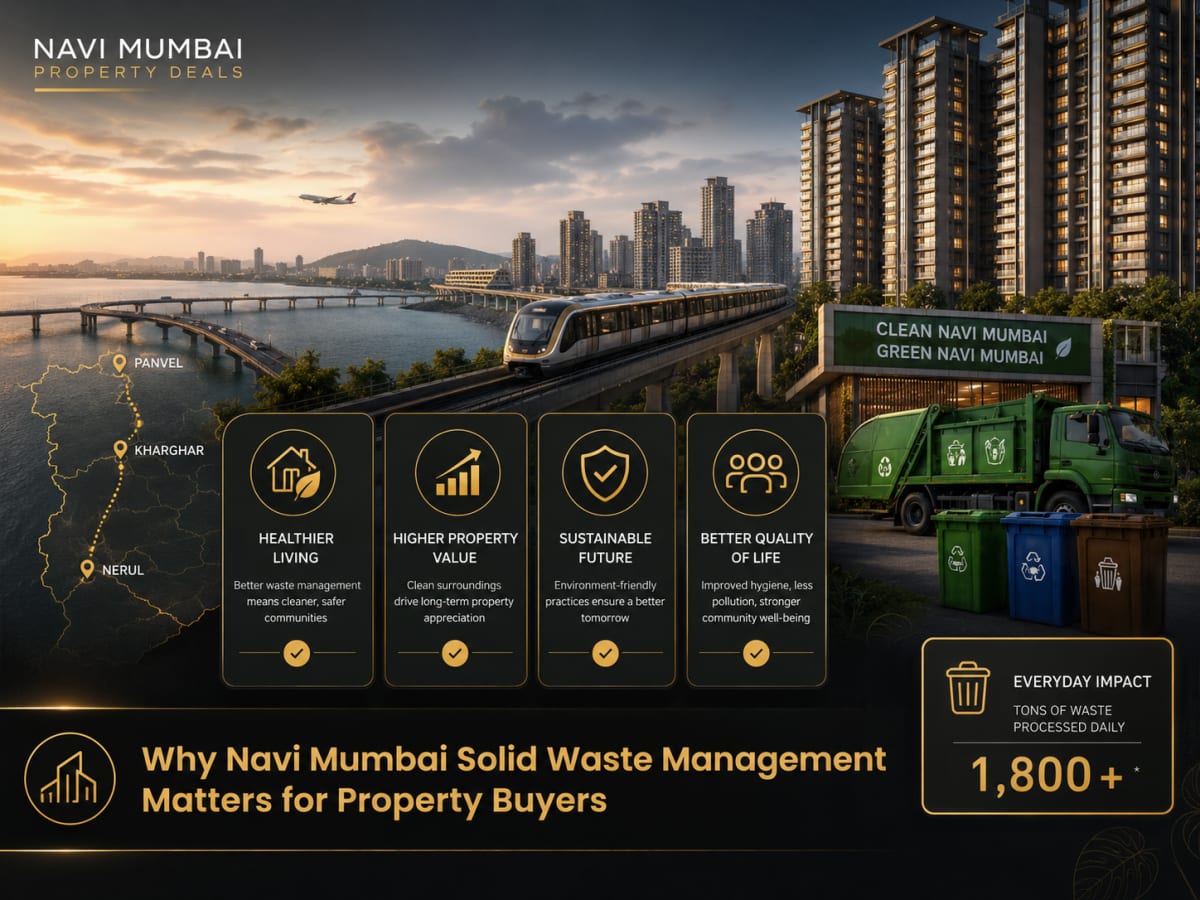
Navi Mumbai is known as one of India’s cleaner planned cities. That is a positive signal. But for a property buyer, city-level cleanliness is not enough. A buyer should check the actual building, lane, market road, service road, society garbage room, nearby nullah, and surrounding land use. Poor waste management can affect daily living more than people realize. It can create:
- Bad smell near the building entrance
- Mosquitoes, rats and insects
- Overflowing bins
- Waste burning smoke
- Blocked drains during monsoon
- Dirty back lanes
- Lower rental appeal
- Society maintenance disputes
- Poor resale impression
A flat may look clean from inside. But if the approach road, garbage room or nearby drain is badly managed, the property can become difficult to live in. That is why solid waste management should be part of your Navi Mumbai civic services guide checklist before buying or renting.
Who Manages Solid Waste in Navi Mumbai?
Not every area people call “Navi Mumbai” is managed by the same authority. This is important. A buyer should first check the local civic authority.
| Area / SituationLikely Authority to CheckWhy It Matters | ||
| Vashi, Nerul, Seawoods, Belapur, Airoli, Ghansoli, Koparkhairane, Turbhe | NMMC | Core municipal waste collection and civic services |
| Panvel, New Panvel, parts around Taloja/Kalamboli depending on location | PCMC / local authority | Waste service quality and rules may differ from NMMC |
| CIDCO-developed nodes or transition pockets | CIDCO + local civic body | Some services may shift depending on handover status |
| NAINA or developing village-side land | CIDCO NAINA / local body / gram panchayat transition | Civic services may not be equal to established city nodes |
| Large societies, malls, hospitals, hotels, campuses | Society / owner / bulk waste generator + civic authority | Separate waste-handling responsibility may apply |
Do not assume that every property marketed as “Navi Mumbai” gets the same level of NMMC service. This is especially important for Panvel, Taloja, Ulwe, Dronagiri, Uran-side growth pockets, NAINA land and gaothan-adjacent areas. For developing locations, also read the CIDCO civic services guide before making a decision.
How Navi Mumbai’s Waste System Works
NMMC’s official Solid Waste Management Department mentions daily services such as road sweeping, gutter cleaning, pre-monsoon gutter cleaning, mechanized road sweeping, garbage collection and transportation. The same official source reports around 700 metric tons of daily garbage generation within the municipal corporation area and 100% doorstep collection from 6,443 housing societies and 800 commercial, educational and industrial premises. For residents and buyers, the practical meaning is this: Navi Mumbai has a structured waste system. But you still need to check whether your specific locality and society are managing waste properly.
Door-to-Door Collection
In established NMMC areas, daily collection is generally a major advantage. But buyers should ask:
- Is garbage collected daily?
- What is the collection timing?
- Is wet and dry waste collected separately?
- Does the society keep the garbage room clean?
- Are bins closed or open?
- Is waste stored near parking, entrance or children’s play area?
Road Sweeping and Gutter Cleaning
Waste management is not only about home garbage. Street cleaning, gutter cleaning and pre-monsoon drain cleaning affect daily living. In Navi Mumbai, this matters especially near:
- Market areas
- Railway station roads
- Food-stall clusters
- Service roads
- Nullah-side buildings
- MIDC-adjacent pockets
- Low-lying roads during monsoon
For more context, connect this with Navi Mumbai stormwater drainage and Navi Mumbai sewerage infrastructure.
Turbhe Solid Waste Facility
Turbhe is an important waste-management zone for Navi Mumbai. Recent reporting has mentioned a proposed large integrated waste-to-energy and Bio-CNG-linked solid waste facility at Turbhe landfill, with plans to expand processing capacity. This does not mean every property near Turbhe is bad. But buyers near Turbhe, Pawne, Mahape MIDC, Sanpada-side industrial edges, or service-road pockets should check the ground reality. Check:
- Odour
- Truck movement
- Waste transport routes
- Air quality
- Nearby industrial activity
- Road cleanliness
- Drainage and nullah condition
If you are comparing residential areas near industrial belts, also read Living Near MIDC Navi Mumbai.
SWM Rules 2026: What Changed After 2025?
![SWM Rules 2026: What Changed After 2025?]](https://res.cloudinary.com/dstrunwjb/image/upload/v1781612476/nmpd/uploads/dfukd83vu1xuvr80r2ie.jpg)
Solid Waste Management Rules, 2026 became important from April 1, 2026. For Navi Mumbai residents, housing societies and commercial property users, the biggest change is stricter responsibility. The updated rules focus on source segregation, bulk waste generator responsibility, digital tracking and environmental compensation for violations. In simple words: Waste is no longer only the municipality’s problem. Societies, commercial buildings, institutions and large campuses also have responsibility.
Four-Stream Segregation
Residents and societies should separate waste properly. The practical categories include:
| Waste TypeSimple MeaningExample | ||
| Wet waste | Food and kitchen waste | Vegetable peels, leftover food |
| Dry waste | Recyclable dry material | Paper, plastic, metal, glass |
| Sanitary waste | Hygiene-related waste | Diapers, sanitary napkins |
| Domestic hazardous / special care waste | Waste needing careful handling | Batteries, bulbs, expired medicines |
A society that does not segregate waste properly may face more civic pressure, complaints or compliance issues over time.
Bulk Waste Generator Responsibility
Large housing societies, malls, hotels, hospitals, educational institutions, commercial buildings and campuses may fall under bulk waste generator responsibilities depending on applicable criteria. Buyers and tenants should ask:
- Does the building generate large daily waste?
- Is wet waste processed on-site where required?
- Is there a composting or waste-processing arrangement?
- Is dry waste handed to authorized recyclers?
- Is the building registered where required?
- Are waste records maintained?
This is especially important for large towers, townships, malls, restaurants, hotels, hospitals, schools, colleges, IT parks and commercial buildings.
Why This Matters for Buyers
A poorly managed society may not only look dirty. It may also face:
- Higher maintenance disputes
- Compliance pressure
- Waste-handling penalties
- Resident complaints
- Bad rental reputation
- Odour and pest issues
- Poor long-term livability
So when you inspect a property, do not only check the flat. Check the waste system.
Locality-Wise Buyer Checks
Use this table during property visits.
| Area TypeWhat to CheckBuyer Risk | ||
| Premium residential nodes like Vashi, Nerul, Seawoods, Belapur | Society garbage room, market waste, road cleanliness, collection timing | Clean city image, but micro-location still matters |
| Kharghar, Panvel, Kalamboli, Taloja edges | Civic authority, service gaps, dumping spots, drainage, PCMC/CIDCO role | Developing-area civic variation |
| Turbhe, Pawne, Mahape, Taloja MIDC-side pockets | Industrial waste, odour, truck movement, air quality, waste-processing activity | Livability and pollution concern |
| Ulwe, Dronagiri and Uran growth areas | Construction debris, open plots, civic handover, collection frequency | Developing-node cleanliness risk |
| Creek/nullah-side properties | Drain blockage, garbage dumping, mosquito issue, monsoon smell | Health and flood discomfort |
| Large townships and high-rises | Bulk waste handling, composting, garbage room design, housekeeping system | Maintenance and compliance risk |
For pollution-linked location decisions, also read Navi Mumbai air quality by locality.
Documents and Proofs to Check Before Buying or Renting
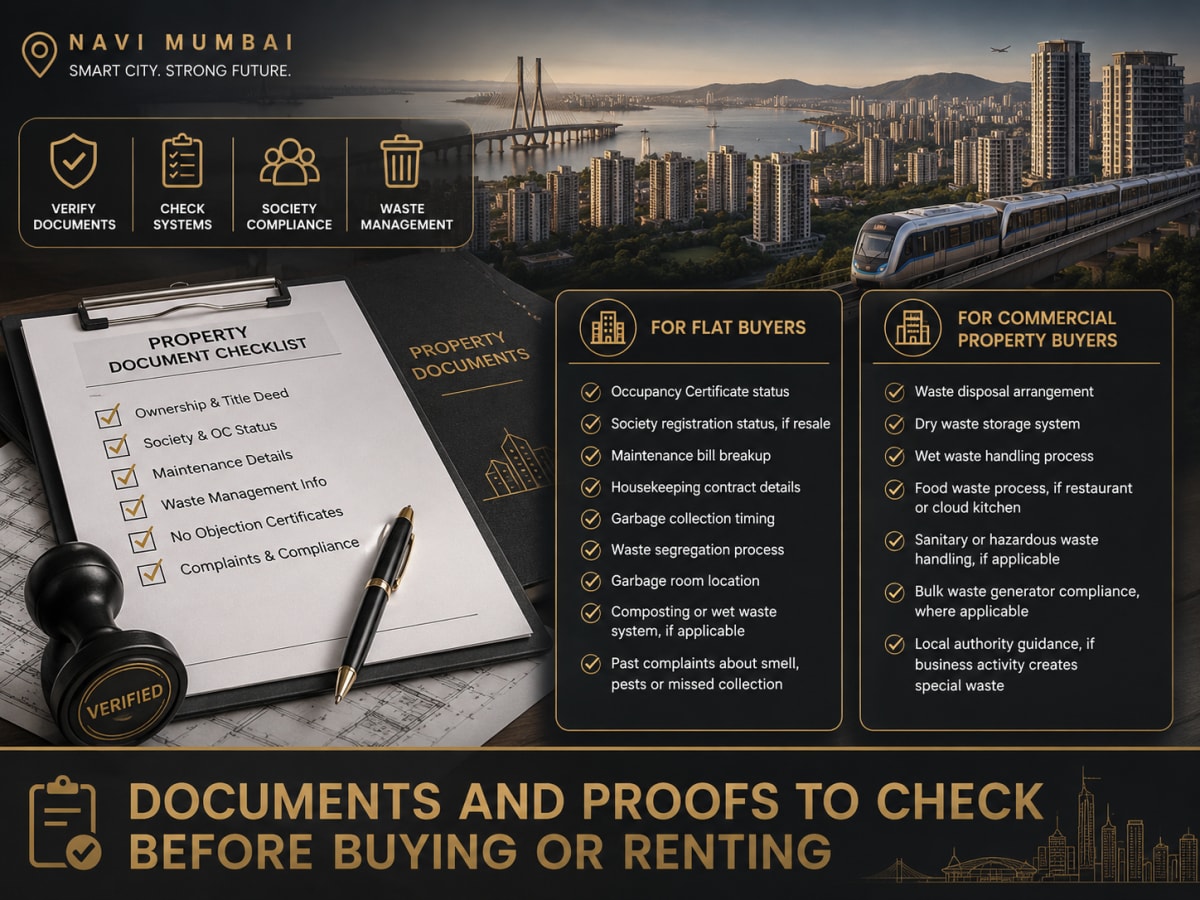
Waste management is usually not part of legal title. But it should still be part of property due diligence.
For Flat Buyers
Ask the society or seller for:
- Occupancy Certificate status
- Society registration status, if resale
- Maintenance bill breakup
- Housekeeping contract details
- Garbage collection timing
- Waste segregation process
- Garbage room location
- Composting or wet waste system, if applicable
- Past complaints about smell, pests or missed collection
For Commercial Property Buyers
Ask for:
- Waste disposal arrangement
- Dry waste storage system
- Wet waste handling process
- Food waste process, if restaurant or cloud kitchen
- Sanitary or hazardous waste handling, if applicable
- Bulk waste generator compliance, where applicable
- Local authority guidance, if business activity creates special waste
For Plot or Land Buyers
For plots, waste risk is different. The concern may be nearby dumping, civic reservation, nullah, landfill road, industrial waste, or lack of collection service. Check:
- 7/12 extract, if rural land
- Property card, if urban land
- Development Plan reservation
- Nearby dumping ground or waste facility
- Access road condition
- Nearby nullah or open drain
- Local civic authority responsibility
- Land-use compatibility
Plain English terms:
- 7/12 extract: Rural land record showing land details and holder/rights entries.
- Property card: Urban land/property record used in city survey areas.
- Mutation/Ferfar: Land-record entry showing change due to sale, inheritance, transfer or other rights.
A land record helps verification. It should not be treated as the only proof of ownership. For plot due diligence, connect this section with check 7/12 and property card online.
How to Verify Waste Management Before Finalizing a Property
Step 1: Visit at the Right Time
Visit once in the morning and once in the evening. Morning shows collection reality. Evening shows smell, traffic, market waste and drain condition. Check:
- Are bins overflowing?
- Is garbage lying outside the gate?
- Is waste stored in open space?
- Is there smell near parking?
- Are stray animals gathering near waste?
- Is the road clean after collection?
Step 2: Check the Garbage Room
A good society usually has a managed waste area. Check:
- Is it covered?
- Is it ventilated?
- Is it cleaned daily?
- Is wet and dry waste separated?
- Is sanitary waste handled separately?
- Is the garbage room too close to flats or parking?
- Is there leakage or bad smell?
Step 3: Speak to Security and Residents
Ask simple questions:
- Does collection happen daily?
- Are there missed collection days?
- Does the society fine non-segregation?
- Is there a mosquito problem?
- Does smell increase in monsoon?
- Is waste burning common nearby?
- Are there complaints to NMMC, PCMC or the ward office?
Residents and security staff often know more than the broker.
Step 4: Check the Surrounding 300–500 Metres
Walk around the building. Look for:
- Nullah-side dumping
- Construction debris
- Scrap yards
- Industrial sheds
- Open bins
- Meat/fish market waste
- Food-stall waste
- Drain blockage
- Dumping on vacant plots
- Burning marks
A property’s real cleanliness is visible outside the brochure.
Red Flags Before Buying or Renting
Be careful if you notice these warning signs:
- Garbage room smells strongly during normal hours
- Wet and dry waste are mixed
- Waste is stored near the main entrance
- Open bins are used without covers
- Society has no proper housekeeping contract
- Nullah or drain nearby has visible garbage
- Waste burning happens nearby
- Construction debris is dumped around the building
- Market waste enters residential lanes
- Seller says “cleaning issue will be solved soon” without proof
- Broker avoids showing the back lane
- Large society has no bulk waste plan
- Commercial building has no food waste or dry waste process
- Residents complain about mosquitoes or missed collection
A clean flat inside a dirty civic pocket is still a risky property decision.
Common Mistakes Buyers Make
Mistake 1: Trusting Only Clean City Rankings
Navi Mumbai’s clean-city reputation is valuable. But rankings do not guarantee that every lane, society and market pocket is clean. Always check the micro-location.
Mistake 2: Checking Only the Lobby
Many buildings keep the lobby clean. The real test is the back side, garbage room, service road, drain and parking level.
Mistake 3: Ignoring Monsoon
Waste and drainage issues become worse during monsoon. If possible, check the area during or after rain.
Mistake 4: Not Checking Authority Jurisdiction
A buyer may think the property is under NMMC, but it may fall under PCMC, CIDCO, NAINA or another authority. This affects complaint handling and service quality.
Mistake 5: Ignoring Industrial Neighbourhoods
MIDC-adjacent areas can be practical for budget or work access. But check odour, air quality, truck movement, waste storage and industrial surroundings. For Taloja-side decisions, read Living Near Taloja MIDC.
Mistake 6: Believing Verbal Promises
“Dumping issue will shift soon” is not enough. Ask for official notice, work order, authority update or written proof.
What to Check Before Paying Token Money
Use this checklist before paying token for a flat, shop, warehouse, office, plot or land parcel.
| CheckDone / Pending | |
| Civic authority confirmed: NMMC / PCMC / CIDCO / NAINA / other | |
| Daily garbage collection checked | |
| Waste segregation system checked | |
| Garbage room inspected | |
| Back lane and service road checked | |
| Nearby nullah or drain inspected | |
| Waste burning checked | |
| Open dumping spots checked | |
| Monsoon smell or waterlogging risk asked | |
| Society maintenance and housekeeping details checked | |
| Bulk waste generator responsibility checked, if applicable | |
| Nearby landfill, waste facility or industrial waste risk checked | |
| For plots, land record and surrounding reservation checked | |
| Residents/security feedback taken | |
| Token terms reviewed before payment |
If you are paying token money, add a basic clause that your payment is subject to document verification and material civic-risk review. For the next step, use verify property documents before paying token.
Example Scenario: Buying Near Taloja / MIDC Edge
A buyer finds a budget flat near a Taloja MIDC-side pocket. The flat is bigger than what the same budget gets in Kharghar. The broker says: “Area developing hai. Rate badhega. Token abhi do.” Before paying token, the buyer should check:
- Is the building under PCMC, CIDCO or another authority? 2. Is garbage collection daily? 3. Is there any open dumping nearby? 4. Is the access road clean? 5. Is there any industrial odour in the evening? 6. Is there a nullah or drain carrying waste? 7. Are there complaints about air or water pollution? 8. Does the society segregate waste? 9. Are nearby vacant plots used for debris dumping? 10. Does the building have proper OC and approvals?
This does not mean every Taloja property is bad. It means Taloja, MIDC-edge and developing-node properties need more ground-level checks than mature residential nodes. For legal and document review, connect this with title search in Navi Mumbai.
When to Consult a Professional
Consult a professional if:
- Property is near dumping ground or waste-processing facility
- Plot is near nullah, creek or open dumping area
- Land is in NAINA, gaothan, MIDC edge or village transition zone
- Commercial building may qualify as a bulk waste generator
- Society has repeated civic complaints
- Waste facility or utility reservation appears near the plot
- Builder gives only verbal assurance
- NRI buyer cannot inspect the locality personally
- You are buying for hotel, school, hospital, warehouse, restaurant or institution use
Depending on the issue, consult:
- Property lawyer
- Local civic consultant
- Architect or planner
- Environmental consultant
- Society manager or auditor
- Revenue consultant for land records
FAQs
Is Navi Mumbai good in solid waste management?
Yes, Navi Mumbai is considered one of India’s better-performing clean cities, especially in established NMMC areas. But buyers should still check the exact society, lane and locality before making a property decision.
Does NMMC collect garbage daily?
NMMC’s official Solid Waste Management Department page states that garbage is collected from housing societies, commercial, educational and industrial premises on a daily basis within its municipal area.
Is every Navi Mumbai locality equally clean?
No. Cleanliness can vary by node, society, market area, civic authority, road condition, construction activity and nearby land use.
What should I check in a housing society?
Check the garbage room, segregation system, collection timing, housekeeping contract, pest problem, smell, resident complaints and maintenance records.
Should commercial property buyers check waste management?
Yes. Restaurants, clinics, hotels, schools, offices, malls and institutions may have higher waste-handling responsibilities. Bulk waste generator rules may apply depending on size and waste generation.
Is Turbhe landfill a concern for nearby buyers?
It can be a factor to check. Buyers near Turbhe, Pawne, MIDC edges or waste-transport routes should inspect odour, truck movement, air quality and surrounding land use before deciding.
Is waste management linked to property value?
Indirectly, yes. Clean surroundings improve livability, rental appeal and resale confidence. Poor waste handling can reduce buyer interest in a specific building or lane.