Living Near JNPT Road in Navi Mumbai: Buyer Risks, Documents & Local Reality
- By Mukund Choudhary
Living near JNPT Road can be a good choice if you want connectivity to Ulwe, Dronagiri, Uran, Panvel, JNPA/JNPT and the airport-influence belt. But it is not a simple “good or bad” location. Before paying token money, check road-facing exposure, truck traffic, dust, noise, flood risk, CRZ/mangrove proximity, RERA status, title records and NAINA/CIDCO approvals. This is an educational guide. Verify the latest position with the relevant authority or a property lawyer before making a transaction. For a wider locality comparison, also read quality of life in Navi Mumbai.
Table of Contents
- Is living near JNPT Road good? 2. Where exactly is JNPT Road? 3. Main benefits 4. Main risks 5. Flats vs plots near JNPT Road 6. Documents to check before token money 7. Red flags 8. Common mistakes 9. How to verify the property 10. FAQs 11. Internal links 12. External sources 13. Schema recommendations 14. Final CTA
Is Living Near JNPT Road Good?
Living near JNPT Road is good for some buyers and risky for others. It works well if you need access to Ulwe, Dronagiri, Uran, Panvel, JNPA/JNPT, logistics jobs, port-linked businesses or airport-side growth areas. It may not work well if you want a quiet, low-traffic, fully settled residential environment like parts of Nerul, Seawoods, Vashi or Palm Beach Road. The biggest mistake is judging the location only by price and future growth. JNPT Road is connected to a major port corridor. JNPA’s official road-access page says NH4B mainly serves heavy containerized vehicle traffic to and from JNPA. That matters for daily living because road-facing homes can face noise, dust and heavy-vehicle movement. [S1] So the correct question is not: “Is JNPT Road good?” The correct question is: “Is this exact building or plot safe, liveable and legally clean?”
Where Exactly Is JNPT Road in Navi Mumbai?
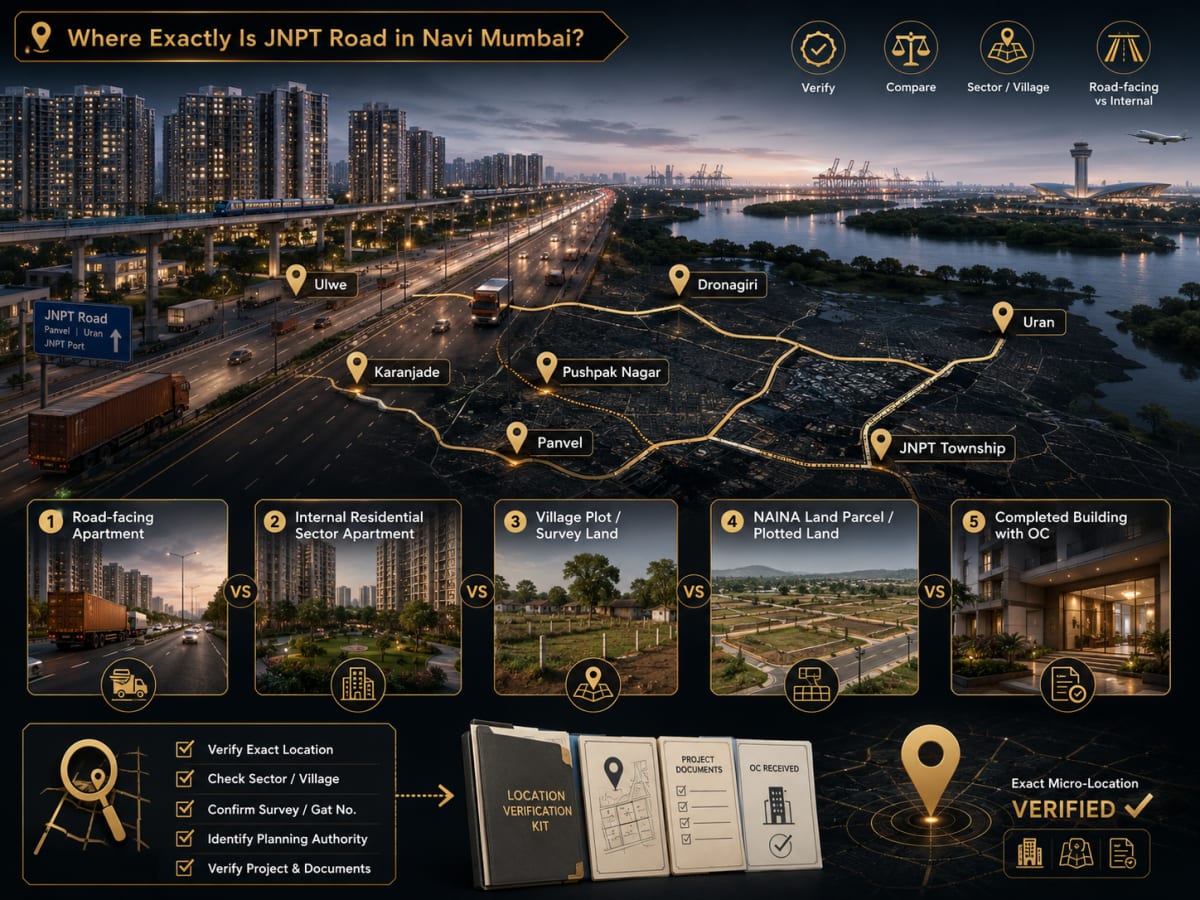
Many listings use “JNPT Road” loosely. A buyer may see this label for properties around Ulwe, Dronagiri, Uran, Karanjade, Pushpak Nagar, Panvel-side villages, JNPT/JNPA Township or port-road connected pockets. That is why micro-location is everything. A flat inside a residential sector is different from a road-facing flat near heavy truck movement. A CIDCO-sector apartment is different from a village plot. A NAINA land parcel is different from a completed building with Occupancy Certificate. A creek-side plot is different from a normal internal-sector resale flat. Before shortlisting, ask for the exact sector, village, survey number, Gat number, building name, project name and planning authority.
Main Benefits of Living Near JNPT Road
Connectivity to Growth Corridors
JNPT Road gives access to important Navi Mumbai and Raigad-side locations such as Ulwe, Dronagiri, Uran, Panvel and port-linked employment zones. For buyers working in shipping, logistics, warehousing, transport, customs, industrial services or port-linked businesses, this location can reduce travel time compared with living deep inside Mumbai or older Navi Mumbai nodes. JNPA’s future-projects page also mentions CIDCO’s proposed six-lane coastal road connecting Belpada near JNPA to Amra Marg at Panvel, planned to improve access to JNPA and the Navi Mumbai airport-side corridor. Treat this as infrastructure context, not a guaranteed price-appreciation promise.
Lower Entry Cost Than Mature Nodes
Many buyers look near JNPT Road because mature Navi Mumbai areas have become expensive. Compared with Vashi, Nerul, Seawoods, CBD Belapur or Palm Beach Road, some JNPT Road-influenced pockets may offer lower entry prices. But lower price is not automatically a bargain. Sometimes the discount is because of truck movement, pending infrastructure, weaker social amenities, title complexity, flood exposure, CRZ concerns or distance from railway/metro access.
Useful for Port, Airport and Logistics Professionals
If your work is connected to JNPA/JNPT, Uran, Dronagiri, Panvel logistics parks, warehouses or airport-side business zones, the location can be practical. But if your daily life depends on schools, hospitals, senior-citizen comfort, walkability and low noise, compare this area with Best Navi Mumbai Areas for Senior Citizens, Best Navi Mumbai Areas for Walkability and Best Navi Mumbai Areas for Hospitals before deciding.
Main Risks Buyers Should Check
Truck Traffic and Road Safety
Heavy vehicles are part of the JNPT Road reality. This does not mean every home nearby is bad. It means you must inspect the actual approach road, entry gate, turning points and night movement. Visit the site during weekday peak hours, late evening and early morning. A project can feel calm on a Sunday afternoon and very different on a weekday night. Road-facing flats may get more dust, honking and vibration. Internal-sector flats may be more comfortable. For broader road issues, link this section to Navi Mumbai Traffic Guide.
Dust, AQI and Construction Pollution
JNPT Road-influenced areas can have dust from trucks, roadworks, construction, open plots and logistics activity. Do not judge only by sample-flat interiors. Stand on the balcony. Check window grills, AC outdoor units, parked vehicles and nearby shops for dust accumulation. For current air-quality data, use official CPCB AQI resources and MPCB updates. AQI changes by season and locality, so do not rely on one old screenshot or broker statement. [S11] Add an internal link here to Navi Mumbai Air Quality by Locality.
Noise From Road, Logistics and Airport-Side Activity
Noise depends on distance from the main road, floor level, glass quality, balcony direction and nearby loading/unloading activity. A higher floor may reduce some street-level disturbance but may not remove highway noise. A rear-facing flat may be better than a road-facing flat in the same building. If the property is near airport-influence areas, also check Navi Mumbai Airport Noise Zone Guide.
Waterlogging, Creek, Nullah and Stormwater Risk
Some JNPT Road-side properties are near creeks, low-lying land, nullahs, wetlands or reclamation-influenced pockets. Do not buy only after a dry-season visit. Ask neighbours about monsoon waterlogging. Check basement ramps, compound-wall marks, road level and drain outlets. If the property is near a creek, nullah or mangrove belt, read Navi Mumbai Flood Risk Property Guide, Property Near Creek Risk Navi Mumbai and Property Near Nullah Risk Navi Mumbai.
CRZ, Mangroves and Coastal Restrictions
This is one of the biggest checks near creek-side or coastal-influence properties. CRZ means Coastal Regulation Zone. It controls what can be developed near the coast, creek, tidal water bodies and certain sensitive areas. MCZMA lists approved CZMP 2019 maps for Maharashtra districts, including Raigad and Thane. NCSCM’s CZMP portal explains CRZ categories and No Development Zone concepts under the 2019 CRZ framework. [S8] [S9] If a plot is near a creek, mangroves, tidal land, salt-pan-like land or coastal belt, do not rely on “CRZ problem solved” from a broker. Verify before transaction with the planning authority, MCZMA/CZMP records and a property lawyer. Link this section to Navi Mumbai CRZ Property Guide and Property Near Mangroves Navi Mumbai.
Flats vs Plots Near JNPT Road
If You Are Buying a Flat
For a flat, your first checks are project legality, completion status and liveability. Check MahaRERA registration, promoter name, project name, completion date, extensions, complaints, uploaded approvals, Commencement Certificate, Occupancy Certificate and sanctioned plan. RERA registration is useful, but it does not replace title due diligence. A RERA number in a brochure is not enough. Search the project on the official MahaRERA portal and check whether the project details match what the seller or builder is showing. MahaRERA’s 2025 Order No. 64/2025 introduced guidelines for the Project Lifecycle Management Module, which is relevant because project updates and lifecycle data are becoming more structured. [S6]
If You Are Buying a Plot
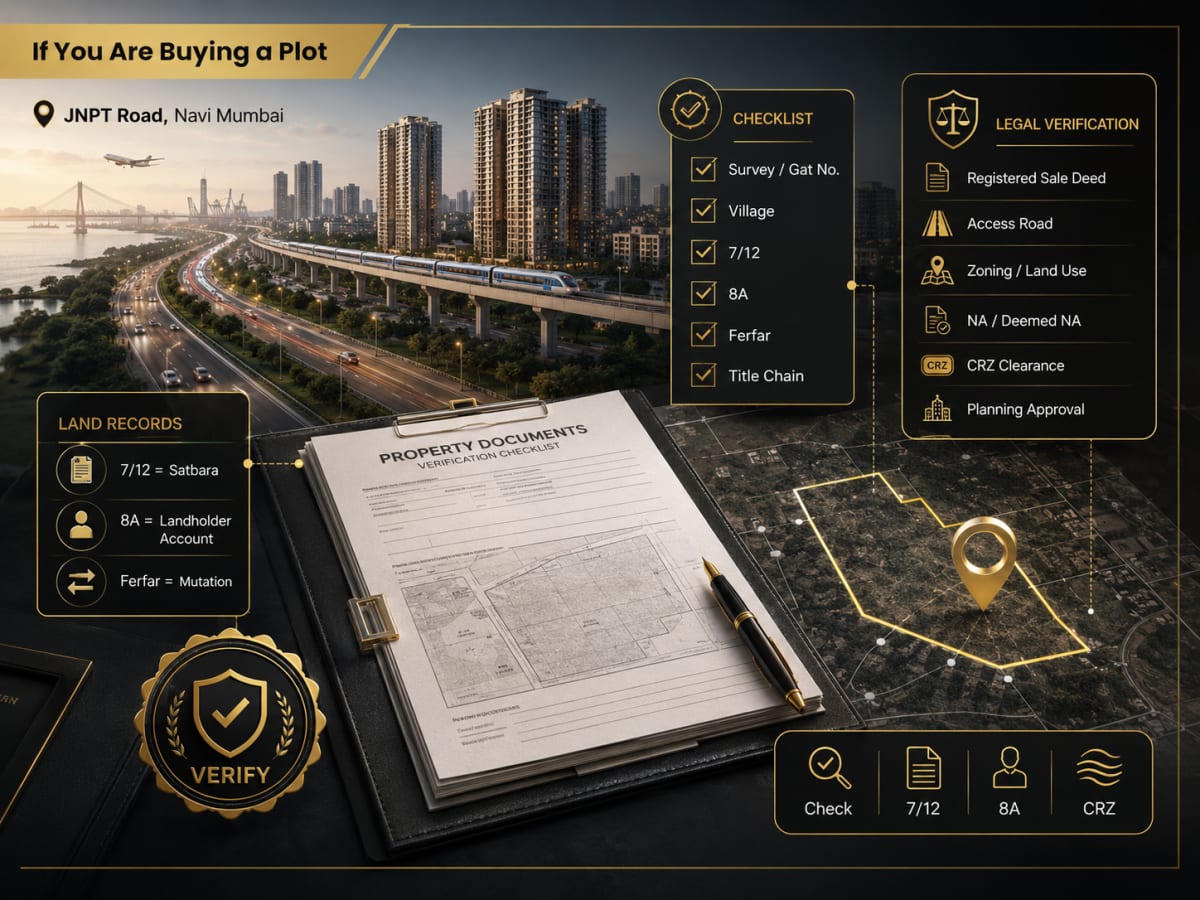
Plot buying near JNPT Road needs deeper verification. You need the exact survey number or Gat number, village name, 7/12 extract, 8A extract, mutation entries, title chain, registered sale deeds, legal access road, zoning status, NA/deemed NA status, CRZ status and planning-authority approval. A 7/12 extract, called Satbara Utara in Marathi, is a land-record extract for rural land. It shows details such as land survey number, area, occupant and rights-related entries. It supports verification, but by itself it should not be treated as final ownership proof. 8A is a landholder account extract. Ferfar means mutation entry. Mutation records show changes recorded in revenue records after sale, inheritance, partition or other events. Property Card, also called Malmatta Patrak, is usually relevant for city-survey properties. Mahabhulekh and Mahabhumi provide digital land-record services such as 7/12, 8A, Ferfar and property card access. [S3] [S4]
If It Is Gaothan Property
Gaothan means village settlement area. Many buyers hear “gaothan” and assume the property is automatically safe or automatically risky. Both assumptions are wrong. For gaothan property, check old ownership chain, inheritance records, mutation entries, construction permission, tax receipts, access road and whether any CIDCO, NAINA, municipal or revenue condition applies. A tax receipt is not ownership proof. It only supports payment history.
If It Falls Under NAINA
NAINA stands for Navi Mumbai Airport Influence Notified Area. Some Panvel, Raigad and airport-influence villages may fall under NAINA planning control. If a JNPT Road-side plot is marketed as “NAINA future growth,” ask for actual approval records. CIDCO’s NAINA Integrated Approval Management System has public-search and approval-related functions. [S7] Check whether the land is affected by development plan reservation, town planning scheme, road widening, final plot adjustment or development permission conditions.
What to Check Before Paying Token Money
Do not pay token money only because the seller says “rate will increase tomorrow.” Use this table first.
| Property TypeWhat to CheckWhy It Matters | ||
| Ready flat | OC, CC, sanctioned plan, MahaRERA, agreement, Index II, society status | Confirms completion and basic transferability |
| Under-construction flat | MahaRERA page, project updates, approvals, builder name, completion timeline | Reduces project-delay and mismatch risk |
| Plot | 7/12, 8A, Ferfar, title chain, survey map, legal access, IGR search | Supports ownership, title and encumbrance verification |
| NAINA plot | NAINA/CIDCO approval, planning status, TPS/final plot, zoning | Avoids buying land affected by planning restrictions |
| Gaothan property | old title records, inheritance, mutation, construction permission, authority status | Prevents family-title and permission disputes |
| Creek/mangrove-side land | CZMP map, CRZ category, MCZMA relevance, flood check | Avoids regulatory and resale problems |
Also search registered transaction history through IGR Maharashtra. The IGR eSearch page itself says property history transaction search is an essential prerequisite for buyers and banks.
Red Flags Near JNPT Road
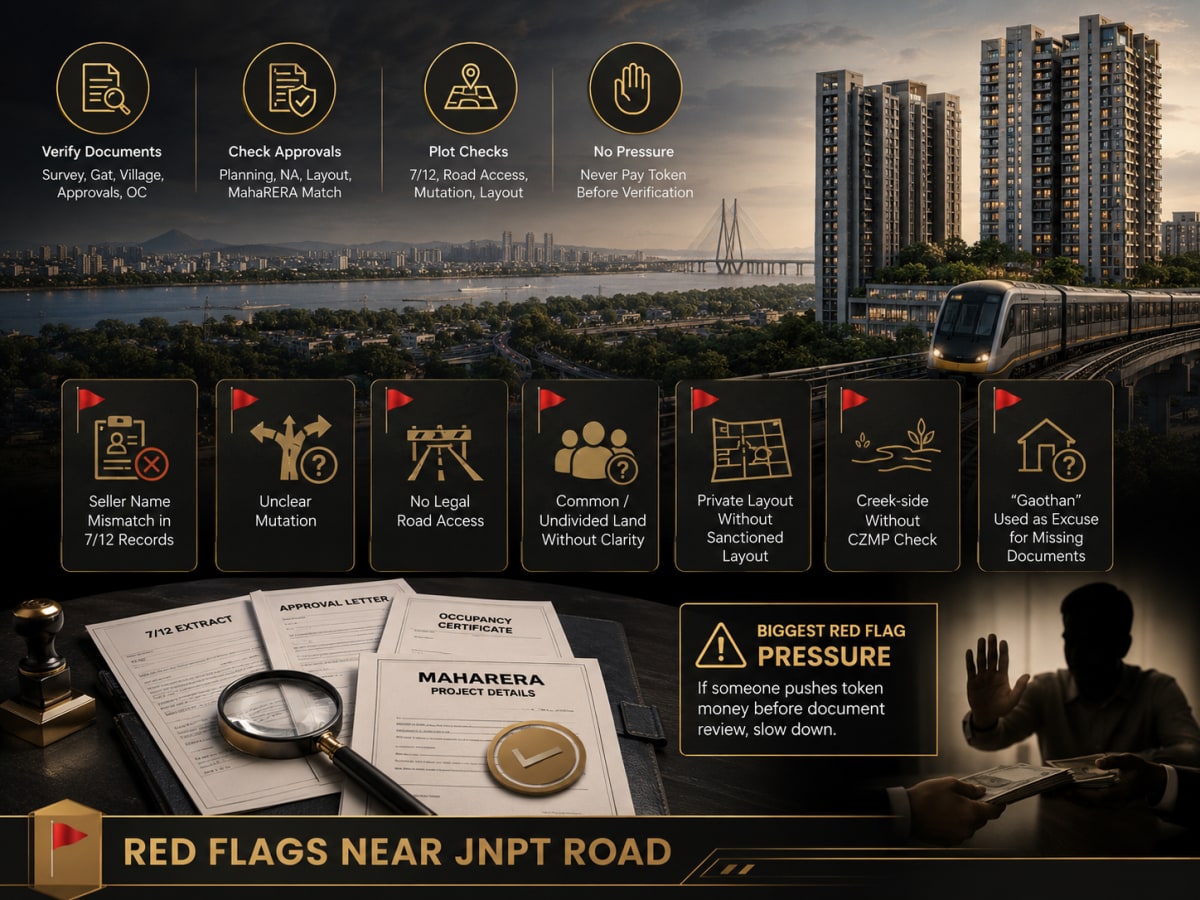
Be careful if the seller cannot share the survey number, Gat number, village name or project approval number. Be more careful if the broker says, “NA is not required now,” but cannot explain which planning approval applies. A missing OC is a major issue in ready-to-move flats. A project name mismatch between brochure and MahaRERA page is another warning sign. For plots, red flags include seller name mismatch in 7/12 records, unclear mutation, no legal road access, common undivided land without clarity, private layout without sanctioned layout, creek-side location without CZMP check and “gaothan” being used as an excuse for missing documents. The biggest red flag is pressure. If someone pushes token money before document review, slow down.
Common Mistakes Buyers Make
Many buyers near JNPT Road focus only on airport, port and infrastructure stories. That is risky. Future infrastructure can improve connectivity, but it does not clean a bad title, remove CRZ restrictions, fix waterlogging or make a road-facing flat silent. Another common mistake is checking only RERA. RERA is important, but buyers still need title, approvals, OC, litigation, mortgage and registered-document checks. Plot buyers often accept photocopies without verifying official portals. That is dangerous. Some buyers also assume the 2025 Maharashtra land-revenue changes mean all NA issues are solved. The Maharashtra Land Revenue Code Second Amendment Act, 2025 changed the NA/non-agricultural assessment framework and introduced a one-time premium concept in relevant cases, but application depends on facts, planning permission and authority interpretation. [S10] Do not rely on a blanket “deemed NA” claim. Verify with the revenue office, planning authority and lawyer before transaction.
How to Verify a Property Near JNPT Road
Start with the authority. Find out whether the property falls under CIDCO, NAINA, Panvel Municipal Corporation, NMMC, revenue jurisdiction, city survey office or another planning authority. Then verify land records on Mahabhulekh/Mahabhumi. For registered transaction history, use IGR Maharashtra. For flats and projects, use MahaRERA. For creek, mangrove or coastal-risk properties, check MCZMA/CZMP sources. Finally, do a physical inspection. Visit on a weekday, at night and during or after heavy rain if possible. Ask residents about waterlogging, truck movement, dust, noise and access-road issues. For deeper document checks, the next step is title search before token money.
Example Scenario
A buyer sees a “JNPT Road plot near airport and Atal Setu” at an attractive rate. The broker says it is a great investment because of JNPT, NAINA and future connectivity. Before token payment, the buyer should ask for the survey number, village name and seller identity documents. Then the buyer should check 7/12, 8A, mutation entries, registered sale deeds, IGR search, NAINA/CIDCO planning status, legal access road, CRZ/CZMP risk and flood history. If the plot is near a creek, nullah or mangrove patch, the buyer should not rely on verbal assurance. The right decision is simple: future growth is useful only after present-day title, access, zoning and environmental risk are clean.
FAQs
Is living near JNPT Road good for families?
It can be good if the building is away from heavy truck movement, has clean approvals, proper access, low noise, reliable utilities and nearby schools or healthcare. Families should avoid judging only by price. Visit at different times before deciding.
Is JNPT Road good for investment?
It can be attractive because of port, logistics, Ulwe, Dronagiri, Uran, Panvel and airport-side connectivity. But investment risk is high if title, RERA, NAINA, CRZ, flood or access-road checks are ignored.
Should I buy a plot near JNPT Road?
Only after proper document verification. Check 7/12, 8A, Ferfar, title chain, IGR records, zoning, legal road access, NA/deemed NA applicability and CRZ/mangrove risk if relevant.
Is RERA enough for buying a flat near JNPT Road?
No. MahaRERA verification is important, but also check OC, CC, sanctioned plan, agreement terms, title, society status, litigation and whether the actual project details match the RERA page.
What if the seller says the land is gaothan?
Do not accept that as a shortcut. Gaothan property still needs title, mutation, inheritance, permission, tax, access and authority checks.
What is the biggest risk near JNPT Road?
For flats, the main risks are road-facing noise, dust, missing OC and poor project due diligence. For plots, the biggest risks are unclear title, NAINA/CIDCO planning issues, CRZ/mangrove restrictions, flood exposure and lack of legal access.