Karanjade OC Certificate Guide: How Homebuyers Can Verify an Occupancy Certificate
Quick Answer
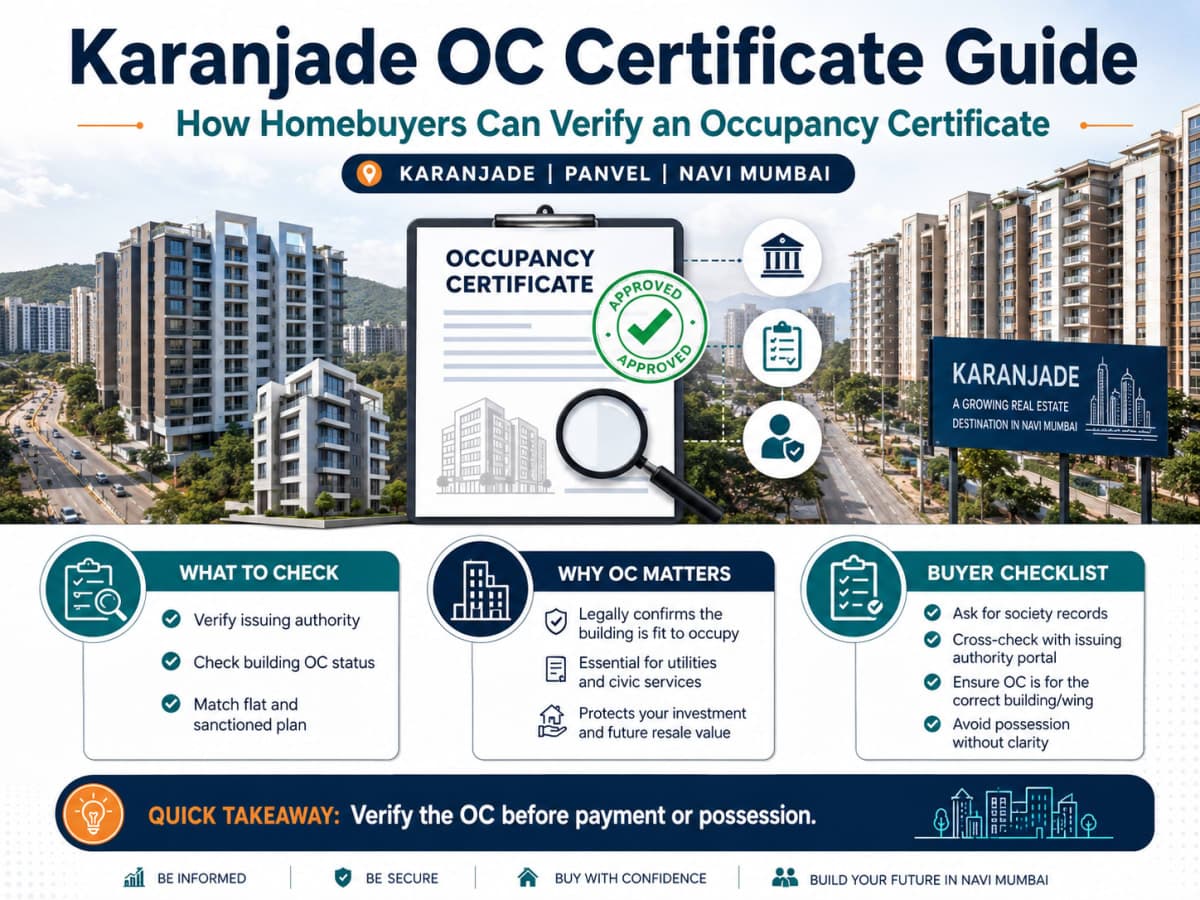
An Occupancy Certificate, commonly called an OC, is an approval issued by the competent authority for occupying a completed building or a specified part of it. When buying a flat in Karanjade, do not simply ask whether the project has an OC. Check whether the certificate covers the same plot, building, wing and floor as the flat you want to buy. A builder’s possession letter, MahaRERA registration, electricity bill, property tax receipt or bank approval should not be treated as a substitute for the actual Occupancy Certificate.
In simple words: An OC is important, but the words “OC received” are not enough. You need to see the complete document and match it with your exact flat.
Why an OC Matters When Buying Property in Karanjade
Karanjade has many new, recently completed and resale residential buildings. Some projects have multiple buildings, phases, wings or floor-wise approvals. This creates a practical problem for buyers. A seller or broker may show you an OC for the project, but that certificate may cover:
- Only one wing
- Only one building
- Only certain floors
- Only one completed phase
- A different plot
- A different developer entity
- A portion of the project subject to conditions
This does not always mean that something is wrong. Large projects often receive approvals in stages. However, it means you must confirm whether the OC shown to you covers the exact flat you are purchasing. The Real Estate (Regulation and Development) Act, 2016 defines an Occupancy Certificate as a certificate issued by the competent authority permitting occupation of a building under applicable local laws. The promoter is also responsible for obtaining the relevant completion or occupancy approvals where required. Official reference: Real Estate (Regulation and Development) Act, 2016, India Code.
What Is an Occupancy Certificate?
An Occupancy Certificate is an official building document issued after the relevant authority examines the completed construction under the applicable approval process. Depending on the project and applicable rules, the authority may review matters such as:
- Whether construction broadly follows the sanctioned plan
- Whether the approved floors and wings have been completed
- Fire-safety compliance, where applicable
- Water, drainage and sewerage arrangements
- Access and common areas
- Conditions mentioned in earlier building permissions
- Other technical or authority requirements
An OC may be issued for the entire building or only for a specified part.
Does an OC prove that the flat has clear ownership?
No. An OC is an important building-occupancy document. It does not independently prove:
- Clear ownership of the flat
- A clean title to the land
- Absence of a mortgage
- Absence of litigation
- Validity of every agreement
- Completion of a CIDCO transfer
- Payment of society dues
- Compliance with every private transaction condition
For ownership and title checks, also read our guide on how to verify property ownership before buying a flat.
Full OC, Partial OC and Conditional OC
Buyers should understand the type and scope of the certificate being shown.
| Type of OC | What it generally means | What the buyer must check |
| Full OC | Covers the completed building or project scope mentioned in the certificate | Confirm that your building, wing and floor are included |
| Partial OC | Covers only certain buildings, wings, floors or portions | Check the exact portion covered |
| Conditional OC | Contains conditions that may require further compliance | Read every condition and ask for proof of compliance |
| Revised or supplementary OC | Extends or changes an earlier approval | Review the earlier and latest documents together |
A partial OC is not automatically invalid. It may be acceptable for a flat situated in the portion specifically covered by it. The problem arises when an OC for one section is presented as if it covers the entire project.
Simple example
Suppose a Karanjade project has three buildings:
- Building A
- Building B
- Building C
The developer shows an OC for Building A. That certificate does not automatically establish OC coverage for a flat in Building C. The buyer must look for an OC that clearly refers to Building C and includes the relevant floor.
Who Issues the OC in Karanjade?
This is one of the most important questions. Karanjade is part of the wider Panvel and Navi Mumbai property market, where buyers frequently hear the names:
- CIDCO
- Panvel Municipal Corporation
- NAINA
- MahaRERA
- Maharashtra IGR
These authorities do not all perform the same function.
| Authority | What it may handle |
| Competent planning or municipal authority | Building permission, sanctioned plans, commencement and occupancy approvals |
| CIDCO | Land allotment, lease conditions, planning or development functions in applicable areas |
| Panvel Municipal Corporation | Municipal and building-related functions within its applicable jurisdiction |
| NAINA/CIDCO | Planning functions in notified NAINA areas |
| MahaRERA | Real-estate project registration, disclosures, updates and complaints |
| IGR Maharashtra | Registration records, registered agreements and Index II |
Do not assume that every Karanjade project follows exactly the same approval route. The safest method is to check the authority named on:
- The Commencement Certificate
- The sanctioned building plan
- The development permission
- The Occupancy Certificate
- The project’s MahaRERA documents
The approval documents should create a consistent trail.
Buyer rule: Identify the authority from the project documents. Do not rely only on the marketing address or what the broker says.
OC vs CC vs Possession Letter
These documents are often confused.
| Document | Basic purpose | Is it the same as an OC? |
| Commencement Certificate | Allows approved construction to begin or proceed to a specified stage | No |
| Completion Certificate | Relates to completion of construction under the applicable approval process | No |
| Occupancy Certificate | Permits occupation of the building or specified portion under applicable rules | This is the OC |
| Possession letter | Builder or seller hands over physical possession of the flat | No |
| MahaRERA registration certificate | Shows that the project is registered with MahaRERA | No |
| Property tax receipt | Shows civic tax assessment or payment | No |
| Electricity bill | Shows an electricity connection and consumption record | No |
For a detailed comparison, read OC vs CC vs Possession Letter.
How to Verify an OC for a Karanjade Flat
Use the following process before paying a large token amount or completing the purchase.
Step 1: Ask for the Complete OC
Do not accept only a WhatsApp screenshot or the first page. Ask for:
- All pages of the OC
- Annexures
- Attached schedules
- Conditions
- Plans attached to the certificate
- Revised or supplementary OCs
- A readable copy showing the reference number and date
A cropped photograph may hide the floors covered or the conditions attached to the approval.
Step 2: Check the Issuing Authority
Look for:
- Full authority name
- Department name
- Certificate number
- Issue date
- Signature or digital authentication
- Approval references
- Official stamp, where applicable
Compare this authority with the one appearing on the sanctioned plan and Commencement Certificate. If the documents show conflicting authority names, ask the developer, seller and a property lawyer to explain the approval history.
Step 3: Match the Plot Details
Compare the OC with the property documents. Check:
- Plot number
- Survey number, CTS number or other land identifier
- Sector or locality
- Project address
- Land-allotment details
- CIDCO lease or allotment details, where applicable
Even a small mismatch should be clarified before proceeding.
Step 4: Match the Project and Developer Name
Confirm that the OC refers to the correct:
- Project
- Developer or promoter
- Applicant
- Building
- Phase
- Address
Sometimes a developer uses different company names for different projects or phases. The name on the OC may also differ from the brand name used in advertisements. In such cases, trace the relationship through the Agreement for Sale, MahaRERA registration and approval documents.
Step 5: Match the Exact Building and Wing
This is a critical check. The OC should clearly cover the building and wing in which your flat is located. For example, an OC mentioning:
Building 1, Wings A and B should not automatically be relied upon for a flat in Wing C. Ask for the certificate or later approval that specifically includes your wing.
Step 6: Check the Approved Floors
Confirm the highest floor covered by the OC. Suppose the document covers:
Ground floor plus seven upper floors A flat on the tenth floor will require a separate or later approval covering that floor. Do not rely only on the flat number. Check its physical floor against the certificate and sanctioned plan.
Step 7: Read Every Condition
Do not stop after finding the words “Occupancy Certificate.” Read the conditions carefully. They may refer to:
- Fire compliance
- Water supply
- Drainage
- Sewerage
- Access roads
- Parking
- Completion of common amenities
- Pending technical work
- Removal of temporary structures
- Compliance within a specified period
- Other departmental NOCs
Ask whether each material condition has been complied with and request supporting documents where necessary. A conditional OC should not automatically be treated as the same thing as an unconditional final approval. The legal and practical effect depends on the wording of the certificate and the status of its conditions.
Step 8: Compare the OC with the Sanctioned Plan
The OC should be reviewed together with the sanctioned building plan. Check:
- Number of buildings
- Number of wings
- Floor count
- Flat location
- Staircases
- Lifts
- Parking areas
- Common spaces
- Refuge areas, where applicable
- Terraces and enclosed areas
- Major additions or alterations
A buyer may need an architect or qualified technical professional to compare the actual construction with the approved plan. For a deeper explanation, see our building plan approval guide.
Step 9: Check the MahaRERA Project Record
For a MahaRERA-registered project, search the project using:
- MahaRERA registration number
- Project name
- Promoter name
- Locality
Review:
- Registered buildings and wings
- Proposed completion date
- Extensions, if any
- Commencement approvals
- Uploaded certificates
- Quarterly project updates
- Project status
- Complaints and orders, where available
MahaRERA services moved to the MahaCRITI platform in 2026, so buyers should use the latest official MahaRERA interface for project searches. Remember that MahaRERA registration does not automatically prove that the project has received an OC. Use our MahaRERA Project Search guide for the complete verification process.
Step 10: Match the Flat Documents
Compare the OC and sanctioned details with:
- Agreement for Sale
- Registered sale deed in a resale transaction
- Allotment letter
- Possession letter
- Flat number
- Wing
- Floor
- Carpet area
- Parking details
- Seller’s earlier purchase agreement
The flat described in the sale documents should correspond with the approved building configuration.
Step 11: Verify the Document with the Authority
Direct authority verification becomes particularly important when:
- The copy is unclear
- The certificate looks altered
- The reference number cannot be traced
- The project name does not match
- The issuing authority is uncertain
- The flat’s wing or floor is missing
- The OC contains important pending conditions
- The builder gives inconsistent answers
Ask the authority whether it provides an online search, certified copy or written verification process. Authority systems and procedures can change, so use the latest official portal or contact details.
Documents to Check Along with the OC
An OC should never be checked in isolation.
Building and approval documents
- Complete Occupancy Certificate
- Partial or supplementary OC
- Annexures and conditions
- Commencement Certificate
- Sanctioned building plan
- Development permission
- Completion-related certificate
- Fire approval, where applicable
- Other NOCs referred to in the OC
Project documents
- MahaRERA registration certificate
- MahaRERA project details
- Registered buildings and wings
- Quarterly updates
- Completion-date extensions
- Uploaded approvals
- Relevant MahaRERA orders or complaints
Flat documents
- Agreement for Sale
- Registered sale deed
- Index II
- Allotment letter
- Possession letter
- Payment receipts
- Parking documentation
- Seller’s purchase agreement
Ownership and society documents
- Title report
- Land ownership or lease documents
- CIDCO allotment or lease papers, where applicable
- Conveyance or deemed conveyance documents
- Society registration certificate
- Share certificate
- Society NOC, where required
- Maintenance no-dues letter
- Loan closure or lender NOC, where applicable
For the wider transaction checklist, use our Flat Buying Documents Checklist.
What to Check Before Paying Token Money
Do not pay token money only because the price looks attractive or another buyer is said to be waiting. Use this checklist first:
| Verification point | Completed? |
| Full OC copy obtained | Yes / No |
| Issuing authority identified | Yes / No |
| Plot details match | Yes / No |
| Project and developer details match | Yes / No |
| Building and wing are covered | Yes / No |
| Flat’s floor is covered | Yes / No |
| OC conditions have been reviewed | Yes / No |
| Sanctioned plan has been checked | Yes / No |
| MahaRERA record has been checked | Yes / No |
| Seller’s ownership documents have been checked | Yes / No |
| Society dues and loan status have been checked | Yes / No |
| Token terms are recorded in writing | Yes / No |
| Lawyer or architect review obtained where needed | Yes / No |
The token receipt should clearly state:
- Property details
- Buyer and seller names
- Token amount
- Refund conditions
- Document-verification condition
- Time allowed for due diligence
- What happens if a serious document problem is found
Have the wording reviewed professionally before payment.
Red Flags Buyers Should Not Ignore
A red flag does not always mean you must reject the property. It means you should pause and verify further.
“OC is under process”
Treat the OC as pending until the authority-issued certificate is produced.
Only one OC page is shared
Important conditions or floor details may be on later pages.
OC is for another wing
Ask for the document covering your actual wing.
Your floor is not mentioned
Check for a supplementary or later OC.
Possession letter is shown instead
A possession letter is not an Occupancy Certificate.
MahaRERA registration is shown as proof
RERA registration and occupancy approval are separate checks.
Bank approval is used as the only assurance
A bank’s lending decision should not replace your independent legal and technical verification.
Property tax or electricity bills are shown as proof
These may show billing or occupation. They do not independently establish that a valid OC covers your building and floor.
The building is already occupied
Occupation by other residents does not remove the need to inspect the actual certificate.
The OC copy appears altered
Watch for:
- Different fonts
- Cropped seals
- Missing pages
- Illegible dates
- Handwritten changes
- Missing reference numbers
- Changed wing or floor details
New Flat vs Resale Flat: What Changes?
The OC check is important in both cases, but the process is slightly different.
| Check | New or ready-to-move flat | Resale flat |
| Who provides the OC? | Developer or promoter | Seller, society or developer |
| MahaRERA check | Usually important for registered projects | Check original project and current disclosures |
| Agreement check | Compare builder agreement with approvals | Compare seller’s registered agreement and sale deed |
| Possession issue | Confirm OC before accepting possession | Confirm existing occupation is covered |
| Society documents | Society may still be forming | Check share certificate, dues and society records |
| Loan status | Check developer and unit-related financing | Check seller’s mortgage and lender NOC |
| Main risk | Premature possession or incomplete phase approval | Missing records, old deviations or wrong-wing OC |
For a new flat
Ask the developer for the OC before accepting possession in a ready building. Confirm:
- The exact wing is included
- Your floor is included
- Conditions have been addressed
- The possession letter matches the approved unit
- MahaRERA disclosures are updated
For a resale flat
Do not assume the society must have every document readily available. Ask:
- Does the seller have the complete OC?
- Does the society have a certified copy?
- Is the OC full, partial or conditional?
- Was any later extension constructed?
- Is the flat on an approved floor?
- Are there any authority notices?
- Does the society have conveyance or deemed conveyance?
- Is any loan outstanding on the flat?
Use our Resale Flat Documents Checklist before finalising the transaction.
Common Mistakes Karanjade Buyers Make
Mistake 1: Asking only, “Does the building have OC?”
Ask a more precise question:
Does this OC cover my plot, building, wing and floor?
Mistake 2: Checking the document name but not its contents
The title “Occupancy Certificate” does not tell you its full scope. Read the entire certificate.
Mistake 3: Assuming CIDCO, PCMC and MahaRERA are interchangeable
Each authority may perform a different role. Identify which authority issued each approval.
Mistake 4: Relying on the broker’s confirmation
A broker can help collect documents, but important approvals should be independently verified.
Mistake 5: Paying token money before checking documents
Once money is paid, recovering it can become difficult if the refund terms are unclear.
Mistake 6: Believing an OC proves ownership
OC verification and ownership verification are separate exercises. Read How to Verify Property Ownership before completing the purchase.
Mistake 7: Ignoring alterations inside the flat
An OC may cover the original approved building, but later changes inside or around the flat may still require separate examination.
Final Karanjade OC Verification Checklist
Before buying, confirm all of the following:
- [ ] I have received every page of the OC.
- [ ] The issuing authority is clearly identified.
- [ ] The document number and date are readable.
- [ ] The plot details match the property.
- [ ] The project and developer details match.
- [ ] My building is included.
- [ ] My wing is included.
- [ ] My floor is included.
- [ ] I know whether the OC is full, partial or conditional.
- [ ] I have read all conditions.
- [ ] I have compared it with the sanctioned plan.
- [ ] I have checked the MahaRERA project record.
- [ ] I have matched the OC with the Agreement for Sale or sale deed.
- [ ] I have checked ownership, mortgage and society documents separately.
- [ ] I have obtained professional verification where the approval trail is unclear.
- [ ] My token payment terms are recorded in writing.
Final Takeaway
An OC is one of the most important documents for a completed or ready-to-move flat in Karanjade. But the real check is not simply whether an OC exists. You must verify:
- Who issued it
- Which plot it covers
- Which building and wing it covers
- Up to which floor it applies
- Whether any conditions remain
- Whether the document matches the sanctioned plan and your flat papers
When these details are clear, you can make a more informed property decision without creating unnecessary fear or relying only on verbal assurances.
Need Help Shortlisting Property in Navi Mumbai?
Navi Mumbai Property Deals helps buyers explore property options across Navi Mumbai and understand the practical documents they should request before moving ahead. Before paying token money, keep this OC checklist ready and have the property documents verified by the relevant authority and qualified professionals.
Disclaimer
This article is for general buyer education and is not legal advice. OC scope, jurisdiction, approval conditions and legal consequences can differ from one project to another. Verify original documents with the issuing authority and consult a property lawyer and, where required, an architect before completing a transaction. Rules, authority boundaries, MahaRERA records and verification systems may change. Check the latest official information before relying on this guide.
Suggested Schema Markup Types
Use the following schema types:
ArticleFAQPageBreadcrumbListWebPage
Do not use HowTo schema unless the visible article and website implementation fully meet Google’s current structured-data requirements.
Internal Links to Add
Add these links naturally to the bold anchor text already used in the article:
- Flat Buying Documents Checklist
- OC vs CC vs Possession Letter
- MahaRERA Project Search
- Resale Flat Documents Checklist
- How to Verify Property Ownership
- Building Plan Approval
- Society NOC
Recommended future supporting pages:
- Karanjade MahaRERA Project Verification
- Karanjade Building Plan Approval Guide
- Karanjade Resale Flat Documents Checklist
- Partial OC Meaning for Homebuyers
- Conditional OC Meaning in Maharashtra
- What to Do If a Building Has No OC
- Karanjade CIDCO Jurisdiction Guide
External Sources Used
- India Code – Real Estate (Regulation and Development) Act, 2016
Used for the statutory meaning of Occupancy Certificate and promoter obligations.
- MahaRERA / MahaCRITI Official Portal
Used for project registration, promoter details, building and wing disclosures, project updates and complaint records.
- CIDCO Official Portal
Used as the official reference for CIDCO-related planning, land and development functions.
- Panvel Municipal Corporation Official Portal
Used for municipal and building-permission verification relevant to properties within its applicable jurisdiction.
- IGR Maharashtra Official Portal
Used for registered-document and Index II verification.
- Economic Times report on conditional Occupancy Certificates and MahaRERA
Used only as contextual reporting on why conditions attached to an OC require careful review.
- Times of India reporting on Navi Mumbai buildings without OCs
Used only to demonstrate that occupation or commencement permission does not independently prove the existence of an OC. NMMC figures should not be presented as Karanjade-specific data.
Frequently Asked Questions
1. What is an Occupancy Certificate for a Karanjade property?
An Occupancy Certificate is an approval issued by the competent authority permitting occupation of a completed building or a specified part of it under applicable rules. Buyers should check whether it covers their exact building, wing and floor.
2. Which authority issues an OC in Karanjade?
The responsible authority can depend on the project’s land, location and approval history. Check the authority named on the Commencement Certificate, sanctioned plan, development permission and OC rather than assuming jurisdiction from the locality name.
3. How can I verify whether a Karanjade building has an OC?
Obtain the complete certificate, check the authority and reference number, match the plot, project, building, wing and floor, read the conditions and cross-check it with sanctioned plans and MahaRERA records.
4. Does MahaRERA registration mean the project has an OC?
No. MahaRERA registration and Occupancy Certificate approval are separate. The project record may contain relevant approvals or updates, but buyers should still inspect the authority-issued OC.
5. Is a possession letter the same as an OC?
No. A possession letter records the handover of possession by the builder or seller. It is not a substitute for an Occupancy Certificate issued by the competent authority.
6. What is a partial OC?
A partial OC covers only the buildings, wings, floors or portions mentioned in the certificate. It may be relevant to your flat only if your exact section is included.
7. What is a conditional OC?
A conditional OC includes requirements or conditions that may still need compliance. Buyers should read the conditions and ask for documents showing whether they have been fulfilled.
8. Does an OC for one wing cover the whole project?
Not necessarily. An OC for Wing A should not automatically be treated as covering Wing B, Wing C or another building unless the document clearly says so.
9. Can I buy a resale flat if the seller does not have the OC?
Do not proceed only on verbal assurances. Ask the society, developer or relevant authority for the complete document and obtain legal and technical verification before deciding.
10. Does bank approval prove that the building has an OC?
No. Bank approval or an earlier home loan may be useful information, but it does not replace independent verification of the current OC, title and property documents.
11. Do property tax receipts or electricity bills prove OC status?
No. These records may show billing, assessment or occupation. They do not independently prove that the authority has issued an OC covering the exact building, wing and floor.
12. What should I do if the builder says the OC is under process?
Treat the OC as pending until the actual authority-issued certificate is produced. Review the Agreement for Sale, MahaRERA disclosures and possession terms with a property lawyer before making further payments.
13. Does an OC prove clear ownership?
No. OC verification relates mainly to building occupancy approval. Ownership, title, mortgage, litigation and society records must be checked separately.
14. Should a lawyer or architect check the OC?
A property lawyer can review the legal and transaction documents. An architect or qualified technical professional can help compare the sanctioned plan, actual construction and the scope of the OC.
15. Should I pay token money before seeing the OC?
For a completed or resale flat, it is safer to inspect the OC and other important documents before paying a substantial token. Any payment should be supported by clear written refund and due-diligence terms.