How to Verify OC From Authority in Navi Mumbai Before Taking Possession
Quick Answer
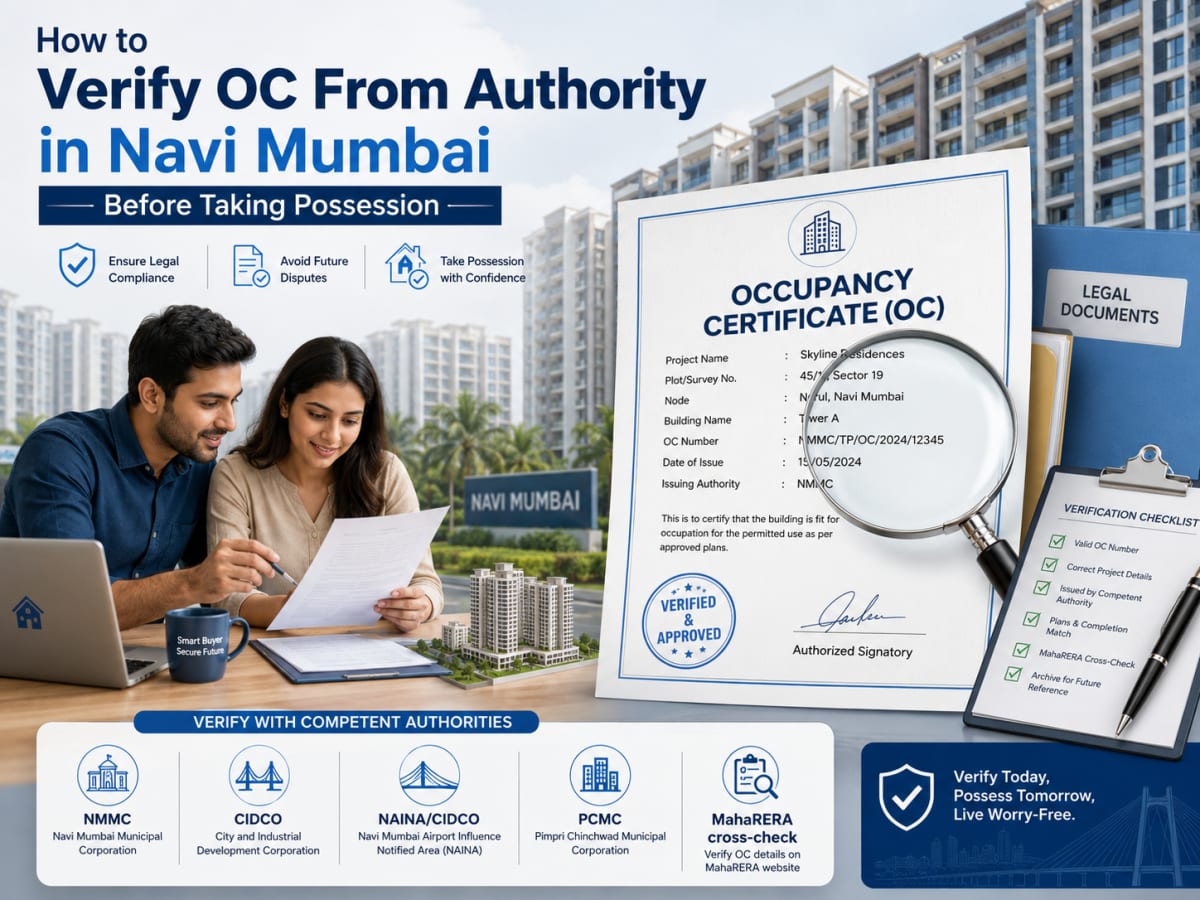
To verify an OC in Navi Mumbai, first collect the Occupancy Certificate copy from the builder, seller, or society. Then match the project name, plot number, wing, floor, phase, and issuing authority. After that, cross-check it with the correct authority such as NMMC, CIDCO, NAINA/CIDCO, PCMC, or the relevant planning authority. For registered projects, also check the MahaRERA project page, but do not treat MahaRERA as the OC issuing authority. In simple words, do not accept possession only because the builder says “OC aa gaya hai.” Verify whether the OC is real, whether it covers your exact flat or wing, and whether it was issued by the correct authority.
Why OC Verification Matters for Navi Mumbai Buyers
In Navi Mumbai, many buyers focus on price, view, carpet area, amenities, and possession date. But one document can quietly decide whether the building is legally ready for occupation: the Occupancy Certificate, commonly called OC. This matters more in Navi Mumbai because the city does not have only one property authority. A flat in Vashi or Nerul may have a different verification route from a property in Kharghar, Panvel, Ulwe, Dronagiri, Taloja, Pushpak Nagar, or NAINA-influence areas. Some properties may involve NMMC. Some may involve CIDCO. Some may fall under NAINA/CIDCO approvals. Some Panvel-side properties may involve PCMC. For registered projects, MahaRERA also becomes an important cross-check. But MahaRERA is not the authority that issues the OC. That is where many buyers get confused. A builder may show a Commencement Certificate and call it “approval.” A seller may show a possession letter and say the building is occupied. A society may have an old photocopy of an OC but not know whether it covers the full building or only one wing. These are common situations, especially in resale flats. The safe approach is simple: before taking possession, paying token money, or buying a resale flat, verify the OC from the correct authority.
What Is an OC in Simple Words?
OC means Occupancy Certificate. It is a certificate issued by the competent authority permitting occupation of a building. Under the Real Estate (Regulation and Development) Act, 2016, an occupancy certificate is issued by the competent authority and permits occupation of a building that has civic infrastructure such as water, sanitation, and electricity. For a homebuyer, OC simply means: The authority has allowed that specific building, wing, tower, or phase to be occupied. But remember one important point. OC does not prove ownership. It does not prove that the seller has clear title. It does not prove that there is no loan, litigation, society dispute, CIDCO transfer issue, or unpaid maintenance. OC is one important approval document. It is not the full property verification. For that reason, OC verification should be connected with your broader Flat Buying Documents Checklist, How to Verify Property Ownership, and Resale Flat Documents Checklist.
OC vs CC in Navi Mumbai: Do Not Confuse These Documents
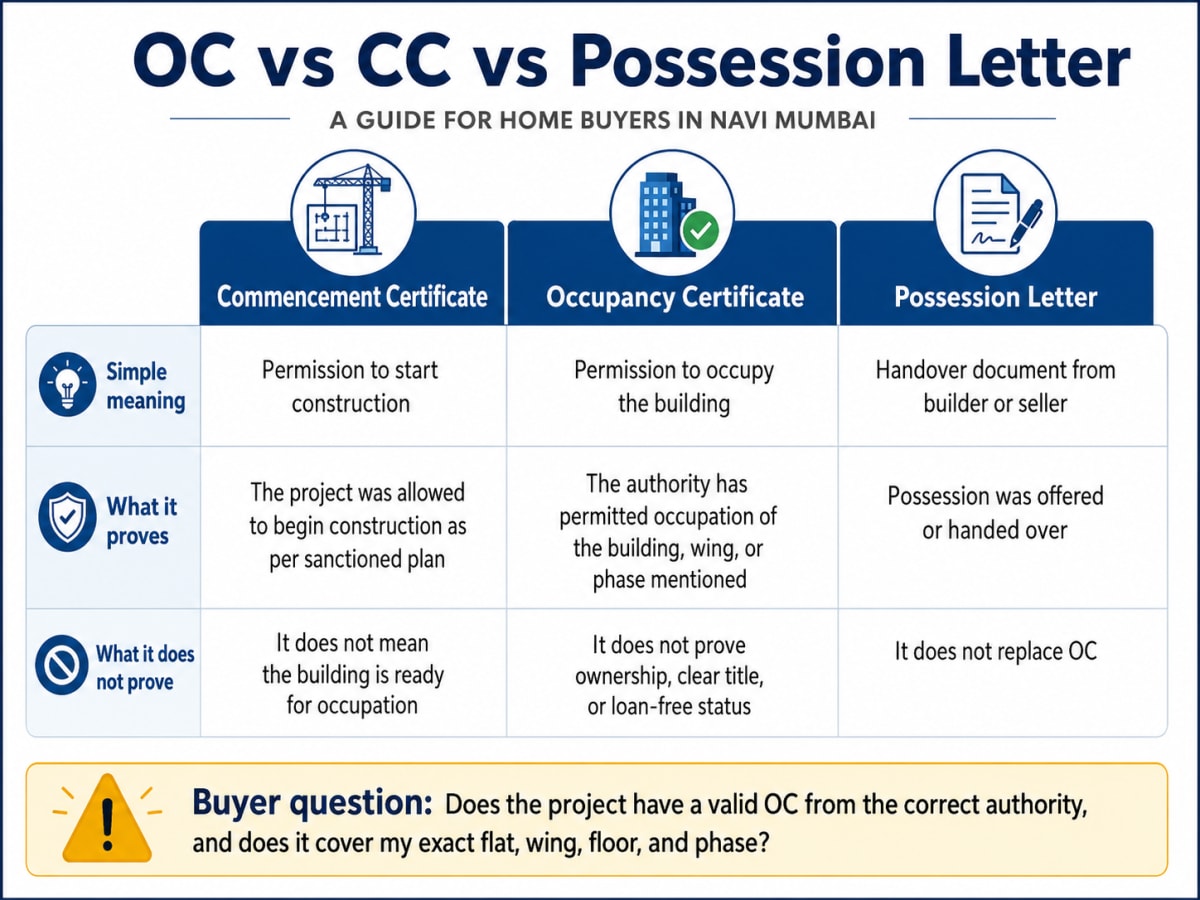
The term “CC” creates confusion because people use it casually in different ways. In many property conversations, CC means Commencement Certificate. But legally, you may also see the term Completion Certificate. These are different from OC.
| DocumentSimple meaningWhat it provesWhat it does not prove | |||
| Commencement Certificate | Permission to start construction | The project was allowed to begin construction as per sanctioned plan | It does not mean the building is ready for occupation |
| Completion Certificate | Certificate that development is completed as per sanctioned plan, layout, and specifications | It supports completion of construction as approved | It is not the same as occupation permission |
| Occupancy Certificate | Permission to occupy the building | The authority has permitted occupation of the building/wing/phase | It does not prove ownership, title, loan-free status, or no future risk |
| Possession Letter | Handover document from builder or seller | Possession was offered or handed over | It does not replace OC |
This is why the final buyer question should not be, “Did the builder get approval?” The better question is: “Does the project have a valid OC from the correct authority, and does it cover my exact flat, wing, floor, and phase?” For a deeper comparison, internally link this section to OC vs CC vs Possession Letter.
Who Issues OC in Navi Mumbai?
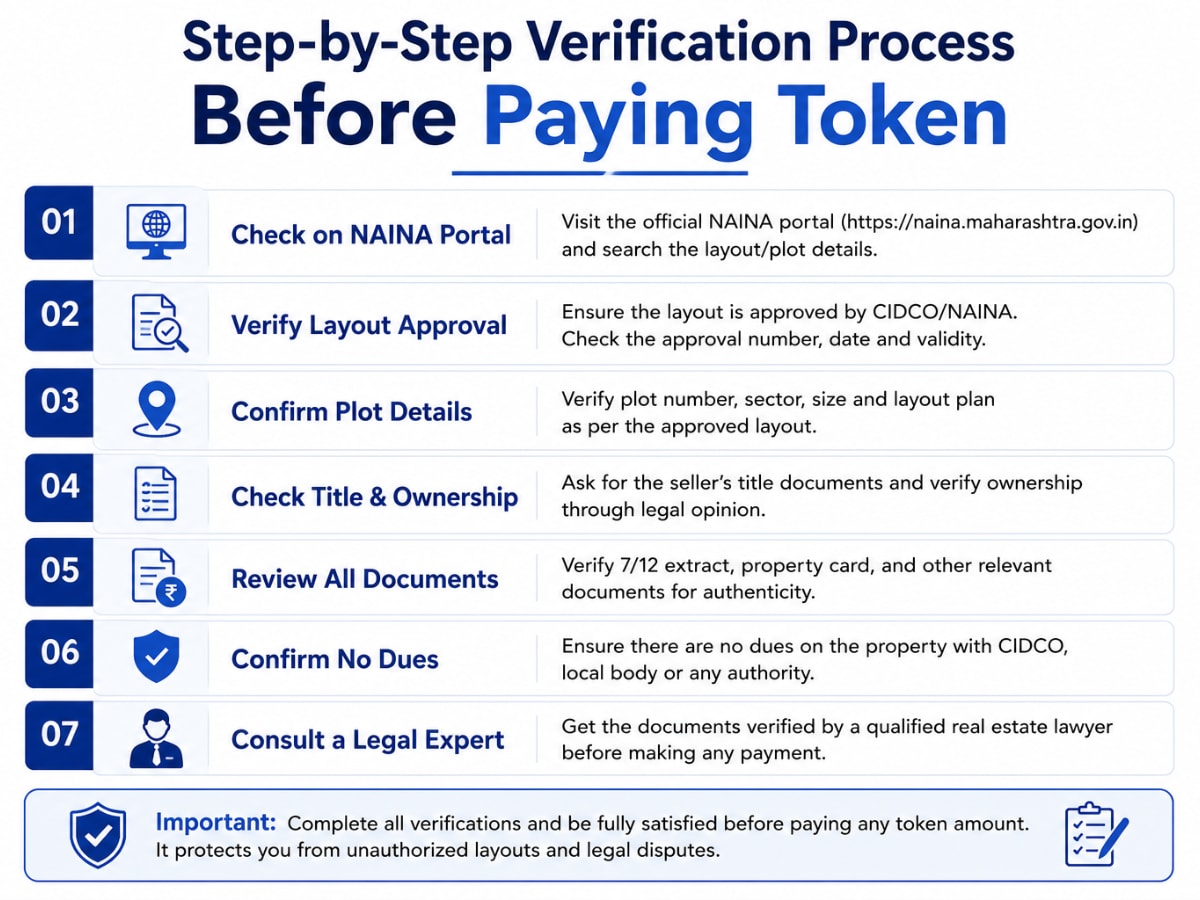
The OC is issued by the competent local or planning authority for that property. The exact authority depends on where the property is located and under whose jurisdiction the building approval was granted. In Navi Mumbai, buyers may need to check one or more of these:
| Authority / platformWhen it may be relevantBuyer’s role | ||
| NMMC | Properties within Navi Mumbai Municipal Corporation limits | Verify OC through NMMC’s official route, Town Planning Department, or ward-level records where applicable |
| CIDCO | CIDCO-developed or CIDCO-controlled areas, leasehold plots, and building permission cases | Check CIDCO Building Permission/COPAS/BPMS references where relevant |
| NAINA / CIDCO | Properties in Navi Mumbai Airport Influence Notified Area | Check NIAMS/NAINA approval records and authority documents |
| PCMC / Panvel authority | Properties in Panvel municipal jurisdiction | Verify with the relevant municipal town planning/building permission department |
| MahaRERA | Registered real estate projects | Cross-check project status, uploaded certificates, complaints, and orders |
| IGR Maharashtra | Registered agreements, sale deeds, Index II, and e-search | Useful for registration and ownership-chain verification, not OC validity |
| Society | Resale flats in cooperative housing societies | Ask for OC copy, society NOC, share certificate, and dues records, but still cross-check authority records |
The most important point: do not verify a Navi Mumbai property through the wrong authority. A Kharghar or Panvel-side buyer should not assume the same route as a Vashi or Nerul buyer. A NAINA property should not be treated like a normal completed society flat inside an older municipal area. A CIDCO leasehold property may also need CIDCO-related document checks apart from OC.
How to Verify OC From Authority in Navi Mumbai
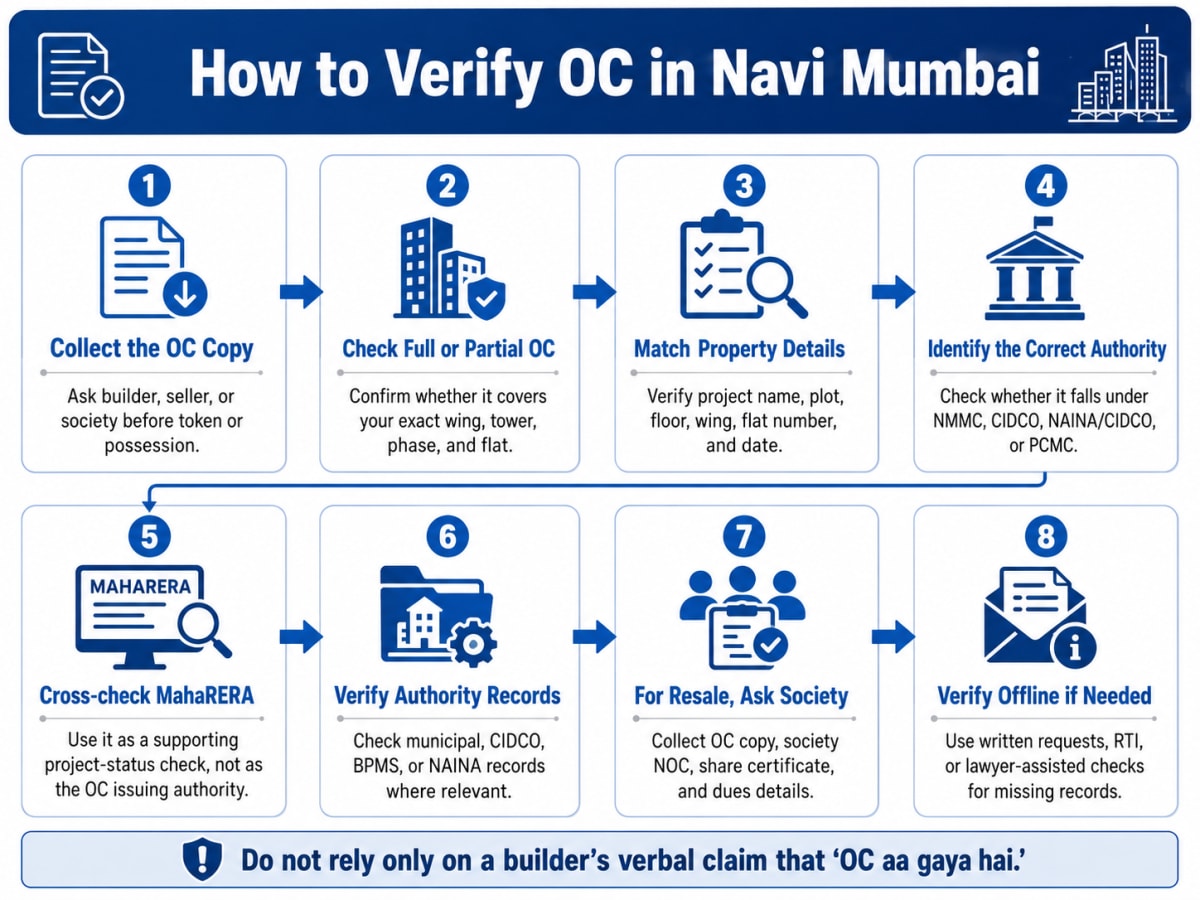
Step 1: Collect the OC copy before possession or token payment
Ask the builder, seller, or society for the OC copy. Do this before paying token money if possible. If the seller says “OC is available but we will give it later,” treat that as a caution point. The OC copy should ideally show the issuing authority name, certificate number or reference number, date of issue, project or building details, plot or sector details, wing or phase details, and whether it is full OC or partial OC.
Step 2: Check whether it is full OC or partial OC
This step is very important in Navi Mumbai’s larger projects. A partial OC may cover only one wing, one tower, one phase, or a specific portion of the project. If your flat is in another wing or phase, that partial OC may not cover your flat. Do not accept a general statement like “project has OC.” Ask: “Does this OC cover my exact building, wing, floor, and flat?”
Step 3: Match the OC with property details
Check whether the OC matches the details in your agreement, sanctioned plan, RERA page, sale deed, society records, and builder documents. Match these details carefully:
| Detail to matchWhy it matters | |
| Project name | Names may vary between marketing name and legal name |
| Plot number / sector | Helps confirm the property location |
| Survey number / gut number / CTS number | Important in land and approval records |
| Building / wing / tower | OC may apply only to a specific wing |
| Floor details | Some approvals may be phase-wise or floor-wise |
| Flat number | Helps connect your unit to the approved building |
| Issuing authority | Confirms whether the correct authority issued it |
| Date and reference number | Needed for official verification |
| Full or partial OC status | Prevents misunderstanding during possession |
If there is a mismatch, do not ignore it. Ask for clarification in writing and verify with the relevant authority or a property lawyer.
Step 4: Identify the correct authority
This is where Navi Mumbai buyers often make mistakes. If the property is under NMMC jurisdiction, check with NMMC’s town planning/building permission route. If it is a CIDCO-related property, check CIDCO’s building permission route. If it is in NAINA influence area, check NIAMS/NAINA records. If it is in Panvel municipal limits, check with PCMC or the relevant local planning authority. Do not assume that a broker, seller, or society committee member knows the correct authority. Ask for the approval letter, building permission reference, and issuing department details.
Step 5: Cross-check the project on MahaRERA, if applicable
If the project is registered under MahaRERA, search the project using the MahaRERA registration number. Check the project profile, uploaded documents, project status, complaints, orders, and any available certificates. But keep this clear: MahaRERA is a cross-check platform for registered real estate projects. It is not the authority that issues the OC. This section should internally link to MahaRERA Project Search.
Step 6: Check CIDCO, NAINA, BPMS, or municipal records where relevant
For CIDCO-related projects, check CIDCO building permission references, COPAS, BPMS, approved cases, or the relevant CIDCO department route. For NAINA projects, check the NIAMS portal and NAINA/CIDCO documents. NIAMS includes owner search and document checklist features, which can help buyers and professionals understand the approval record. For municipal areas, check whether the local body uses BPMS, town planning records, or an offline verification process. Maharashtra’s BPMS portal includes online services such as building permission, revised building permission, part occupancy, and full occupancy building permission.
Step 7: For resale flats, ask society but do not stop there
In a resale flat, the builder may not be easily available. The society becomes the first practical source for documents. Ask the society for the OC copy, society NOC, share certificate, maintenance dues statement, property tax-related records, and any correspondence with the authority. But a society copy alone should not be treated as final proof. If you are buying an older flat in Vashi, Nerul, Seawoods, Kharghar, Koparkhairane, Ghansoli, Airoli, or Belapur, also check whether the building has old OC records, conveyance/deemed conveyance status where relevant, and any pending structural or compliance issue. This section should internally link to Society NOC and Resale Flat Documents Checklist.
Step 8: Check registration records separately through IGR Maharashtra
IGR Maharashtra can help you check registration-related records such as e-search, free search, paid search, sale deed, agreement registration, and Index II. These records are useful for ownership-chain and document verification. But IGR records do not prove that a building has OC. So use IGR for registered document verification, not OC validation.
Step 9: If OC is not found online, verify offline
Not every OC record may be easy to verify online. Some older buildings or authority records may require an offline application, written request, RTI route, ward office visit, town planning department visit, or lawyer-assisted document search. If the amount involved is high, do not depend on a WhatsApp PDF or broker assurance. Get written confirmation or a certified copy from the relevant authority wherever possible.
New Flat vs Resale Flat: How OC Verification Changes
OC checking is different for a new flat and a resale flat.
| PointNew flat / under-construction projectResale flat | ||
| Main source | Builder and authority records | Seller, society, and authority records |
| RERA check | Usually important if project is registered | May be relevant if project was recently completed or registered |
| OC risk | Builder may offer possession before OC or with partial OC | Society may have old/incomplete/missing OC records |
| Key question | Can the builder legally hand over this flat for occupation? | Does this building/society have valid OC records and clean resale paperwork? |
| Extra checks | Sanctioned plan, revised plan, CC, OC, RERA status | OC, society NOC, share certificate, dues, sale deed chain, IGR records |
| Buyer caution | Do not accept fit-out possession blindly | Do not assume “people are living here” means documents are complete |
For resale flats, OC is only one part of the verification. You still need to check ownership chain, society records, loan status, property tax dues, maintenance dues, and registered documents. For new flats, the biggest caution is possession without OC or possession based on partial OC that does not cover your flat.
What OC Does Not Prove
This section is important because many buyers overestimate OC. OC does not prove that the seller is the legal owner. It does not prove that the title is clear. It does not prove that the flat is loan-free. It does not prove that there is no court case. It does not prove that CIDCO transfer is complete. It does not prove that society dues are paid. It does not prove that all future risks are gone. OC only supports one important point: the competent authority has permitted occupation of the building, wing, phase, or portion mentioned in that certificate. So never say, “OC hai toh sab safe hai.” A better approach is: “OC is available. Now we must cross-check ownership, society records, registered documents, dues, and authority-specific approvals.” This section should internally link to How to Verify Property Ownership.
Documents Checklist Before Taking Possession or Buying Resale
| DocumentWhy to check it | |
| Occupancy Certificate | Confirms authority permission for occupation of the specified building/wing/phase |
| Commencement Certificate | Confirms permission to start construction as per sanctioned plan |
| Completion Certificate | Helps check whether construction was completed as approved |
| Sanctioned building plan | Helps match approved floors, wing, layout, and usage |
| Revised sanctioned plan | Important if the project changed during construction |
| MahaRERA project details | Useful for project status, uploaded documents, complaints, and orders |
| Agreement for sale / sale deed | Core ownership and transaction document |
| Index II / registration record | Helps verify registered transaction details |
| Society NOC | Important in resale transactions |
| Share certificate | Important for society membership and resale flats |
| Maintenance dues statement | Helps avoid hidden dues |
| Property tax records | Helps check municipal dues |
| CIDCO transfer documents, if applicable | Important for CIDCO leasehold properties |
| NAINA approval documents, if applicable | Important for NAINA-area properties |
| Loan closure / NOC, if applicable | Needed if seller had a home loan |
| Written token terms | Protects buyer before payment |
Do not pay token money only because the flat looks attractive or the price feels below market. In Navi Mumbai, a slightly cheaper flat with unclear OC or title documents can become expensive later.
Red Flags Buyers Should Not Ignore
A missing OC does not automatically mean every property is a fraud. But it does mean the buyer must slow down and verify properly. Be careful if the builder offers only fit-out possession and says OC will come later. Be careful if the seller shows only a Commencement Certificate and calls it OC. Be careful if the OC is partial but your flat is in a different wing or phase. Also be careful if the OC copy does not show a clear authority name, reference number, date, or project details. If the project name, plot number, wing, floor, or phase does not match your agreement, do not treat it as a small spelling issue without verification. For resale flats, one common risk is this: the society says the building has OC, but nobody has checked whether the available copy is complete, whether it covers the full building, or whether the issuing authority can confirm it. Another red flag is pressure. If the broker or seller says, “Pay token today, documents baad mein dekh lenge,” step back. Document verification should happen before emotional commitment.
Local Navi Mumbai Example
Suppose a buyer is looking at a resale flat in an older society in Nerul. The seller says the building is occupied for many years and there is no issue. The society gives a photocopy of an OC, but the copy does not clearly show the wing details. In this case, the buyer should not reject the flat immediately, but should also not blindly proceed. The buyer should ask for a clearer OC copy, match it with the building and flat details, check society NOC and dues, verify registered sale documents through IGR Maharashtra, and if needed, verify the OC with the relevant authority. A practical buyer does not panic. A practical buyer verifies.
Common Mistakes Buyers Make
Many buyers check the flat but not the file. They inspect the view, flooring, kitchen, parking, and amenities, but they do not check whether the building has valid OC for their specific wing. Another mistake is trusting only the broker’s statement. A broker may not always know the legal difference between Commencement Certificate, Completion Certificate, Occupancy Certificate, and Possession Letter. Some buyers also assume that if banks are giving loans, all documents must be perfect. Bank due diligence helps, but it should not replace your own verification and lawyer review. Resale buyers often make one more mistake. They assume that if many families are already living in the building, OC must be available. Occupation and legal occupation are not the same thing.
Final Buyer Checklist Before Possession
Before taking possession or buying a resale flat in Navi Mumbai, check these points:
| CheckpointBuyer action | |
| OC copy received | Ask builder/seller/society for copy |
| Issuing authority clear | Confirm whether it is NMMC, CIDCO, NAINA/CIDCO, PCMC, or another authority |
| Full or partial OC | Check whether it covers your exact wing/phase |
| Flat details match | Match project, plot, wing, floor, and flat |
| MahaRERA checked | Search project if registered |
| Sanctioned plan checked | Match OC with approved plan |
| Society records checked | Required for resale flats |
| IGR records checked | Verify registered documents separately |
| Dues checked | Check maintenance, property tax, and loan dues |
| Lawyer review done | Recommended before high-value payment |
| Token terms written | Token should be conditional on document verification |
FAQs
1. How do I verify OC from authority in Navi Mumbai?
1. How do I verify OC from authority in Navi Mumbai?
Collect the OC copy, identify the correct authority, match property details, and verify through the relevant authority route such as NMMC, CIDCO, NAINA/CIDCO, PCMC, or the concerned planning authority. For registered projects, also check MahaRERA as a supporting cross-check.
2. Is MahaRERA the issuing authority for OC?
2. Is MahaRERA the issuing authority for OC?
No. MahaRERA is not the OC issuing authority. OC is issued by the competent local or planning authority. MahaRERA can help you check project registration, uploaded documents, complaints, orders, and project status.
3. What is the difference between OC and Commencement Certificate?
3. What is the difference between OC and Commencement Certificate?
A Commencement Certificate allows construction to begin as per sanctioned plans. OC allows occupation of the building or specific portion mentioned in the certificate. A building can have commencement approval but still not have OC.
4. What is the difference between OC and Completion Certificate?
4. What is the difference between OC and Completion Certificate?
A Completion Certificate supports that the construction has been completed as per sanctioned plans and specifications. OC permits occupation. Buyers should not treat both as the same.
5. Can I take possession without OC?
5. Can I take possession without OC?
Do not take possession only on verbal assurance or only on a possession letter. If OC is not available, verify the reason with the relevant authority and consult a property lawyer before deciding.
6. Is partial OC safe?
6. Is partial OC safe?
Partial OC may be acceptable only if it covers your exact building, wing, phase, floor, and flat. If the partial OC is for another wing or phase, it should not be treated as OC for your flat.
7. How do I verify OC for a resale flat?
7. How do I verify OC for a resale flat?
Ask the seller and society for the OC copy, society NOC, share certificate, dues statement, and registered document chain. Then cross-check the OC with the issuing authority wherever possible.
8. Does OC prove ownership?
8. Does OC prove ownership?
No. OC does not prove ownership. Ownership should be verified through sale deed, chain documents, Index II, society records, loan status, title search, and legal review.
9. What if the builder says OC is applied for?
9. What if the builder says OC is applied for?
Ask for written proof and verify the status from the relevant authority. Do not rely only on verbal statements before possession or major payment.
10. What should I check before paying token money?
10. What should I check before paying token money?
Before token money, check seller identity, ownership chain, OC, CC, sanctioned plan, MahaRERA status if applicable, society records, dues, loan status, registered documents, CIDCO/NAINA approvals if applicable, and written refund terms .