CBD Belapur Property Document Checklist for Buyers
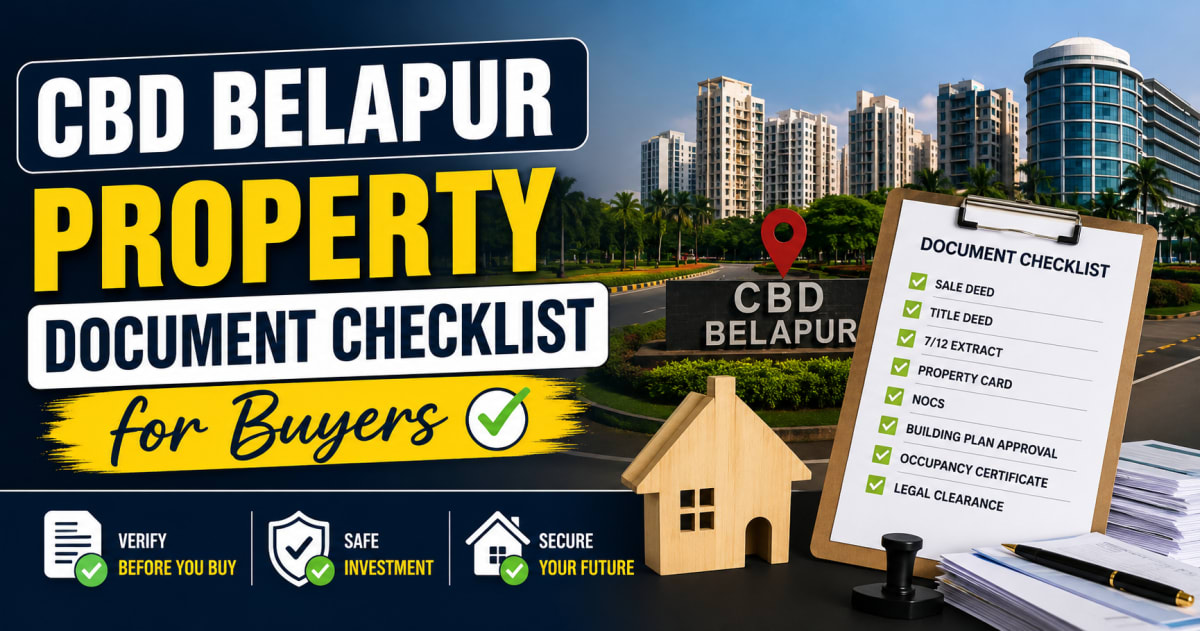
CBD Belapur is one of Navi Mumbai’s most established residential, commercial and administrative locations. It has suburban railway connectivity, Navi Mumbai Metro access, CIDCO Bhavan, the NMMC headquarters and a large office ecosystem. These factors make CBD Belapur attractive to homebuyers, investors and commercial-property buyers. But a strong location does not automatically mean that every property has clear documents. Before paying token money, you need to check the seller’s ownership, CIDCO records, building approvals, Occupancy Certificate, society documents and registration history. This CBD Belapur property document checklist explains every important check in simple English.
Quick Answer
Before buying property in CBD Belapur, check these seven document groups:
- Seller and ownership documents
- Registered agreements and Index II records
- CIDCO allotment, lease and transfer records
- NMMC building approvals and Occupancy Certificate
- MahaRERA project information
- Society documents and outstanding dues
- Existing loan, litigation and physical alteration records
Do not rely only on a broker’s assurance, society NOC, property-tax bill, home-loan approval or photocopied agreement. The documents should match the actual flat, seller, building, wing, floor, plot and approved use.
CBD Belapur Property Documents at a Glance
| Document group | Main purpose | Where to verify |
| Registered agreement | Shows the recorded property transaction | IGR Maharashtra and original documents |
| Title chain | Shows how ownership passed between parties | Registered documents and legal title search |
| Index II | Summarises a registered transaction | IGR Maharashtra |
| CIDCO allotment and lease records | Shows original allotment and lease conditions | CIDCO |
| Sanctioned building plan | Shows approved construction | NMMC or the competent planning authority |
| Occupancy Certificate | Permits occupation of the approved building portion | Issuing planning authority |
| MahaRERA documents | Shows registered project and promoter disclosures | MahaRERA |
| Share certificate | Shows society membership linked to the flat | Cooperative housing society |
| Society dues letter | Shows pending maintenance or special charges | Society |
| Loan-release documents | Shows whether an existing mortgage has been cleared | Seller’s lender and registered records |
| Property-tax records | Shows municipal assessment and dues | NMMC |
| Structural records | Helps assess an older building’s condition | Society, NMMC and registered structural engineer |
Why Document Verification Matters in CBD Belapur

CBD Belapur has more than one type of property. You may find:
- Older cooperative housing societies
- CIDCO-built flats
- Private buildings on CIDCO-allotted plots
- Redeveloped societies
- New residential towers
- Commercial office buildings
- Mixed-use properties
- Shops and offices near the station
- Properties with multiple ownership transfers
The required documents can differ based on the property’s age, original allotment, planning authority, current use and transaction history. For example, a resale flat in an older CIDCO-linked society may require a different verification process from an under-construction MahaRERA-registered tower. That is why a generic “sale deed plus society NOC” check is not enough.
First Identify What Type of Property You Are Buying
Before collecting documents, classify the property.
| Property type | Additional checks required |
| Under-construction flat | MahaRERA, sanctioned plans, project phase and completion timeline |
| Ready-to-move builder flat | OC, unsold inventory ownership and builder dues |
| Resale society flat | Title chain, share certificate, society dues and alterations |
| CIDCO-built property | Original allotment and transfer history |
| Private building on CIDCO land | Lease deed, CIDCO conditions and building approvals |
| Redevelopment property | Development agreement, member entitlement and revised approvals |
| Commercial office | Approved commercial use, fire compliance, parking and fit-out permission |
| Tenanted property | Tenancy agreement, deposit, possession and termination terms |
Identifying the property type helps you avoid asking for the wrong documents or missing an important approval.
1. Check the Seller’s Identity and Right to Sell
Start with the person offering the property for sale. Ask for:
- PAN card
- Aadhaar card or another valid identity document
- Address proof
- Registered purchase agreement
- Original allotment document, where relevant
- Share certificate
- Recent property-tax record
- Society maintenance bill
The name on the identity document should match the name appearing in the ownership documents.
Check all co-owners
If the agreement names two or more owners, every co-owner should normally participate in the transaction or give legally valid authority to another person. Do not accept statements such as:
“My brother’s name is there, but he does not need to sign.” The authority to sell must be supported by proper documents.
When the seller is using a Power of Attorney
Ask for the complete Power of Attorney, not only the signature page. Check:
- Who granted it
- Who received it
- Whether it covers the exact property
- Whether it permits sale and registration
- Whether it is registered where legally required
- Whether it remains valid
- Whether the person who granted it is alive
A Power of Attorney should be reviewed by a property lawyer before the agreement is signed.
When the original owner has died
Ask for documents that establish who can legally deal with the property. Depending on the situation, these may include:
- Death certificate
- Will
- Probate, where applicable
- Legal-heir or succession-related documents
- Release deed
- Family settlement
- Society transmission records
A society nomination does not always settle every ownership or inheritance question.
2. Build the Complete Ownership Chain
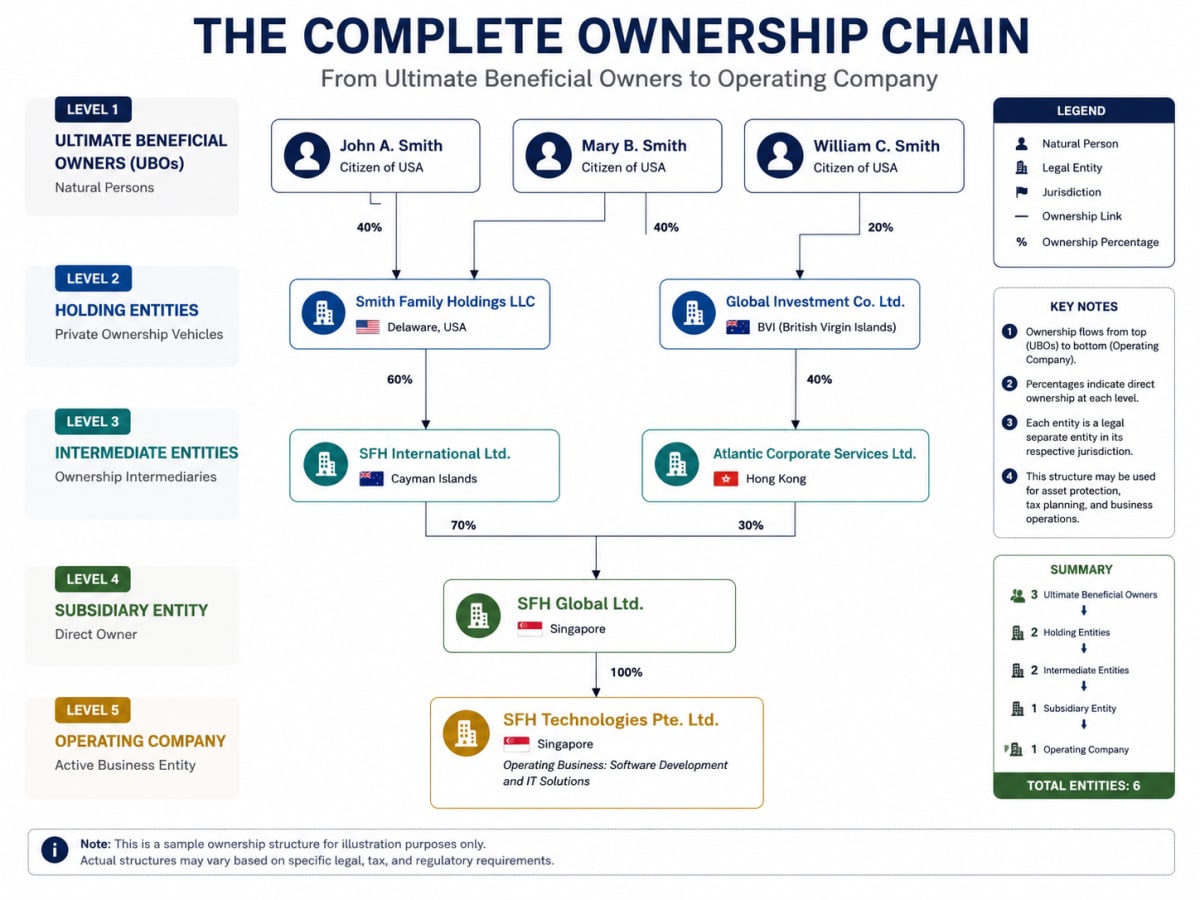
The ownership chain shows how the property moved from the original allottee or first buyer to the present seller. For example:
- CIDCO or builder allotted the flat to Buyer A.
- Buyer A sold it to Buyer B.
- Buyer B sold it to the current seller.
- The current seller is now selling it to you.
You should collect the registered document for each transfer.
What to match in every agreement
Check whether these details remain consistent:
- Flat number
- Building name
- Wing
- Floor
- Sector
- Plot number
- Carpet or built-up area
- Parking description
- Buyer and seller names
- Registration details
- Property use
A missing link in the ownership chain needs an explanation. Read our guide on How to Verify Property Ownership before relying only on the current seller’s agreement.
3. Check the Registered Agreement and Index II
The registered agreement is one of the main transaction documents. It records information such as:
- Buyer and seller
- Property description
- Consideration amount
- Payment terms
- Rights being transferred
- Registration details
- Stamp duty
Check the registration details through Maharashtra’s Department of Registration and Stamps where the required record is available.
What is Index II?
Index II is a summary generated from a registered property document. It normally contains important details such as:
- Buyer’s name
- Seller’s name
- Property description
- Registration number
- Date
- Consideration
- Stamp-duty information
However, Index II is not the complete agreement. It does not contain every clause, declaration, restriction or obligation recorded in the full document. Use Index II to support verification, but read the complete registered agreement.
Common Index II mismatches
Pause the transaction if:
- Seller’s name differs
- Flat number is incorrect
- Building or wing differs
- Area differs significantly
- Registration number cannot be confirmed
- Previous transaction is missing
- Property description is incomplete
Small clerical differences may sometimes be explainable, but they should not be ignored.
4. Check Whether the Property Is CIDCO-Linked
CIDCO developed Navi Mumbai and allotted many plots and properties across its planned nodes. CBD Belapur also houses CIDCO Bhavan, CIDCO’s headquarters. CIDCO has historically played an important role in the development and land structure of Navi Mumbai. However, you should not assume that every CBD Belapur property has the same CIDCO status. A property may be:
- Directly allotted by CIDCO
- Built by CIDCO
- Constructed by a private developer on CIDCO-allotted land
- Held under a lease
- Transferred multiple times
- Conveyed to a society
- Claimed to have been converted to freehold
Each situation requires different records.
CIDCO Documents to Check
Where applicable, ask for:
- CIDCO allotment letter
- Agreement to lease
- Final lease deed
- Possession receipt
- Transfer permission
- Transfer order
- CIDCO no-dues record
- Estate or service-charge statement
- Mortgage permission, where applicable
- Change-of-use approval
- Conveyance document
- Freehold-conversion document, if claimed
- Correspondence about breaches or pending dues
Do not accept a verbal freehold claim
A seller or broker may say:
“The property is now freehold.” Ask for the official order or document showing that the specific property was converted. A general government announcement or policy discussion does not prove that an individual flat or plot has completed the conversion process. CIDCO’s lease, transfer and conversion procedures may change. Check the latest position directly through CIDCO and have the property file reviewed professionally.
5. Verify the Sanctioned Building Plan
The sanctioned plan shows what the planning authority approved for construction. It can help you confirm:
- Building location
- Approved number of floors
- Wing configuration
- Flat layout
- Approved use
- Parking areas
- Common areas
- Refuge areas
- Terraces
- Commercial spaces
Compare the plan with the flat you are physically inspecting.
Watch for unauthorised alterations
Common changes may include:
- Enclosed balconies
- Covered terraces
- Combined flats
- Removed internal walls
- Converted common passages
- Lofts or mezzanine levels
- Commercial use in residential premises
- Parking converted into storage
- Refuge area used for another purpose
Not every internal change has the same legal effect. An architect should examine any material difference between the approved plan and current premises. Read our detailed guide on Building Plan Approval before finalising the property.
6. Check the Commencement Certificate and Occupancy Certificate
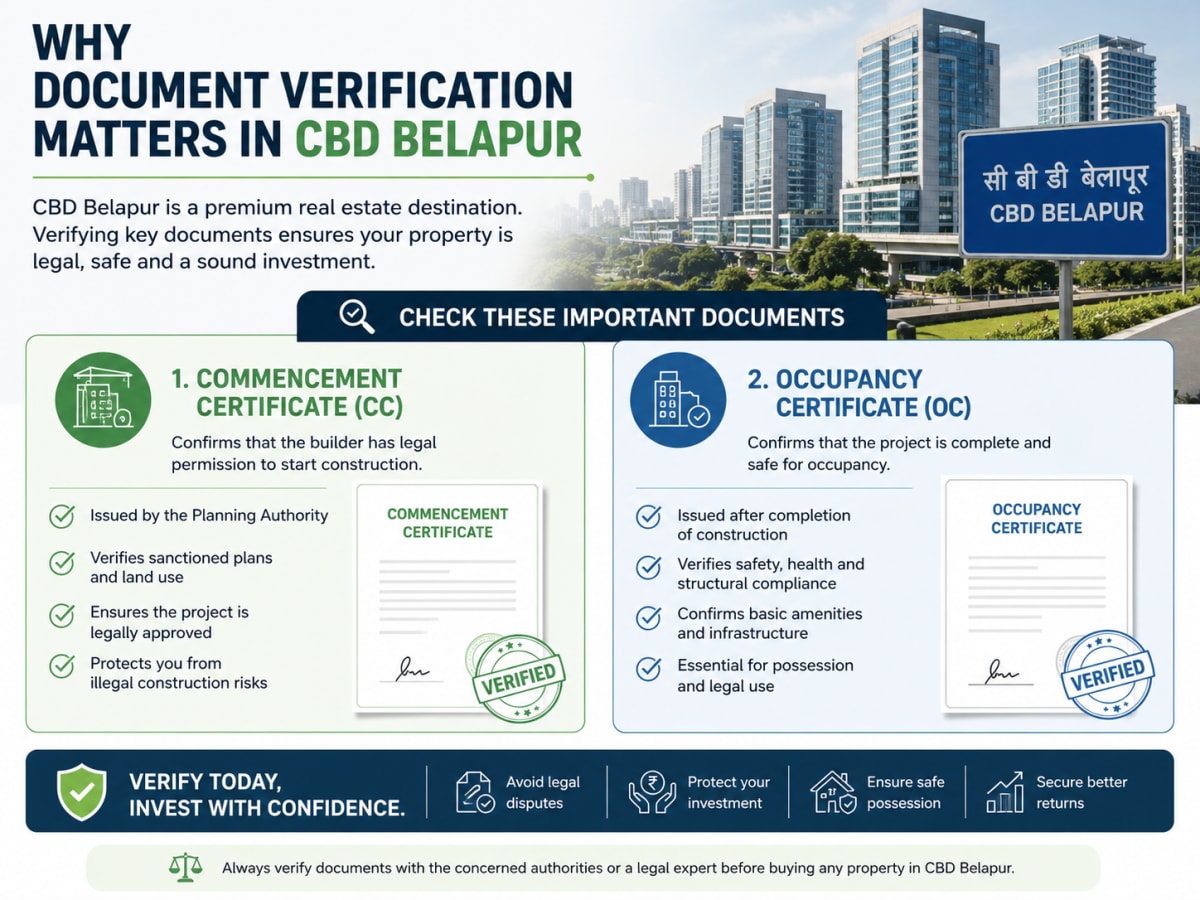
A Commencement Certificate and an Occupancy Certificate serve different purposes.
| Document | Simple meaning |
| Commencement Certificate | Allows approved construction to begin or continue |
| Completion-related document | Records completion under the applicable process |
| Occupancy Certificate | Permits occupation of the approved building or portion |
| Possession letter | Records handover by the builder or seller |
A possession letter does not replace an Occupancy Certificate. Read OC vs CC vs Possession Letter for a complete comparison.
What to Check in the Occupancy Certificate
Ask for the complete OC, including:
- All pages
- Certificate number
- Issue date
- Building details
- Plot details
- Wing
- Floors covered
- Conditions
- Schedules
- Annexures
- Revised certificates
Confirm that the OC covers your exact wing and floor. A partial OC for one wing or lower floors may not cover another wing or an upper-floor flat. In June 2025, NMMC was reported to have identified 2,111 buildings within its jurisdiction that had commencement permissions but did not have Occupancy Certificates in municipal records. This is a practical reminder that physical occupation alone does not prove that a building has an OC.
7. Verify the Project on MahaRERA
For an under-construction or registered project, search the official MahaRERA portal. Check:
- Project registration number
- Promoter’s legal name
- Project name
- Registered phase
- Building and wing details
- Approved plans
- Declared completion date
- Extension information
- Quarterly progress updates
- Uploaded OC or completion records
- Complaints and orders
Use our MahaRERA Project Search guide to check the correct project and phase.
MahaRERA registration is not a complete legal clearance
A MahaRERA registration is an important starting point, but it should not be treated as proof that:
- The seller has clear title
- Every approval is valid
- The exact flat matches the sanctioned plan
- There is no mortgage
- The building has a full OC
- There are no disputes
Compare the MahaRERA disclosures with the original documents and authority records.
8. Check the Society Documents
A society’s records are especially important for resale properties. Ask for:
- Society registration certificate
- Original share certificate
- Membership details
- Maintenance no-dues letter
- Special-repair dues
- Sinking-fund liabilities
- Transfer forms
- Nomination details
- Parking record
- Society correspondence relating to the flat
- Building OC and sanctioned plan
- Conveyance or deemed-conveyance records
- Redevelopment discussions
- Pending litigation
- Alteration complaints
What does a share certificate prove?
A share certificate shows that the holder is recorded as a member of the cooperative society in connection with the stated shares and flat. It is an important society document. However, it does not replace:
- Registered ownership documents
- Title-chain verification
- CIDCO records
- Building approvals
- OC verification
What does a Society NOC prove?
A Society NOC may confirm matters such as:
- The society’s awareness of the transfer
- Maintenance-dues status
- Membership or transfer procedure
- No objection under the stated circumstances
Its exact value depends on the wording. Read our guide on Society NOC to understand what the document proves and what it does not prove.
9. Check Property Tax and Municipal Records
Ask for:
- Latest property-tax bill
- Recent payment receipt
- Assessment number
- Name in the municipal record
- Pending arrears
- Municipal notices
- Approved property use
Property-tax records are useful supporting documents. But payment of property tax does not by itself prove:
- Ownership
- Clear title
- Valid OC
- Sanctioned construction
- Approved alterations
The municipal record should be compared with the registered agreement, society records and building approvals.
10. Check for an Existing Home Loan or Mortgage
A seller may have purchased the flat using a home loan. In that case, the lender may hold the original property documents. Ask for:
- Loan account details
- Outstanding loan statement
- Lender’s document list
- Foreclosure statement
- No-dues certificate after repayment
- Release or satisfaction documents where applicable
- Confirmation of how the lender will hand over originals
Do not pay the full amount directly to the seller without understanding how the existing loan will be closed. The agreement should clearly state:
- Amount payable to the lender
- Amount payable to the seller
- Date of loan closure
- Delivery of original documents
- Consequences if the lender does not release its charge
11. Check for Litigation and Other Claims
A property can be affected by more than a bank mortgage. Possible claims may include:
- Family dispute
- Inheritance dispute
- Society litigation
- Builder-society dispute
- Court attachment
- Government acquisition issue
- CIDCO breach notice
- Municipal action
- Tenant claim
- Development or redevelopment dispute
A property lawyer should conduct a title search suitable for the property type and transaction history. Do not rely only on a seller’s statement that “there is no case.” Ask for a written declaration in the agreement and verify the available records.
12. Check the Physical Flat Against the Documents
Document verification should include a physical inspection. Carry the approved floor plan or agreement plan during the visit. Check:
- Flat number
- Floor
- Wing
- Room layout
- Carpet area
- Balcony
- Terrace
- Parking
- Common passage
- Loft or mezzanine
- Commercial or residential use
Carpet area differences
Small measurement differences may arise from measurement methods, finishes or document history. A material difference should be examined by an architect and addressed in the agreement. Do not depend only on the area mentioned in a property advertisement.
CBD Belapur Resale Flat Document Checklist
Resale buyers should collect the following.
Ownership documents
- [ ] Current seller’s registered agreement
- [ ] Complete chain of previous agreements
- [ ] Index II for registered transactions
- [ ] Seller’s identity documents
- [ ] Original allotment document
- [ ] Power of Attorney, if applicable
- [ ] Inheritance documents, if applicable
- [ ] Loan-closure documents
- [ ] Title-search report
CIDCO documents, where applicable
- [ ] Allotment letter
- [ ] Agreement to lease
- [ ] Lease deed
- [ ] Transfer order
- [ ] CIDCO dues statement
- [ ] Mortgage permission
- [ ] Conveyance record
- [ ] Freehold-conversion order, if claimed
Building documents
- [ ] Sanctioned plan
- [ ] Commencement Certificate
- [ ] Occupancy Certificate
- [ ] Revised OC, where applicable
- [ ] Revised sanctioned plans
- [ ] Structural records for an older building
- [ ] Fire and lift records where relevant
Society documents
- [ ] Share certificate
- [ ] Membership confirmation
- [ ] Maintenance no-dues letter
- [ ] Special-repair dues
- [ ] Parking record
- [ ] Society transfer forms
- [ ] Conveyance status
- [ ] Redevelopment information
- [ ] Litigation disclosure
- [ ] Alteration complaint record
Use our complete Resale Flat Documents Checklist before preparing the resale agreement.
CBD Belapur Under-Construction Property Checklist
For an under-construction flat, focus on the project and promoter. Check:
- [ ] MahaRERA registration
- [ ] Correct project phase
- [ ] Promoter’s legal name
- [ ] Title report uploaded on MahaRERA
- [ ] Sanctioned plans
- [ ] Commencement Certificate
- [ ] Approved number of floors
- [ ] Declared completion date
- [ ] Extension history
- [ ] Draft Agreement for Sale
- [ ] Carpet area
- [ ] Payment schedule
- [ ] Parking terms
- [ ] Possession terms
- [ ] Cancellation and refund clauses
- [ ] Promised amenities
- [ ] OC requirement before final possession
- [ ] Home-loan and mortgage disclosures
Do not depend only on a brochure, sample flat or verbal possession date. The registered agreement and official project records should support the sales promises.
CBD Belapur Commercial Property Checklist
CBD Belapur has a large office and institutional market. For a commercial office, add these checks:
- Approved commercial use
- OC coverage for the premises
- Fire-related compliance where applicable
- Lift records
- Parking rights
- Fit-out permission
- Signage permission
- Society or condominium restrictions
- Maintenance charges
- Property-tax classification
- Existing tenancy
- Tenant deposit
- Lease termination terms
- Electricity load
- Operating-hour restrictions
- Permission for the intended business activity
A property being physically used as an office does not automatically prove that the use is approved.
Older Building and Structural Checks
CBD Belapur has several established buildings and societies. For an older building, ask about:
- Structural audit
- Major repair history
- Water leakage
- Concrete deterioration
- Lift replacement
- Fire systems
- Plumbing replacement
- Terrace waterproofing
- Special repair contributions
- Dangerous-building notices
- Redevelopment discussions
In November 2025, NMMC reportedly stated that buildings in use for more than 30 years were required to undergo structural audits under the relevant municipal provisions. The report also said NMMC had identified 513 dangerous buildings. Ask for the latest official NMMC notice and building-specific audit record rather than relying only soon the building’s age.
Why CBD Belapur Continues to Attract Property Buyers
CBD Belapur has several location advantages:
- Suburban railway connectivity
- Navi Mumbai Metro connectivity
- CIDCO headquarters
- NMMC headquarters
- Government and institutional offices
- Commercial buildings
- Access toward Nerul, Seawoods, Kharghar and Panvel
- Established schools, hospitals and markets
These factors can support residential, rental and office demand. But demand should not be confused with legal safety. A property near the station may still have:
- Incomplete title documents
- Pending CIDCO transfer
- Missing OC
- Society disputes
- Unauthorised alterations
- Existing mortgage
- Commercial-use restrictions
Location helps you shortlist a property. Documents help you decide whether to proceed. A separate supporting guide should explain CBD Belapur Property Demand: How Station, CIDCO and Government Offices Affect It in more detail.
Red Flags That Should Make You Pause
| Red flag | Why it matters |
| Seller refuses to show original documents | Ownership or mortgage details may be unclear |
| One agreement is missing from the title chain | Ownership transfer may be incomplete |
| Seller’s name differs across records | Identity or ownership needs clarification |
| CIDCO lease deed is unavailable | Lease rights and conditions cannot be confirmed |
| Freehold status is only verbally claimed | Property-specific conversion may not be complete |
| OC does not cover the purchased floor | Occupation approval may be incomplete |
| Flat differs materially from the plan | Alterations may not be approved |
| Share certificate has incorrect details | Society records may be incomplete |
| Society refuses dues confirmation | Financial liabilities may remain |
| Existing loan is not disclosed clearly | Lender may hold the original documents |
| Large non-refundable token is demanded | Buyer may lose money before verification |
| Broker says bank approval is enough | Bank checks do not replace buyer due diligence |
| Premium location is used as proof of safety | Location and legal status are separate issues |
A red flag does not always mean that the transaction must be rejected. It means the buyer should pause, collect the missing information and obtain professional advice before proceeding.
Common Mistakes Buyers Make
Mistake 1: Checking only the latest agreement
The latest agreement does not show whether the earlier ownership chain is complete. Collect the previous registered documents.
Mistake 2: Treating Index II as a title certificate
Index II is a useful transaction summary. It is not a complete legal opinion on ownership.
Mistake 3: Assuming every CBD Belapur property has the same CIDCO rules
CIDCO requirements can differ based on allotment type, lease conditions, transfer history and later government policies.
Mistake 4: Believing a Society NOC proves everything
A Society NOC does not replace title, OC, sanctioned-plan or mortgage verification.
Mistake 5: Depending only on MahaRERA
MahaRERA is essential for registered projects, but authority records and transaction documents must also be checked.
Mistake 6: Ignoring physical alterations
The papers may describe one layout while the actual flat contains enclosed balconies, terraces or combined areas.
Mistake 7: Assuming bank approval removes all risk
A bank follows its internal lending policy. Its approval is not a guarantee of perfect title or building compliance.
Mistake 8: Paying token money before seeing the file
Complete the main checks before paying a large or non-refundable token.
Final Buyer Checklist Before Paying Token Money
Confirm the following:
- [ ] I have verified the seller’s identity
- [ ] All co-owners are participating
- [ ] The ownership chain is complete
- [ ] Registered agreements and Index II details match
- [ ] Original documents are available or held by a known lender
- [ ] CIDCO allotment and lease records have been checked where applicable
- [ ] CIDCO transfer and dues status are clear
- [ ] Freehold status is supported by a property-specific document
- [ ] The sanctioned plan covers the flat
- [ ] The OC covers the correct wing and floor
- [ ] MahaRERA details have been checked where applicable
- [ ] Society share certificate details match
- [ ] Society maintenance and special dues are known
- [ ] Parking terms are documented
- [ ] Property-tax dues have been checked
- [ ] Existing mortgage is being properly closed
- [ ] The physical flat matches the approved records
- [ ] Material alterations have been reviewed
- [ ] Litigation and claims have been checked
- [ ] The draft agreement records all important protections
- [ ] Token refund terms are written clearly
- [ ] A property lawyer has reviewed high-risk or unclear issues
Should You Buy When One Document Is Missing?
It depends on the document and why it is missing. A recent maintenance receipt may be easy to obtain. A missing ownership agreement, unclear lease deed, absent OC or disputed succession record requires more serious examination. Use this simple approach:
| Finding | Recommended action |
| Minor supporting record missing | Ask the seller to obtain it |
| Certified copy is available | Verify it through the issuing authority |
| Ownership-chain document missing | Pause and obtain legal review |
| CIDCO status unclear | Verify directly with CIDCO |
| OC does not cover the flat | Do not assume approval |
| Existing mortgage not explained | Confirm the lender-led closure process |
| Seller refuses verification | Treat it as a serious warning |
| Multiple records conflict | Do not pay a non-refundable token |
The goal is not to create fear. It is to make the transaction clear before your money is committed.
Get the Property File Checked Before You Buy
A CBD Belapur property may involve registered agreements, CIDCO records, NMMC approvals, MahaRERA disclosures, society documents and physical-plan verification. Navi Mumbai Property Deals follows a buyer-first approach. Before paying token money, collect the complete property file, identify missing documents and verify important records through the relevant authorities and qualified professionals. A good location can make a property attractive. A properly checked document file can help you make a more informed buying decision.
Disclaimer
This article is for general property-buyer education. It is not legal, architectural, financial or title advice. Document requirements can differ based on the property’s ownership history, CIDCO allotment terms, lease status, building approvals, society structure, intended use and transaction type. Verify the latest records with MahaRERA, CIDCO, NMMC, IGR Maharashtra and other relevant authorities. Consult a qualified property lawyer, architect or financial professional before completing a transaction.
Frequently Asked Questions
1. Which documents should I check before buying a flat in CBD Belapur?
Check the seller’s registered agreement, title chain, Index II, CIDCO records where applicable, sanctioned plan, Occupancy Certificate, MahaRERA details, share certificate, society dues, property tax and mortgage status.
2. How do I verify ownership of a CBD Belapur property?
Start with the current registered agreement and trace every previous ownership transfer. Compare names and property details with Index II, society records and original documents. A property lawyer should conduct an appropriate title search.
3. Are all CBD Belapur properties CIDCO leasehold?
Do not assume so. The status depends on the original allotment, lease, conveyance and any later conversion. Check the property-specific CIDCO documents.
4. How can I check whether a property is freehold or leasehold?
Review the allotment letter, lease deed, conveyance records and any official freehold-conversion order. A verbal statement from a broker or seller is not enough.
5. Is CIDCO permission required for every CBD Belapur resale flat?
Requirements can differ according to the property’s allotment terms, lease status, society conveyance and current CIDCO policy. Verify the specific property with CIDCO or a qualified property lawyer.
6. Is Index II proof of ownership?
Index II supports verification of a registered transaction, but it is not a complete title certificate. Read the full registered agreement and previous ownership documents.
7. Is a share certificate enough to prove ownership?
No. A share certificate is an important society membership record, but registered ownership documents and title history must also be checked.
8. Does a Society NOC prove that the property is legally clear?
No. A Society NOC may confirm dues or transfer-related information, but it does not prove clear title, valid OC or sanctioned construction.
9. How do I check a CBD Belapur project on MahaRERA?
Search the official MahaRERA portal using the project registration number, project name or promoter name. Check the correct phase, approved buildings, completion date, extensions, uploaded documents and complaints.
10. Does MahaRERA registration guarantee clear title?
No. MahaRERA registration is an important regulatory check, but buyers should independently verify title, building approvals, mortgages and property-specific documents.
11. How do I verify an Occupancy Certificate in CBD Belapur?
Collect the complete OC and check the issuing authority, certificate number, building, wing, floor and conditions. Verify it through NMMC or the relevant competent planning authority.
12. Can I buy a flat without an OC?
Do not decide without examining the building’s approval history, reason for the missing OC, municipal records, sanctioned plan and lender position. Obtain professional advice before proceeding.
13. What should I check in an older CBD Belapur society?
Check structural-audit records, repair history, lift condition, fire systems, special repair dues, conveyance status, municipal notices and redevelopment discussions.
14. Does an approved home loan mean the documents are clear?
No. A lender’s approval follows its internal policy. Buyers should still conduct independent document and title verification.
15. How do I check whether the flat has an existing mortgage?
Ask for the seller’s loan statement, foreclosure letter and lender document list. The sale agreement should explain how the loan will be closed and when the original documents will be released.
16. Should I pay token money before checking the documents?
It is safer to complete the main document checks first. Where a token is necessary, record clear refund conditions if title, CIDCO, OC, society or loan verification is unsatisfactory.
17. What documents should I check for a commercial office?
Check approved commercial use, OC coverage, sanctioned plan, parking rights, fire requirements, fit-out permission, society restrictions, property tax, existing tenancy and intended-business permissions.
18. Does proximity to CBD Belapur station increase property demand?
Station and metro accessibility can support buyer and tenant interest. However, the effect varies by sector, property condition, price, building quality and document status. It does not guarantee appreciation or rental occupancy.